
Verkle Trees Deployed To Slash Ethereum Node Storage Requirements In 2026
 Aime Summary
- Ethereum developers have aligned on a hardening roadmap targeting mid-to-late 2026 for the deployment of Verkle Trees, a critical structural upgrade to sustain network scalability.
- The implementation replaces the Merkle Patricia Trie to significantly reduce data burdens on nodes, lowering barriers for running full nodes and improving consensus efficiency.
- Concurrently, the zQR framework introduces offline, privacy-preserving verification of zero-knowledge proofs via QR codes, integrating blockchain auditability and LLMs for circuit generation.
- While Verkle Trees address protocol-level scalability, the zQR framework targets user-level adoption by enabling lightweight verification of zkSNARKs on resource-constrained mobile devices.
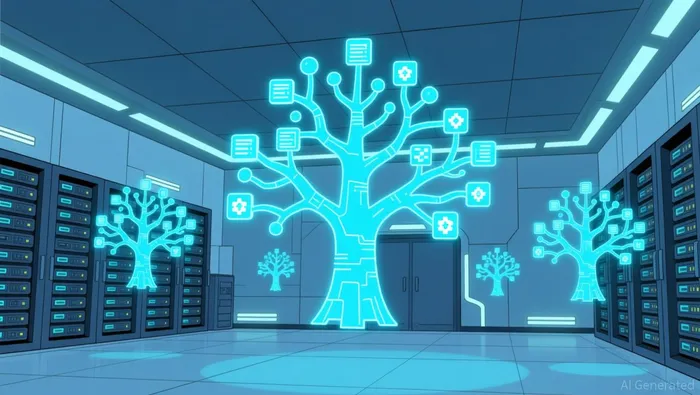
Ethereum protocol developers have officially aligned on a technical roadmap that positions mid-to-late 2026 as the deployment window for Verkle Trees. This upgrade represents a fundamental shift in the network's architecture, replacing the current Merkle Patricia Trie structure with a more efficient data structure. The primary objective is to sustainably reduce the storage requirements for network nodes, thereby addressing the growing data burden that has historically hindered decentralization.
By lowering the barrier to entry for running full nodes, EthereumENS-- aims to transition from a lagging asset to a robust settlement backbone. This structural efficiency gain is driven by technical necessity rather than price speculation, supporting long-term network scalability and faster finality. The upgrade is expected to facilitate a more efficient consensus layer, ensuring the network can handle increased transaction volumes without compromising node accessibility.
The strategic focus for 2026 extends beyond Verkle Trees to include a comprehensive Layer 2 oriented approach. By leveraging rollups and sidechains, the network aims to eliminate high transaction fees that have historically hindered user experience. This dual strategy of protocol-level optimization and Layer 2 scaling is designed to curb network state growth while maintaining institutional adoption.
How Verkle Trees Change Node Requirements?
The transition to Verkle Trees is critical for sustainable scaling because it fundamentally alters how data is stored and verified on the Ethereum network. The current Merkle Patricia Trie structure requires nodes to store and process large amounts of data, which increases the hardware requirements for participants. Verkle Trees significantly reduce this data burden, making it more feasible for individuals and smaller entities to run full nodes.
This reduction in node storage requirements is essential for maintaining the network's decentralization. As the network state grows, the cost and complexity of running a node increase, potentially leading to centralization. By addressing this issue, Ethereum aims to foster a more robust, community-driven network that is less reliant on a few large entities.
Furthermore, the upgrade supports faster protocol improvements and more efficient consensus mechanisms. The streamlined data structure allows for quicker verification processes, which can enhance the overall performance of the network. This technical advancement is a key component of Ethereum's strategy to become a reliable settlement backbone for future finance.
What Is The zQR Framework For Mobile Privacy?
The zQR framework addresses the practical adoption challenges of zero-knowledge proofs (ZKPs) by encoding zkSNARK proofs into verifiable QR codes for offline mobile verification. This approach bridges the gap between complex cryptographic protocols and user-friendly interactions, allowing users to generate ZKPs locally and encode them into QR codes for offline scanning by verifiers.
The system integrates blockchain for on-chain auditability and non-repudiation, while utilizing Large Language Models (LLMs) to automatically generate proof circuits. This integration lowers the technical barriers for issuers, who can now construct proof circuits using natural language prompts rather than specialized cryptographic expertise. The architecture involves three primary roles: Issuers, Provors, and Verifiers.
Experimental results demonstrate that while proof generation is computationally intensive on mobile devices, verification is lightweight and constant-time. This makes the framework suitable for applications requiring selective disclosure and privacy, such as anonymous payments, access control, and voting. A lightweight variant, zQR.v2, allows issuers to pre-generate proofs, shifting the computational load away from the prover.
How Does zQR Impact User Accessibility?
The zQR framework enables privacy-preserving authentication by allowing verifiers to validate user attributes without requiring specialized hardware or complex user interfaces. The verification latency remains nearly constant regardless of circuit complexity, making it suitable for real-time mobile interactions. This is a significant improvement over traditional ZKP methods, which often require high computational resources.
Financially, the framework is cost-effective for users. Smart contract deployment costs on Ethereum are minimal, ranging from approximately $3.45 to $4.20 USD for typical configurations. Crucially, on-chain proof verification is gas-free for provers when using view functions, reducing the economic barriers to adoption.
Despite these advantages, challenges remain regarding trusted setup security, scalability, and the semantic accuracy of LLM-generated circuits. The framework currently relies on trusted setup ceremonies, which require careful management to ensure security. Additionally, the scalability of the system may be limited by the computational constraints of mobile devices during the proof generation phase.
What Is The Market Relevance Of These Upgrades?
The deployment of Verkle Trees and the introduction of the zQR framework reflect a broader trend in the crypto industry toward sustainable scaling and user-centric privacy solutions. For investors, these developments signal a maturation of the Ethereum ecosystem, focusing on long-term resilience and practical utility rather than short-term speculation.
The emphasis on decentralization and node accessibility is likely to enhance the network's security and censorship resistance. Meanwhile, the zQR framework offers a viable path for integrating zero-knowledge proofs into everyday applications, potentially driving adoption in sectors such as finance, healthcare, and government.
However, investors should remain aware of the technical risks associated with these upgrades. The successful implementation of Verkle Trees depends on extensive testing and community consensus, while the zQR framework faces challenges related to security and scalability. Monitoring these developments will be crucial for understanding the future trajectory of the Ethereum network and its associated assets.

Blending traditional trading wisdom with cutting-edge cryptocurrency insights.
Latest Articles
Stay ahead of the market.
Get curated U.S. market news, insights and key dates delivered to your inbox.


AInvest
PRO
AInvest
PRO




Comments
No comments yet