
Verkle Trees Advance: Ethereum's Verifiable Computation Transition Gains Momentum
 Aime Summary
- Verkle Trees replace Merkle Patricia Trees on EthereumENS--, reducing full node storage needs by up to 90% and enabling more users to run nodes on standard hardware.
- The implementation of Verkle Trees enhances data validation efficiency and supports Ethereum's broader roadmap for scalability, decentralization, and quantum-resistant security.
- These trees are a key component of Ethereum's modular and rollup-centric architecture, reducing proof sizes and improving overall network influence.
Ethereum is undergoing significant cryptographic upgrades, with Verkle Trees being a central component of its long-term vision. By replacing traditional Merkle Patricia Trees, Verkle Trees drastically reduce the amount of storage required for full nodes. This shift makes running a node more accessible, promoting broader network participation and reinforcing decentralization.
The transition is part of a broader effort to make the Ethereum network more secure against quantum computing threats. Verkle Trees integrate vector commitments and lattice-based cryptography, contributing to Ethereum's quantum-resistant security goals.
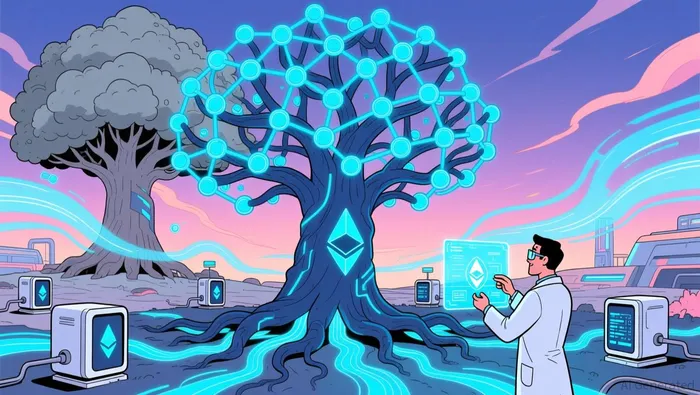
These technical advancements align with Ethereum's modular architecture and its focus on rollups as the primary scaling solution. However, the shift to a more rollup-centric model introduces risks, such as reduced mainnet economic activity and liquidity traps.
How Do Verkle Trees Impact Ethereum's Infrastructure?
The adoption of Verkle Trees supports Ethereum's infrastructure development, particularly in capturing yield and enhancing network influence. Smaller proof sizes make transactions more efficient, which is crucial for scaling the network while maintaining security.
This innovation is also aligned with Ethereum's long-term strategy, including Pectra and account abstraction upgrades. Together, these improvements aim to create a more user-friendly experience and a more robust platform for decentralized applications according to industry analysis.
Despite these benefits, the transition introduces new challenges. As more activity shifts to Layer-2 solutions, the mainnet may face reduced economic value. This shift could undermine Ethereum's role as a primary value layer if not carefully managed according to market experts.
What Are the Risks and Limitations of Verkle Trees?
While Verkle Trees offer significant improvements in scalability and security, their implementation does not eliminate all risks. Regulatory scrutiny remains a concern, especially as Ethereum's ecosystem expands and becomes more complex according to regulatory analysis.
Additionally, the focus on Layer-2 solutions may lead to a liquidity trap where the mainnet's utility diminishes over time. Maintaining a balance between innovation and mainnet activity will be critical for Ethereum's long-term success.
Ethereum's technical roadmap continues to evolve rapidly, with Verkle Trees being one of several innovations aimed at enhancing the network's performance. However, the success of these upgrades will depend on addressing the associated risks and ensuring a sustainable balance between Layer-1 and Layer-2 activity.

Blending traditional trading wisdom with cutting-edge cryptocurrency insights.
Latest Articles
Stay ahead of the market.
Get curated U.S. market news, insights and key dates delivered to your inbox.


AInvest
PRO
AInvest
PRO



Comments
No comments yet