
Verkle Trees Advance: Ethereum's Verifiable Computation Transition Gains Momentum
 Aime Summary
Verkle Trees are replacing Merkle Patricia Trees on EthereumENS-- to reduce node storage requirements by up to 90%, enabling more users to operate full nodes on standard hardware. This cryptographic innovation allows faster and more efficient data validation, improving network decentralization and accessibility, and is a key step in Ethereum's roadmap for scalability. Verkle Trees are part of Ethereum's Verge phase, which aims to scale the network and enhance security, particularly against quantum computing threats.
Ethereum's transition to Verkle Trees marks a significant advancement in the blockchain's capacity to handle state changes efficiently. By reducing the storage burden on nodes, the network is making it feasible for more participants to run full nodes on everyday computers. This shift is a cornerstone of Ethereum's long-term vision for scalability and decentralization.
The implementation of Verkle Trees aligns with Ethereum's broader goals of transitioning to quantum-secure cryptography. These trees use vector commitments to verify data, which is more efficient than traditional Merkle Tree systems. This helps Ethereum prepare for future cryptographic challenges and reinforces its decentralized architecture.
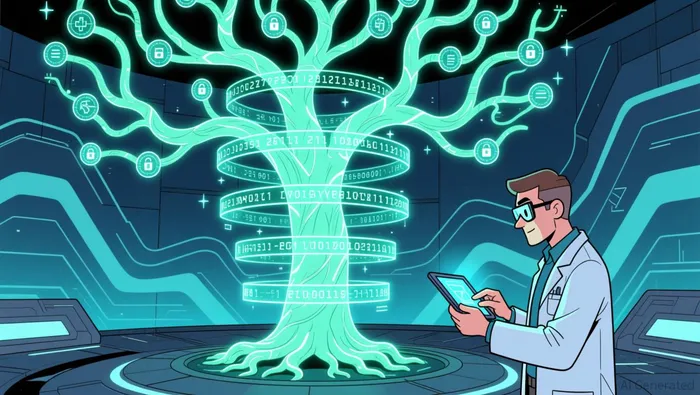
Ethereum's roadmap includes eight workstreams, with Verkle Trees playing a central role in transitioning to more efficient computation and verification. By enabling mathematical verification of the network's state, this upgrade is part of Ethereum's strategy to enhance efficiency and security. It also supports the broader transition to quantum-resistant cryptography.
How Do Verkle Trees Improve Scalability and Security?
Verkle Trees reduce the computational burden on nodes by enabling verifiable computation through mathematical proofs. This allows nodes to validate data without maintaining large portions of the network state, making the system more scalable. The cryptographic efficiency of Verkle Trees is particularly relevant as the blockchain industry moves toward modular and rollup-centric architectures.
The adoption of Verkle Trees supports Ethereum's Verge phase, which is focused on scaling the network and preparing it for future cryptographic challenges. This includes the replacement of hash functions and the formalization of the EVM. These changes are designed to make Ethereum more robust and efficient, supporting its vision as a decentralized and secure platform for global applications.
What Are the Quantum-Security Implications of Verkle Trees?
Ethereum's use of Verkle Trees is part of a larger transition to quantum-safe cryptographic methods. Traditional cryptographic methods, such as ECDSA, are vulnerable to quantum attacks. In response, Ethereum is integrating lattice-based and hash-based cryptographic solutions.
The 2026 upgrade includes Quantum-Safe Verkle Trees, lattice-based vector commitments, and Dilithium signatures to maintain data integrity in a post-quantum era. This transition is supported by Ethereum's account abstraction and EIP-4844, which facilitate data availability for bulky PQC signatures.
Are There Risks to Ethereum's Transition to Verkle Trees?
Ethereum's transition to a modular, rollup-centric future has raised concerns about a potential liquidity trap. As activity shifts to Layer-2 solutions, there is a risk that mainnet activity and fee capture could decline. While rollups offer scalability and lower costs, they may dilute the mainnet's economic value.
The adoption of Verkle Trees and related upgrades aims to mitigate these risks by improving user experience and scalability. However, the success of these upgrades will depend on Ethereum's ability to maintain its dominance as the settlement layer while rollups capture more user activity and fee revenue.
Ethereum's roadmap, including Verkle Trees and Pectra, aims to improve scalability and user experience. These upgrades introduce volatility around implementation timelines and investor sentiment. Despite these challenges, Ethereum remains a high-risk, high-reward bet on the future of on-chain finance.

Mezclando la sabiduría tradicional en el comercio con las perspectivas más avanzadas en el área de las criptomonedas.
Latest Articles
Stay ahead of the market.
Get curated U.S. market news, insights and key dates delivered to your inbox.


AInvest
PRO
AInvest
PRO



Comments
No comments yet