
Verkle Trees Advance as Ethereum Focuses on Scalability and Institutional Adoption
 Aime Summary
Verkle Trees are a key component of Ethereum's 2026 roadmap, aimed at reducing node hardware demands and improving state verification efficiency.
These upgrades are part of the broader Prague/Electra and Glamsterdam hard forks, which aim to streamline block production and increase transaction throughput.
Institutional adoption is growing, supported by low fees and extended staking queues, as EthereumETH-- continues to attract major financial institutions.
Ethereum's 2026 roadmap prioritizes Verkle Trees to reduce the computational and storage burden on node operators. This is part of a broader effort to make the network more accessible and scalable. 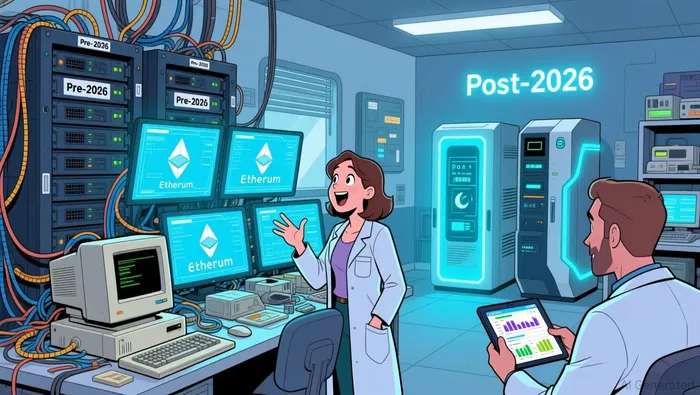 The introduction of Verkle Trees allows nodes to verify the state of the Ethereum network more efficiently, supporting higher transaction throughput and lower costs for developers and users.
The implementation of Verkle Trees is expected to contribute to Ethereum's scalability goals and support further innovation in decentralized finance and smart contracts. These technical improvements are designed to make the network more efficient and accessible, reducing the computational burden on nodes and lowering entry barriers for participants.
The broader upgrades, including the Glamsterdam and Hegota hard forks, aim to improve execution layer performance. These changes are expected to significantly enhance Ethereum's scalability by increasing transaction throughput and lowering costs for developers and users.
What are the implications of Verkle Trees for Ethereum's long-term goals?
Verkle Trees are expected to improve Ethereum's state storage and verification efficiency, enabling easier node operation and greater decentralization. They reduce data requirements for light clients, making it easier for more people to run and verify Ethereum without high resource demands.
By reducing the storage burden on node operators and improving state verification efficiency, these upgrades will support the growth of decentralized applications and tokenized assets. The implementation of Verkle Trees is a critical step in Ethereum's long-term vision for scaling and decentralization.
How do Verkle Trees fit into Ethereum's broader roadmap for 2026?
Verkle Trees are a central component of Ethereum's roadmap for reducing the computational and storage burden on node operators. These upgrades are part of a larger set of planned hard forks, including the Glamsterdam and Hegota upgrades, which aim to improve execution layer performance and streamline block production.
The upgrades are also anticipated to attract more institutional capital and developers to the platform, supporting continued growth in decentralized applications and real-world asset tokenization. These developments will also support the tokenization of real-world assets and increase Ethereum's total value locked (TVL) and institutional participation.
What are the potential risks or limitations of these upgrades?
While Verkle Trees offer significant benefits, they also present technical challenges, including the need for a deep understanding of cryptographic primitives and client architecture. Developers must adopt best practices and use verified contracts to ensure transparency and trust as Ethereum's state and complexity grow.
The implementation of these upgrades may face challenges in managing Ethereum's state growth and mitigating smart contract vulnerabilities like reentrancy risks. Additionally, the effectiveness of these upgrades may depend on the broader ecosystem, including Layer-2 solutions and regulatory developments.

Blending traditional trading wisdom with cutting-edge cryptocurrency insights.
Latest Articles
Stay ahead of the market.
Get curated U.S. market news, insights and key dates delivered to your inbox.


AInvest
PRO
AInvest
PRO



Comments
No comments yet