
Verizon Stock: Why This High-Yield Dividend Play Could Be Undervalued in 2026
 Aime Summary
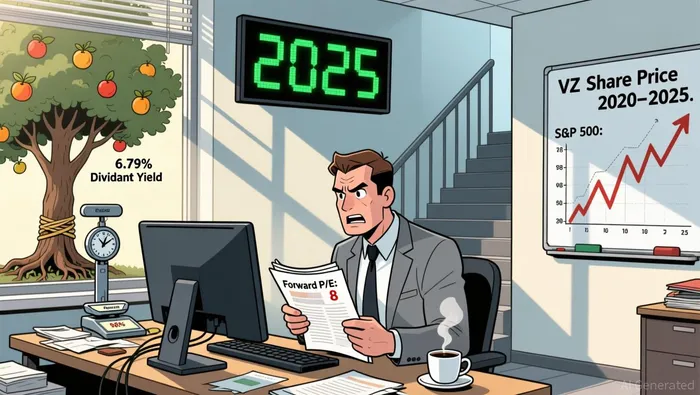
Verizon (VZ) currently offers a dividend yield of 6.79%, with a payout ratio of 58%, indicating the dividend remains relatively safe according to recent analysis. The stock trades at a forward P/E of about 8, significantly below the S&P 500's 26 average, raising questions about its potential as a value stock according to financial data. VerizonVZ-- is undergoing a major restructuring, including $116 billion in debt reduction and 13,000 job cuts, under new CEO Dan Schulman as reported.
Verizon (VZ) has long been a mainstay in dividend investing—offering yields that consistently outperform its peers. Yet, in recent years, the stock has struggled to gain traction. Since 2020, it has lost nearly 35% of its value, making it a mixed bag for investors who expect both income and growth. However, with a current dividend yield of more than 6.7% and a stock price that's significantly undervalued, the company may be entering a phase where it's finally rewarding long-term shareholders.
Is Verizon Stock a Buy for High-Yield Investors in 2026?
For investors focused on dividend income, the appeal of VZVZ-- is hard to ignore. The company has paid a dividend for 19 consecutive years and increased it by roughly 2% annually. The current payout ratio of 58% provides a buffer against unexpected financial shocks, making the yield look more sustainable than many higher-yielding alternatives. That said, Verizon's balance sheet remains a concern, with about $116 billion in debt. The company is actively reducing that burden, but until it gets more manageable, the dividend remains at risk if cash flows weaken.
Why Verizon Stock May Be Undervalued Right Now
Verizon is trading at less than 9 times earnings, a valuation that seems out of step with its industry. Telecom stocks tend to trade at a premium when they offer high yields and show strong cash flow. In Verizon's case, it has both: it generates over $26 billion in pre-tax income annually, a number that should support both debt servicing and dividend growth according to financial reports.
The market's reluctance to price in these strengths may stem from broader concerns about the sector. Growth is slowing, and while 5G adoption is increasing, it hasn't translated into the kind of revenue acceleration investors hoped for. That said, if the company's restructuring—led by new CEO Dan Schulman—delivers on cost savings and margin expansion, the stock may be a compelling buy for those seeking long-term income.
What to Watch: Verizon's 2025 Earnings and Restructuring Progress
Verizon is expected to report fourth-quarter 2025 earnings on January 30, 2026. This report will be the first under Schulman and will offer an early look at the effectiveness of his cost-cutting strategy. The restructuring includes a 13,000-employee reduction and a focus on improving operating margins. If these changes lead to better free cash flow generation, the company will be in a stronger position to reduce its debt load and improve its long-term dividend outlook.
Additionally, Verizon's planned acquisition of Frontier Communications is a potential catalyst. The deal is expected to expand its fiber and wireless subscriber base, which could improve customer retention and pricing power. However, this acquisition also adds to its financial obligations, so it's critical that the company executes its debt reduction strategy without overextending.
Verizon's stock may not be a growth play, but for investors focused on income and stability, it could be an attractive option—especially if the market continues to underprice its strong cash flows and high yield.

Stay ahead of the market.
Get curated U.S. market news, insights and key dates delivered to your inbox.




Comments
No comments yet