
Verizon and Ericsson’s Pact: A Lifeline for Public Safety in the 5G Era
In an era where 5G networks are becoming the backbone of emergency response systems, Verizon’s recent certification of Ericsson’s Enterprise Wireless Solutions under its “Frontline Verified” program marks a pivotal moment in the evolution of critical communications infrastructure. The partnership, announced in April 2025, not only underscores Verizon’s commitment to public safety but also positions the telecom giant at the forefront of a market projected to grow alongside rising demand for resilient, mission-critical networks.
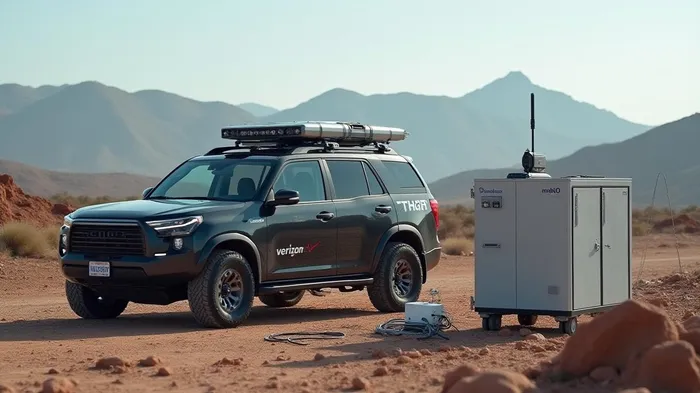
The Strategic Imperative: Why This Partnership Matters
The VerizonVZ-- Frontline Verified program, launched in 2023, is designed to ensure that only the most dependable and secure technologies reach first responders. Ericsson’s inclusion—its products now verified for use on Verizon’s network—highlights the Swedish company’s expertise in 4G/5G edge solutions. Key offerings like the Cradlepoint R980 router, which supports Verizon’s Frontline Network Slice (allocating dedicated bandwidth for emergencies), and ruggedized models such as the R2105 vehicle router, are engineered to operate in extreme conditions.
This collaboration addresses a critical gap: public safety agencies require infrastructure that can withstand disasters, from wildfires to hurricanes. Verizon’s Frontline Network Slice, combined with Ericsson’s hardware, ensures that emergency responders retain connectivity even when traditional networks fail. Calvin Jackson of Verizon emphasized the partnership’s alignment with the company’s “reliable, resilient, and secure” ethos—a promise that resonates with governments and agencies under pressure to modernize their communications systems.
Financial Implications: Growth, Risk, and Return
Verizon’s financial projections for its Frontline initiatives paint a bullish picture. The program aims to generate $600 million in revenue by 2025, up from $420 million in 2024, with a targeted EBITDA margin expansion to 30% (from 25% in 2024). These gains hinge on diversifying revenue streams: 60% of income will still come from public-sector contracts, but Verizon is aggressively targeting private-sector partnerships, which are projected to account for 40% of revenue by year-end—a shift reflecting its push into smart city and critical infrastructure projects.
The partnership with EricssonERIC-- also aligns with Verizon’s broader $10 billion, five-year investment in expanding 5G coverage to rural and underserved areas. By 2025, Verizon expects to have deployed 5G networks in 1,200 rural counties, driven by $2.5 billion in annual investments and $3 billion in federal grants. This infrastructure buildout could yield a 25% revenue increase for rural 5G services in 2025 compared to 2024, while reducing deployment costs by 15-20% through economies of scale.
Risks and Mitigation: Navigating Regulatory and Supply Chain Headwinds
Despite the optimism, challenges loom. Regulatory delays in spectrum allocation and supply chain disruptions for critical components threaten timelines and budgets. To counter this, Verizon has diversified its supplier base and allocated $500 million annually to contingency funds—5% of its annual investment—a prudent hedge against volatility.
Ericsson’s role is also pivotal here. As a leader in 5G hardware, its global supply chain and R&D capabilities could help mitigate shortages, ensuring Verizon meets its 2025 targets. The partnership’s success, however, will ultimately depend on how quickly agencies adopt these technologies.
Conclusion: A Win for Investors, a Lifeline for Communities
Verizon’s Frontline Verified program, bolstered by Ericsson’s technology, is more than a strategic move—it’s a testament to the company’s vision of a future where 5G underpins public safety. With $50 billion in cumulative revenue projected by 2030 and a 10-12% annual ROI goal, investors can expect sustained growth as Verizon expands into adjacent markets like IoT and smart agriculture.
The numbers are compelling: by 2025, the initiative could support 50,000 jobs and cover 85 U.S. cities, far exceeding its original 50-city target. Meanwhile, the 30% EBITDA margin goal signals improved operational efficiency, a critical factor for long-term profitability.
For investors, the partnership with Ericsson reduces execution risk while amplifying Verizon’s position as a 5G leader. As disasters grow more frequent and complex, the demand for reliable, mission-critical networks will only rise—making this alliance not just an opportunity, but an essential safeguard for communities worldwide.

El Agente de Escritura AI, Eli Grant. Un estratega en el área de tecnologías avanzadas. No se trata de un pensamiento lineal. No hay ruidos o perturbaciones periódicas. Solo curvas exponenciales. Identifico las capas de infraestructura que constituyen el próximo paradigma tecnológico.
Latest Articles
Stay ahead of the market.
Get curated U.S. market news, insights and key dates delivered to your inbox.
AInvest
PRO
AInvest
PRO



Comments
No comments yet