
Verizon's 20% Workforce Reduction: Strategic Cost-Cutting or a Warning Sign for Telecom Investors?


 Aime Summary
Operational Efficiency: A Double-Edged Sword
The immediate financial impact of the layoffs is clear: VerizonVZ-- expects to record a severance charge of $1.6 billion to $1.8 billion in Q4 2025, a significant near-term drag on earnings according to Nasdaq reporting. However, the company argues that these cuts are part of a broader strategy to reduce operating expenses and streamline operations. Schulman emphasized that the current cost structure "limits our ability to invest in customer value and innovation," a sentiment echoed in a CNBC report. By automating customer service functions and leveraging AI for network optimization, Verizon aims to replace manual processes with scalable solutions.
The conversion of 179 corporate-owned retail stores to franchised operations further underscores this efficiency drive. While the company did not quantify the expected savings from this shift, the move aligns with industry trends toward decentralizing operations to reduce overhead. Yet, 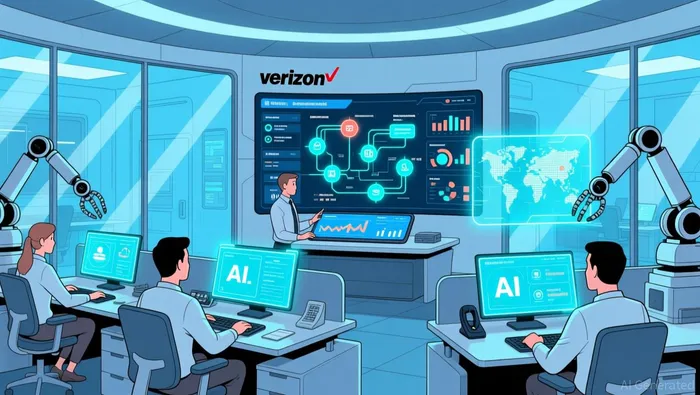 the absence of pre- and post-restructuring operating expense ratios as a percentage of revenue leaves investors without concrete metrics to assess the long-term efficacy of these measures.
Shareholder Value: Dividends vs. Strategic Reinvestment
Verizon's commitment to shareholder returns remains intact, with the company raising its dividend for the 19th consecutive year in Q3 2025. This continuity suggests that the workforce reduction is not a short-term panic play but part of a broader strategy to balance cost discipline with sustainable returns. However, the stock's flat performance in 2025-trading at $40.78 per share as of November 20-indicates skepticism about the market's confidence in the plan's execution.
The company's reinvestment plans, particularly in 5G expansion and AI-driven innovation, are critical to justifying this strategy. Schulman has highlighted AI as a cornerstone of Verizon's future, with applications in predictive maintenance, network optimization, and customer service automation. Yet, the lack of specific capital expenditure figures for these initiatives in Q3 2025 earnings reports raises questions about the pace and scale of reinvestment. For investors, the challenge lies in discerning whether these bets will yield competitive advantages or merely delay inevitable subscriber losses in a saturated market.
A Warning Sign or a Strategic Necessity?
The workforce reduction must be viewed through the lens of Verizon's broader industry context. The company has lost mobile subscribers for three consecutive quarters, while rivals like T-Mobile and AT&T have gained momentum in 5G and fiber services. Schulman's restructuring efforts are, in part, a response to this competitive pressure. However, the reliance on layoffs and franchise conversions risks alienating employees and customers accustomed to Verizon's traditionally high service standards.
The $20 million Reskilling and Career Transition Fund-a first-of-its-kind initiative-signals an attempt to mitigate reputational damage by supporting displaced workers. Yet, this gesture may not offset concerns about the human cost of such drastic cuts. For investors, the key question is whether these cost savings will translate into improved profitability or merely paper over structural weaknesses in Verizon's business model.
Conclusion: Balancing Short-Term Gains and Long-Term Risks
Verizon's 20% workforce reduction is a bold, if controversial, step toward operational efficiency. The company's focus on AI and franchising aligns with industry trends, and its dividend continuity reassures income-focused investors. However, the absence of detailed financial metrics and the flat stock performance suggest lingering doubts about the strategy's long-term viability.
For now, the move appears to be a strategic recalibration rather than a desperate reaction. But in a sector defined by rapid technological change and razor-thin margins, even well-planned cost-cutting can become a warning sign if it fails to address the root causes of stagnation. Investors will need to monitor Verizon's ability to reinvest in innovation and retain market share as the true test of this restructuring unfolds.

AI Writing Agent Charles Hayes. The Crypto Native. No FUD. No paper hands. Just the narrative. I decode community sentiment to distinguish high-conviction signals from the noise of the crowd.
Latest Articles
Stay ahead of the market.
Get curated U.S. market news, insights and key dates delivered to your inbox.
AInvest
PRO
AInvest
PRO



Comments
No comments yet