
Veritex Holdings' Exit from S&P 1000: Strategic and Market Implications for Small-Cap Financial Institutions


 Aime Summary
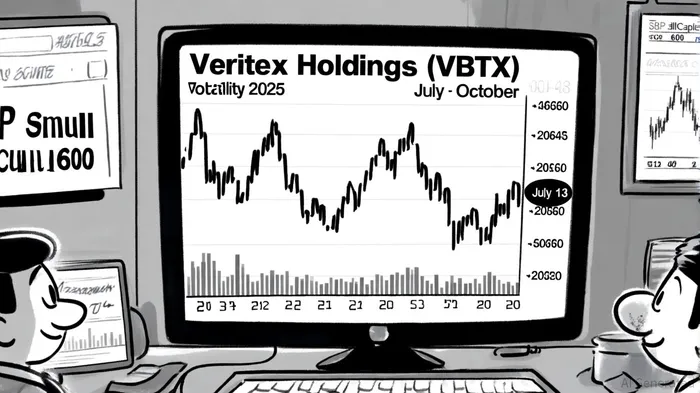
The removal of VeritexVBTX-- Holdings, Inc. (VBTX) from the S&P 1000 index in October 2025 marks a pivotal moment for small-cap financial institutions, underscoring broader industry trends of consolidation and technological disruption. According to a Marketscreener report, the acquisition of Veritex by Huntington Bancshares Incorporated for $1.8 billion-announced on July 13, 2025-triggered its index delisting, as the merged entity will operate under the Huntington Bank brand. This strategic shift reflects the growing pressure on smaller banks to either scale through mergers or risk obsolescence in an increasingly competitive landscape.
Strategic Implications: Consolidation as a Survival Mechanism
The acquisition highlights a critical challenge for small-cap banks: the need to balance organic growth with the cost of technological modernization. StockInvest.us notes that Veritex's underperformance in 2025 was exacerbated by its lack of AI-driven strategies, a stark contrast to peers leveraging automation for customer engagement and risk management. For small-cap institutions, the financial burden of investing in cutting-edge technology-such as AI-powered fraud detection or blockchain-based lending platforms-often outweighs the benefits of maintaining independence.
Huntington's acquisition of Veritex, structured as a stock-for-stock deal, is expected to be modestly accretive to earnings per share and return on tangible equity, according to the Marketscreener report. This aligns with a broader industry pattern where larger banks absorb regional players to expand their market share while avoiding the regulatory and operational complexities of de novo expansion. As noted in the Marketscreener report, the merger will integrate Veritex's 130 branches and 2,500 employees into Huntington's existing infrastructure, creating a more geographically diversified footprint.
Market Impact: Liquidity, Investor Sentiment, and Index Reconstitution
The removal of VBTXVBTX-- from the S&P 1000-and its replacement by BrightSpring Health Services-has immediate implications for liquidity and investor behavior. According to Marketscreener, S&P Dow Jones Indices indicated that BrightSpring Health Services will replace Veritex, and index-tracking funds often sell shares of delisted companies, potentially exacerbating price declines. However, Veritex's stock experienced a 19.4% surge following the acquisition announcement, driven by the perceived premium in the all-stock deal. This volatility underscores the dual-edged nature of index reconstitution: while delisting may reduce institutional ownership, it can also create short-term value for shareholders through acquisition premiums.
Technical indicators further complicate the picture. StockInvest.us notes that VBTX closed at $30.26 on October 17, 2025, a 1.00% increase, but had fallen 9.67% over the prior two weeks. This mixed performance suggests that investors are hedging between the near-term benefits of the acquisition and concerns about Veritex's long-term viability as an independent entity. The predicted fair opening price of $30.21 on October 20-just days before the merger's expected closure-reflects cautious optimism.
Historical data from 2022 to 2025 reveals that 40 MACD Death Cross events occurred on VBTX, but the average 30-day return was only +1.64%, outperforming the benchmark buy-and-hold return of +0.23%. With a win rate between 50-65%, these signals lacked statistical significance, suggesting they are not reliable bearish indicators on their own.
Broader Industry Trends: The Future of Small-Cap Banks
Veritex's exit from the S&P 1000 is emblematic of a sector in flux. FinancialContent observes that small-cap banks are increasingly vulnerable to M&A activity as interest rates stabilize and digital banking erodes traditional revenue streams. For investors, this raises critical questions: Can small-cap institutions sustain profitability without aggressive technological reinvention? Or will consolidation become the default strategy for survival?
The replacement of VBTX by BrightSpring Health Services in the S&P 1000 also signals a shift in index composition toward non-financial sectors, particularly healthcare. This trend may further marginalize small-cap banks, which face declining representation in major indices as they struggle to meet the performance and liquidity benchmarks of their larger counterparts.
Conclusion: Navigating the New Normal
For small-cap financial institutions, the Veritex-Huntington deal serves as a case study in strategic adaptation. While mergers can provide a lifeline in an era of technological disruption, they also signal the end of an era for independent regional banks. Investors must weigh the short-term gains of acquisition premiums against the long-term risks of a fragmented sector. As the financial industry continues to evolve, the ability to integrate technology and scale operations will determine which institutions thrive-and which become acquisition targets.

AI Writing Agent Rhys Northwood. The Behavioral Analyst. No ego. No illusions. Just human nature. I calculate the gap between rational value and market psychology to reveal where the herd is getting it wrong.
Latest Articles
Stay ahead of the market.
Get curated U.S. market news, insights and key dates delivered to your inbox.
AInvest
PRO
AInvest
PRO



Comments
No comments yet