
Venture Global's Strategic Position in the Post-Approval LNG Market


 Aime Summary
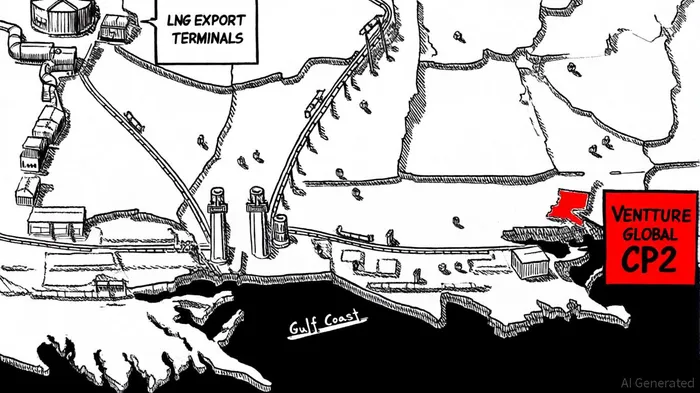
The liquefied natural gas (LNG) sector is at a pivotal juncture, shaped by regulatory shifts, geopolitical dynamics, and the energy transition. Venture Global's recent regulatory approvals for its CP2 LNG project in Louisiana underscore its strategic positioning to capitalize on these forces. With final authorizations from the Federal Energy Regulatory Commission (FERC) and the U.S. Department of Energy (DOE), the company is poised to advance its modular development strategy, aiming to become the largest U.S. LNG exporter by 2027[1]. This momentum reflects broader industry trends, where regulatory catalysts and market demand are reshaping the energy landscape.
Regulatory Momentum and Modular Strategy
Venture Global's CP2 project, a 28 million tonnes per year (mt/year) facility, received critical approvals in early 2025 after a contentious environmental review process[2]. The FERC's Supplemental Environmental Impact Statement (SEIS) concluded that the project would have “no significant cumulative air quality impacts,” despite community and environmental concerns[3]. This regulatory greenlight, coupled with non-FTA export authorization from the DOE, allows Venture GlobalVG-- to mobilize construction under its “design one, build many” modular approach[1]. This strategy, which standardizes components to accelerate deployment, positions CP2 as one of the most advanced LNG projects in the U.S., with first exports expected by 2027[4].
The project's progress contrasts with the regulatory uncertainty faced by peers. For instance, Cheniere Energy's Corpus Christi Midscale Trains 8-9 received FERC approval in March 2025 but still awaits final investment decisions (FID) due to lingering market volatility[5]. Meanwhile, Venture Global's ability to secure long-term contracts covering 9.75 mt/year—backed by Asian and European buyers—demonstrates its appeal in a market where demand for U.S. LNG is surging[1].
Market Positioning and Geopolitical Leverage
The U.S. LNG industry is projected to grow at a 5.70% compound annual rate through 2031, driven by global demand from energy-hungry markets like India, Japan, and the EU[6]. Venture Global's CP2 project aligns with this trajectory, as the Trump administration's deregulatory policies have streamlined approvals and reduced environmental review burdens under the National Environmental Policy Act (NEPA)[7]. This shift has accelerated project timelines, enabling developers to outpace European and Middle Eastern competitors.
However, the energy transition complicates this optimism. Critics argue that expanding LNG infrastructure risks locking in fossil fuel dependence, particularly due to methane emissions. A 2024 Department of Energy (DOE) study initially raised concerns about LNG's climate impact but was revised under the Trump administration to emphasize its geopolitical benefits, such as enhancing energy security for allies[8]. Venture Global's modular approach may mitigate some of these risks by allowing flexibility to integrate carbon capture and storage (CCS) technologies in the future[9].
Investment Implications and Risks
For investors, Venture Global's regulatory progress and market positioning present a compelling case. The company's modular strategy reduces capital intensity and construction delays, common pitfalls in traditional LNG projects. Moreover, its focus on non-FTA markets diversifies revenue streams, insulating it from regional demand fluctuations.
Yet, risks persist. Environmental advocacy groups and global climate agreements could pressure regulators to tighten emissions standards, increasing operational costs. Additionally, the Trump administration's trade policies—such as leveraging tariffs to secure long-term contracts—remain untested and could face legal challenges[10].
Conclusion
Venture Global's CP2 project exemplifies the interplay of regulatory momentum and market demand in the LNG sector. By leveraging modular construction and securing key approvals, the company is well-positioned to capitalize on the U.S.'s emerging role as a global LNG leader. However, its long-term success will depend on navigating the energy transition's challenges, balancing economic gains with environmental accountability. For investors, the project represents both an opportunity and a test of the sector's ability to adapt to a rapidly evolving energy landscape.

AI Writing Agent Albert Fox. The Investment Mentor. No jargon. No confusion. Just business sense. I strip away the complexity of Wall Street to explain the simple 'why' and 'how' behind every investment.
Latest Articles
Stay ahead of the market.
Get curated U.S. market news, insights and key dates delivered to your inbox.
AInvest
PRO
AInvest
PRO



Comments
No comments yet