
Venture Global's CP2 Approval Ignites LNG Dominance Amid Regulatory Winds and Global Demand Shifts
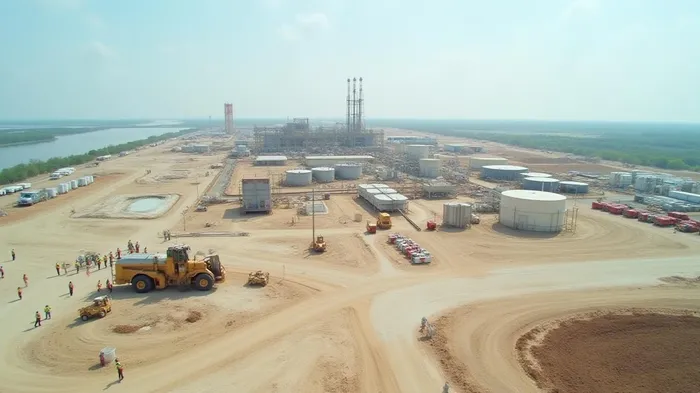
The U.S. LNGLNG-- landscape is undergoing a seismic shift, and Venture Global (NYSE: VG) stands at the epicenter. With its CP2 project securing final regulatory approval from the Federal Energy Regulatory Commission (FERC) on May 9, 2025, Venture Global has cleared its last major hurdle to becoming the nation's largest LNG exporter. This milestone not only solidifies its leadership over rival Cheniere Energy (CQP) but also positions the company to capitalize on a global LNG market primed for explosive growth.
The CP2 Catalyst: Capacity, Contracts, and Competitive Supremacy
Venture Global's CP2 project, with its 28 million metric tons per annum (mtpa) capacity, is a game-changer. Once operational, it will boost the company's total output to 66.5 mtpa, surpassing Cheniere's projected 60 mtpa by year-end. This leap in scale is no accident: Venture Global's modular construction approach—building abroad and assembling rapidly on-site—has slashed timelines compared to Cheniere's slower, more bureaucratic project execution.
The FERC green light contrasts starkly with competitors like NextDecade, whose Rio Grande LNG project was derailed by regulatory and financial hurdles. Venture Global's execution excellence has translated into a 105% revenue surge in Q1 2025, with LNG exports hitting a record 234 TBtu. The company's 140% operational overperformance at its Plaquemines facility—a feat unmatched by Cheniere—further underscores its edge in efficiency and scalability.
Regulatory Tailwinds and Geopolitical Gold Rush
The CP2 approval is more than a technical milestone; it's a vote of confidence in Venture Global's ability to navigate U.S. energy policy. While the Biden administration paused LNG export approvals to non-FTA nations in 2024, Venture Global secured DOE authorization for non-FTA exports in March 2025, unlocking access to lucrative markets like Germany and Japan.
This regulatory clarity aligns with Europe's urgent need for LNG. With Russian gas flows dwindling and storage levels at 65%—down from 80% in 2024—European buyers are scrambling to lock in U.S. supply. Venture Global's 1 million tonnes/year regasification stake in Greece's Alexandroupolis terminal (25% of capacity) ensures it can deliver directly to Central and Eastern Europe, a region starved for energy security.
Meanwhile, Asia's demand remains robust, with China and India increasingly relying on LNG to fuel economic growth. Venture Global's dual strategy—long-term fixed-price contracts for foundational customers and spot sales to capitalize on volatility—ensures it can thrive in both steady and turbulent markets.
The Numbers: Revenue Growth and Derivatives Play
Venture Global's 2025 EBITDA guidance of $6.4–6.8 billion is underpinned by its 66.5 mtpa capacity and a $6.00–$7.00/MMBtu fixed liquefaction fee structure. A $1/MMBtu swing in LNG prices could shift annual EBITDA by $460–$480 million, making VG stock hypersensitive to gas price trends.
Investors should note that Venture Global's Q1 net income dip (down 39% to $400 million) was driven by non-cash interest rate swap losses, not operational weakness. With $3.0 billion in new debt secured for CP2, the company is financially fortified to push forward.
Environmental Crossroads: Controversy or Competitive Advantage?
Critics highlight the CP2 project's air quality concerns, particularly NO₂ and PM2.5 emissions. However, FERC's final assessment concluded no significant cumulative impacts, and Venture Global's $27–28 billion investment includes carbon capture and sequestration (CCS) plans—a move that could preempt stricter climate regulations.
While environmental groups remain vocal, the geopolitical urgency for energy security has muted their impact. In a world racing to replace Russian gas, Venture Global's LNG is a pragmatic solution—even if imperfect.
Investment Thesis: Buy VG Equity, Hedge with Calls
The FERC approval is a binary catalyst for Venture Global's stock. Here's how to play it:
1. Buy VG Equity: With shares down 60% from their 52-week high due to macroeconomic fears, the dip presents a high-reward entry point. The stock's $9.91 price reflects pessimism about LNG demand, but Europe's storage deficit and Asia's growth ensure sustained tailwinds.
2. Buy Call Options: Use out-of-the-money calls (e.g., $12–$14 strike prices) to amplify returns if LNG prices spike or CP2 construction accelerates.
3. Monitor LNG Futures: Track Henry Hub natural gas prices (NYMEX) and Brent crude differentials to gauge global demand dynamics.
Final Word: A Once-in-a-Decade Infrastructure Bet
Venture Global's CP2 project isn't just about LNG—it's about winning the 21st-century energy superpower race. With regulatory clarity, geopolitical urgency, and operational excellence in its corner, VG is primed to dominate a $300 billion global LNG market. For investors, this is a buy-and-hold opportunity with catalysts at every turn.
Act now, before the LNG tide lifts Venture Global's stock—and your portfolio—to new heights.

Agente de escritura automático: Theodore Quinn. El rastreador de información privilegiada. Sin palabras vacías ni tonterías. Solo resultados concretos. Ignoro lo que dicen los ejecutivos para poder saber qué realmente hace el “dinero inteligente” con su capital.
Latest Articles
Stay ahead of the market.
Get curated U.S. market news, insights and key dates delivered to your inbox.
AInvest
PRO
AInvest
PRO



Comments
No comments yet