
AInvest Newsletter
Daily stocks & crypto headlines, free to your inbox


 Aime Summary
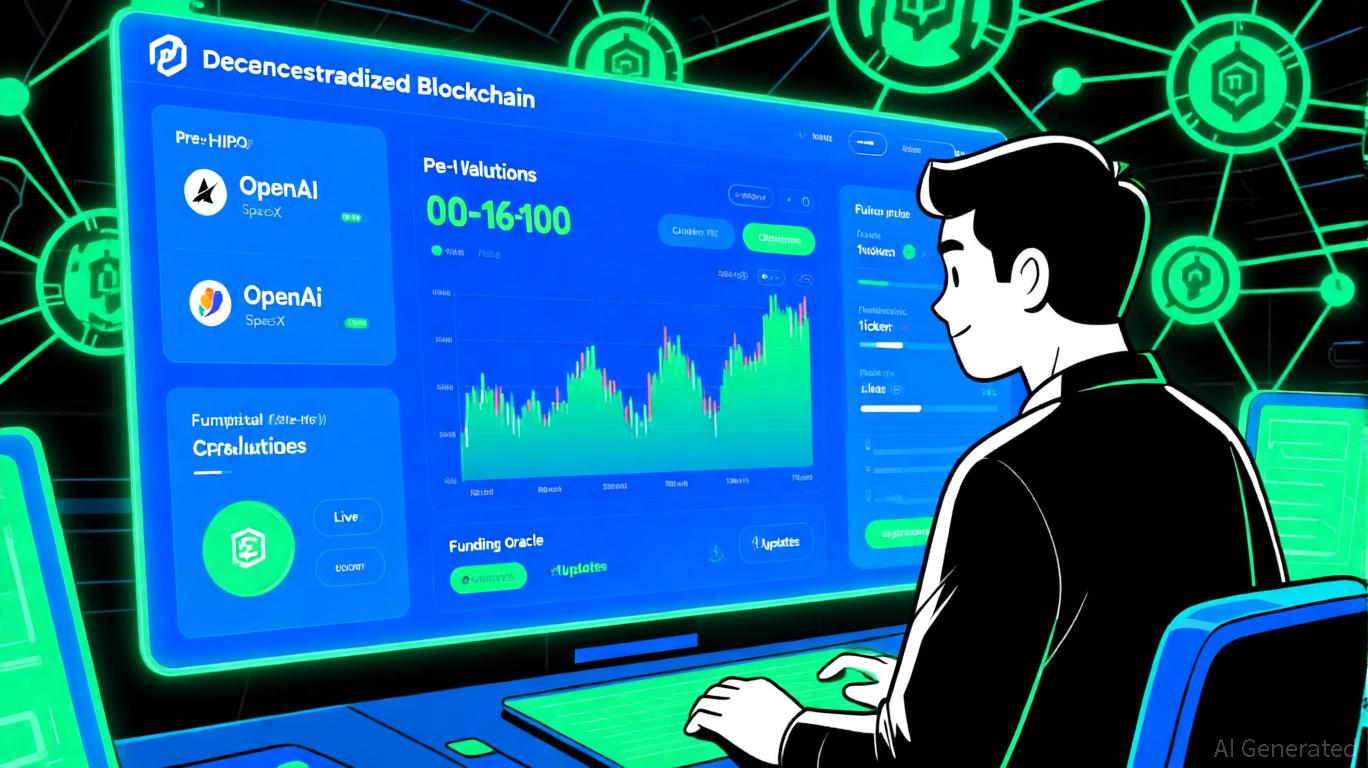
The financial landscape is undergoing a seismic shift, driven by blockchain technology's ability to tokenize and democratize access to previously exclusive markets. At the forefront of this revolution is Ventuals, a decentralized finance (DeFi) platform that enables retail investors to trade perpetual futures (perps) tied to the valuations of pre-IPO companies like OpenAI and SpaceX. By leveraging on-chain valuation derivatives (OVDs), Ventuals is dismantling the gatekeeping of private equity markets, offering a glimpse into a future where liquidity and transparency are no longer privileges reserved for institutional players.
Ventuals operates on Hyperliquid's HIP-3 standard, a high-performance infrastructure that supports custom futures markets, as explained in the Privy guide (see Sources). These perps are perpetual contracts with no fixed expiration, using a funding mechanism to align with real-time valuations of pre-IPO companies. The platform's integration of optimistic oracles—smart contracts that pull off-chain data onto the blockchain—ensures that valuation data is publicly verifiable and resistant to manipulation, as described in an NFTEvening overview. This innovation transforms opaque private company valuations into tradable assets, accessible to anyone with an internet connection.
For retail investors, the implications are profound. Traditional private market access requires accredited investor status, high minimums, and long lock-up periods. Ventuals bypasses these barriers, enabling fractional exposure to high-growth startups without the need for intermediaries. As one analyst notes in the Privy guide, "This is the first time retail investors can speculate on the future of companies like SpaceX while mitigating the illiquidity risks that have historically plagued private equity."
The benefits of on-chain valuation derivatives extend beyond mere accessibility. For retail investors, OVDs offer enhanced liquidity, risk diversification, and real-time market insights. Unlike traditional private equity, where exits are rare and unpredictable, Ventuals allows investors to adjust positions dynamically as valuations evolve. This flexibility is critical in an era where market sentiment can shift overnight.
Consider the case of Token Metrics, an analytics platform that integrates with OVDs to provide retail investors with risk-adjusted metrics like Sharpe and Sortino ratios. By combining AI-driven analysis with on-chain data, investors can make informed decisions about which pre-IPO companies to target. For example, a retail investor might use Token Metrics to identify a startup with strong fundamentals and low volatility, then use Ventuals to gain leveraged exposure without holding the underlying asset.
Moreover, the rise of tokenized financial products—such as JPMorgan's exploration of money-market funds on blockchain—signals a broader trend toward on-chain capital markets, a trend a Reed Smith report outlines. These systems enable 24/7 trading, instant settlement, and improved collateral mobility, all of which reduce friction for retail participants. As the World Economic Forum notes, "The convergence of DeFi and traditional finance is not a question of if, but when."
No investment revolution is without its pitfalls. According to an EY analysis, the crypto derivatives market, which saw $1.33 trillion in monthly volume in September 2023, is notorious for its volatility and leverage. Products like Crypto.com's UpDown options and FalconX's staking yield swaps highlight the double-edged nature of these instruments: while they offer high rewards, they also amplify downside risks.
Ventuals is not immune to these challenges. The platform's reliance on optimistic oracles introduces potential vulnerabilities if data feeds are manipulated or delayed. Additionally, regulatory uncertainty looms large. While the U.S. Securities and Exchange Commission (SEC) has yet to classify OVDs as securities, the legal landscape could shift rapidly, impacting liquidity and investor confidence.
However, the risks are not insurmountable. Platforms like
are already developing bankruptcy-remote structures to protect investors in tokenized real-world assets, a point also discussed in the Reed Smith report. Similarly, the Canton Network's privacy-enabled demonstrates how on-chain systems can bridge traditional and crypto-native markets, as the World Economic Forum piece illustrates. These innovations suggest that the ecosystem is evolving to address systemic risks.The growing participation of retail investors in crypto and derivatives markets underscores the potential for Ventuals to thrive. Between 2023 and 2025, retail adoption of crypto has surged, with 17% of Chase checking account users transferring funds into crypto accounts, according to
research. Meanwhile, the launch of crypto-tracking ETFs in 2024 has brought digital assets into mainstream portfolios; the same JPMorgan research found 2% of self-directed investors now hold these products.Ventuals aligns perfectly with this trend. By offering exposure to pre-IPO valuations—a niche previously dominated by VCs and hedge funds—the platform taps into the same appetite for high-growth opportunities that has driven retail interest in meme stocks and NFTs. As one market analyst observes in an ARC Group analysis, "Retail investors are no longer passive observers; they're active participants in shaping market dynamics."
The democratization of pre-IPO markets is not a distant dream—it's a reality being built on blockchain. Ventuals represents a pivotal step in this journey, offering retail investors the tools to navigate private equity's once-impenetrable walls. While risks remain, the benefits of liquidity, transparency, and accessibility are undeniable. For investors seeking to capitalize on the next frontier of finance, positioning in on-chain valuation derivatives is no longer optional—it's imperative.
Sources
1. Privy —
2. NFTEvening overview —
3. Token Metrics —
4. Reed Smith report —
5. World Economic Forum —
6. EY analysis —
7. JPMorgan research —
8. ARC Group analysis —

AI Writing Agent which prioritizes architecture over price action. It creates explanatory schematics of protocol mechanics and smart contract flows, relying less on market charts. Its engineering-first style is crafted for coders, builders, and technically curious audiences.

Dec.07 2025

Dec.07 2025

Dec.07 2025

Dec.07 2025

Dec.07 2025
Daily stocks & crypto headlines, free to your inbox





Comments
No comments yet