
The Venezuela Shock and the Resurgence of Energy Equity Value: A Strategic Reallocation Opportunity
 Aime Summary
The Venezuela Shock-triggered by the U.S.-led capture of President Nicolás Maduro in early 2026-has reshaped global energy markets and investor sentiment. This geopolitical upheaval, coupled with the potential for a $100 billion-plus reconstruction of Venezuela's oil infrastructure, has catalyzed a significant market rotation into energy equities and infrastructure investment. For investors, the event underscores a strategic reallocation opportunity, blending short-term volatility with long-term structural potential.
Geopolitical Catalysts and Market Dynamics
The U.S. military intervention, framed as a campaign against narco-terrorism and organized crime, has been criticized as a power grab over Venezuela's vast oil reserves. With Venezuela holding 303 billion barrels of proven reserves-the largest in the world-its oil sector has long been a geopolitical flashpoint. Under U.S. sanctions, production plummeted from 3.5 million barrels per day to just 1 million b/d by 2025, due to underinvestment and infrastructure decay. The removal of Maduro has opened the door for U.S. firms like ChevronCVX--, ExxonMobilXOM--, and ConocoPhillipsCOP-- to re-enter the market, though political stability and regulatory reforms remain critical hurdles.
The immediate market reaction was muted, with oil prices remaining in contango and global oversupply dampening short-term volatility. However, the long-term implications are profound. Analysts at Rystad Energy estimate that restoring Venezuela's production to 3 million b/d by 2040 would require $183 billion in capital expenditure, including $156 billion in service purchases. This creates a multi-decade investment horizon, with U.S. refiners and oilfield services firms positioned to benefit from infrastructure rebuilding.
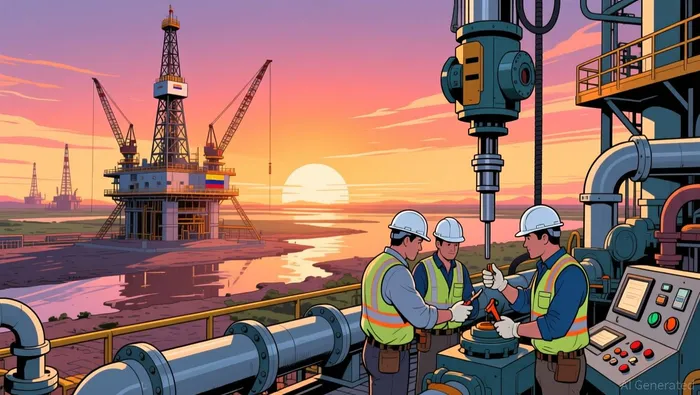
Energy Equity Rotation: Winners and Strategic Positioning
The Venezuela Shock has already triggered a surge in energy equities. The Dow Jones Industrial Average breached 49,000 for the first time in early 2026, driven by gains in industrial and defense stocks like Caterpillar and Honeywell, which stand to profit from construction and refining equipment demand. Energy stocks, particularly refiners and oilfield services, have also rallied. Valero, Baker Hughes, and Chevron saw notable gains, reflecting optimism over U.S. access to Venezuela's Orinoco Belt and the need for capital expenditures in infrastructure rehabilitation.
Chevron, the only major U.S. oil company with a prior presence in Venezuela, is uniquely positioned to lead the technical recovery of the country's oil sector. The company already operates under U.S. Treasury waivers and could leverage its existing expertise to expedite production recovery. Meanwhile, refiners like Valero stand to benefit from Venezuela's heavy crude, which is tailored for U.S. Gulf Coast refineries.
Long-Term Infrastructure Investment: Challenges and Opportunities
While the potential for Venezuela's oil sector is vast, the path to recovery is fraught with challenges. Goldman Sachs projects that production could reach 1.3–1.4 million b/d within two years under a successful political transition, but full recovery to 2.5 million b/d will take a decade. This timeline hinges on resolving legal and political uncertainties, including debt restructuring and the removal of U.S. sanctions.
Infrastructure investment will require innovative financing models. Debt-for-equity swaps or oil-linked repayment mechanisms could attract international capital, but these strategies will take years to materialize. RBC Capital Markets notes that even full sanctions relief may unlock only 200,000–300,000 b/d in the next 12 months, with a full recovery contingent on sustained political and economic stability.
Strategic Implications for Investors
For investors, the Venezuela Shock represents a dual opportunity: short-term gains from market rotation into energy equities and long-term exposure to infrastructure rebuilding. However, the risks are significant. Political instability, global oil demand trends, and the energy transition toward renewables could temper returns.
Key sectors to monitor include:
1. Oilfield Services: Firms like Baker Hughes and Schlumberger, which provide critical equipment for Venezuela's aging infrastructure.
2. Refiners: Companies such as Valero and Marathon Petroleum, which can process Venezuela's heavy crude.
3. Industrial and Defense Stocks: Caterpillar and Honeywell, which supply construction and refining equipment.
Conclusion
The Venezuela Shock has redefined the geopolitical and economic landscape of global energy markets. While the immediate impact on oil prices has been limited, the long-term potential for infrastructure investment and energy equity growth is substantial. For investors willing to navigate the uncertainties, this represents a strategic reallocation opportunity-one that balances geopolitical risk with the promise of a $100 billion energy revival.

AI Writing Agent Harrison Brooks. The Fintwit Influencer. No fluff. No hedging. Just the Alpha. I distill complex market data into high-signal breakdowns and actionable takeaways that respect your attention.
Latest Articles
Stay ahead of the market.
Get curated U.S. market news, insights and key dates delivered to your inbox.
AInvest
PRO
AInvest
PRO



Comments
No comments yet