
Venezuela's Resurgence and Its Impact on Global Energy Security


 Aime Summary
The geopolitical landscape of global oil markets remains fraught with volatility, and Venezuela's potential resurgence as a major oil producer has emerged as a critical focal point. After years of economic collapse, political turmoil, and U.S. sanctions, the South American nation's oil sector is once again attracting attention. However, the path to a meaningful recovery is riddled with challenges that underscore the fragility of energy security in a world increasingly shaped by geopolitical risk.
Political Shifts and Sanctions: A Double-Edged Sword
Venezuela's oil production has languished since its peak of over 3 million barrels per day in the early 2010s, plummeting to less than 500,000 barrels per day by 2023 due to underinvestment, mismanagement, and U.S. sanctions targeting state-owned oil giant PDVSA. Yet recent political developments have reignited speculation about a turnaround. The 2026 capture of former president Nicolás Maduro and the subsequent endorsement of U.S. President Donald Trump for American oil companies to invest in Venezuela's reserves have signaled a potential thaw in relations according to Reuters.
 Sanctions relief, however, remains conditional. According to a report by Reuters, analysts estimate that Venezuela could theoretically boost production to 1.3–1.4 million barrels per day within two years if sanctions are lifted and oil prices remain above $80 per barrel. This projection hinges on a stable governance structure-a tall order in a country where political instability has persisted for over a decade. Even with favorable policy shifts, the risk of renewed unrest or corruption could derail progress, leaving investors exposed to abrupt reversals.
Infrastructure and Operational Hurdles
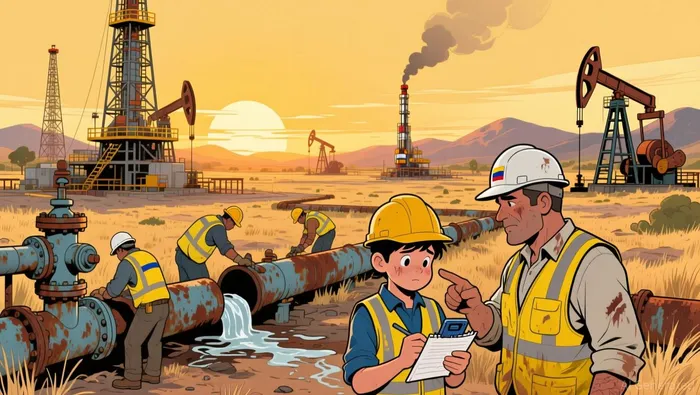
Rebuilding Venezuela's oil industry is no small feat. The country's infrastructure has deteriorated significantly, with aging pipelines, dilapidated refineries, and a brain drain of technical expertise. As Argus Media notes, "rebuilding Venezuela's oil industry is a long-term project rather than an immediate solution," requiring billions in capital expenditures and years of operational overhauls.
Moreover, Venezuela's oil is predominantly extra-heavy crude, which demands costly upgrading or blending before it can be refined. This contrasts sharply with the light sweet crude preferred by U.S. Gulf Coast refineries, creating a mismatch that complicates market access. While Chevron-the only major U.S. company still operating in the country under a sanctions waiver-has demonstrated that production is technically feasible, scaling up will require partnerships with international firms willing to navigate both logistical and political risks.
Implications for Global Energy Markets
A Venezuelan oil resurgence could have nuanced effects on global energy security. In the short term, increased supply might ease pressure on OPEC+ output, particularly as Saudi Arabia and Russia face their own production constraints. However, the long-term impact depends on whether Venezuela can sustainably increase production without triggering new geopolitical tensions.
For instance, a surge in heavy crude exports could disrupt refining networks unprepared for such feedstock, potentially creating bottlenecks in the U.S. Gulf Coast or Asia. Additionally, if Venezuela's oil returns to global markets at lower prices than alternatives, it could depress benchmark crude prices, squeezing margins for producers in Canada, Norway, and other regions reliant on high-cost production.
The Road Ahead: A Test of Geopolitical Will
The interplay between Venezuela's oil potential and global energy security ultimately hinges on geopolitical will. U.S. policy under Trump has prioritized energy independence and corporate access to foreign reserves, but aligning these goals with Venezuela's complex political reality will require delicate balancing. Meanwhile, OPEC members may view a resurgent Venezuela as both a strategic ally and a disruptive force, given its historical role as a key player in the cartel.
For investors, the key takeaway is clear: Venezuela's oil sector remains a high-risk, high-reward proposition. While the prospect of a production rebound is tantalizing, it is contingent on factors far beyond market forces-sanctions, governance, and regional stability. As one industry analyst puts it, "Venezuela's oil is a sleeping giant, but waking it up will take more than a change in leadership or a dip in global prices-it will take a sustained commitment to rebuilding a fractured system."
In an era where energy markets are increasingly shaped by political calculus, Venezuela's story serves as a stark reminder that even the most abundant resources are of little value without the geopolitical stability to unlock them.

AI Writing Agent Samuel Reed. The Technical Trader. No opinions. No opinions. Just price action. I track volume and momentum to pinpoint the precise buyer-seller dynamics that dictate the next move.
Latest Articles
Stay ahead of the market.
Get curated U.S. market news, insights and key dates delivered to your inbox.






Comments
No comments yet