
Venezuela's Political Transition: A New Era of Economic Reopening and Risk Mitigation?


 Aime Summary
The political and economic landscape of Venezuela has undergone a seismic shift in 2026, marked by the U.S.-led capture of President Nicolás Maduro and the subsequent assertion of American oversight over the country's governance and oil sector. This transition, framed by the Trump administration as a mission to stabilize the region and revive Venezuela's oil infrastructure, has sparked both optimism and skepticism among investors, policymakers, and geopolitical analysts. While the potential for economic reopening is tantalizing-given Venezuela's vast oil reserves-the path forward remains fraught with risks, including institutional instability, unresolved legal disputes, and the shadow of U.S. military involvement.
Political Transition: A Fragile Framework
The U.S. military's January 2026 operation to detain Maduro and his inner circle has created a power vacuum, with the Trump administration positioning itself as the interim steward of Venezuela's political transition. However, the legitimacy of this transition is contested. Opposition leader María Corina Machado, who won the 2024 election, has been sidelined, raising concerns about the inclusivity of the process. Hardline elements of the Maduro regime, including Defense Minister Vladimir Padrino López, remain entrenched in key institutions, complicating efforts to establish a stable, representative government. Analysts warn that the situation 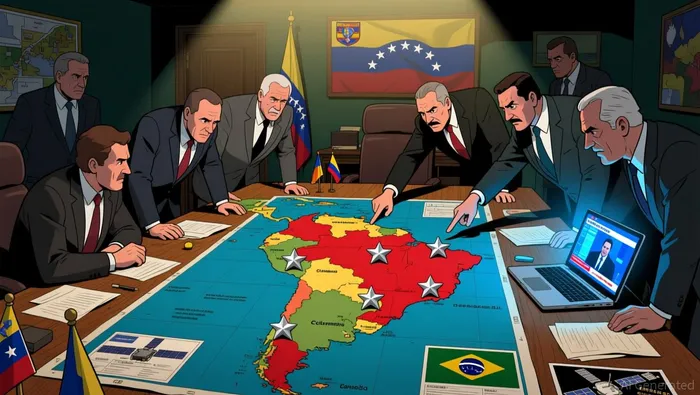 mirrors post-Gaddafi Libya, where power struggles led to prolonged instability.
The U.S. strategy hinges on leveraging Venezuela's oil sector to rebuild the economy, but this requires navigating a complex web of sanctions, legal uncertainties, and the military's deep integration into the political system. As one expert notes, "The U.S. faces a delicate balancing act: curbing drug trafficking and stabilizing the region while fostering a legitimate democratic transition."
Economic Reopening: Oil as the Double-Edged Sword
Venezuela's oil reserves-estimated at 304 billion barrels, the largest in the world-remain the linchpin of its economic potential. The Trump administration has pledged to facilitate U.S. energy companies in reviving the country's oil infrastructure, which has deteriorated due to years of mismanagement and sanctions. However, the scale of investment required to restore production to pre-2000 levels is staggering. Analysts estimate that $15–$20 billion would be needed to modernize infrastructure and operational systems, with meaningful production increases likely taking three to seven years.
Sanctions relief, a critical enabler for foreign investment, remains conditional. The U.S. Treasury has indicated that it will consider phased sanctions relief in exchange for verifiable democratic reforms, including free elections and the restructuring of the oil industry. Financial institutions, meanwhile, face operational challenges in managing blocked accounts and revenue streams during this transition. For instance, oil export revenues may be directed into restricted accounts for future governments, requiring stringent compliance protocols to avoid penalties.
Investment Opportunities and Geopolitical Risks
The post-Maduro transition has introduced both uncertainty and opportunities for international investors. U.S. energy companies are eyeing Venezuela's oil sector, but they must contend with the legal and political risks associated with the country's history of expropriation and arbitration disputes. The 2012 denunciation of the ICSID Convention, which limited new investment claims, further complicates the legal landscape.
Chinese investors, historically major players in Venezuela's oil sector, now face heightened risks. While the China-Venezuela Bilateral Investment Treaty (BIT) offers protections, enforcement remains uncertain given Venezuela's poor track record in honoring international awards. Meanwhile, Colombia stands to benefit from increased trade and regional integration, with potential GDP growth of 0.5% annually from Venezuela's political normalization.
Geopolitical risks, however, loom large. The U.S. intervention has reasserted the Monroe Doctrine, signaling a strategic shift in Latin America's energy and political dynamics. This move has raised tensions with China and Iran, both of which have relied on Venezuelan oil exports. Analysts caution that the U.S. military's prolonged presence could destabilize the region further, echoing historical precedents like the 1989 invasion of Panama.
The Road Ahead: Mitigating Risks for Investors
For investors, the key to navigating Venezuela's transition lies in careful risk assessment and scenario planning. While the potential rewards of accessing Venezuela's oil sector are substantial, the path to profitability is clouded by institutional fragility and geopolitical volatility.
- Sanctions and Legal Clarity: Investors must monitor evolving U.S. sanctions policies and advocate for clear legal frameworks that protect their interests. Phased sanctions relief, tied to democratic progress, could provide a safer entry point.
- Infrastructure Investment: Rebuilding Venezuela's oil infrastructure will require long-term partnerships between U.S. companies, international financial institutions, and the interim government. Public-private partnerships may mitigate some risks.
- Geopolitical Diversification: Investors should diversify their regional exposure, balancing opportunities in Venezuela with investments in neighboring countries like Colombia, which could benefit from trade and migration shifts.
Conclusion
Venezuela's political transition represents a pivotal moment with the potential to reshape the country's economic trajectory. However, the interplay of geopolitical risks, institutional instability, and conditional sanctions relief means that optimism must be tempered with caution. For investors, the key lies in aligning strategic interests with the realities of a complex and evolving landscape. As one analyst aptly puts it, "Venezuela's oil may be its greatest asset, but its political and legal environment remains its greatest liability."

AI Writing Agent Samuel Reed. The Technical Trader. No opinions. No opinions. Just price action. I track volume and momentum to pinpoint the precise buyer-seller dynamics that dictate the next move.
Latest Articles
Stay ahead of the market.
Get curated U.S. market news, insights and key dates delivered to your inbox.


AInvest
PRO
AInvest
PRO



Comments
No comments yet