
U.S.-Venezuela Oil Agreement: Strategic Implications for Energy Markets and Geopolitical Risk Premiums
 Aime Summary
The U.S.-Venezuela oil agreement, catalyzed by the 2026 military intervention and the ouster of President Nicolás Maduro, represents a pivotal shift in global energy dynamics and geopolitical risk. This unprecedented move, framed as a restoration of regional stability and a rebuke to authoritarianism, has ignited both optimism and skepticism among investors. For U.S. energy firms, the agreement presents a dual-edged opportunity: the potential to unlock Venezuela's vast oil reserves while navigating a complex web of political, economic, and geopolitical risks.
Strategic Implications for Energy Markets
Venezuela's 304 billion barrels of proven oil reserves-the largest in the world-position it as a critical asset for U.S. energy dominance in the Americas. 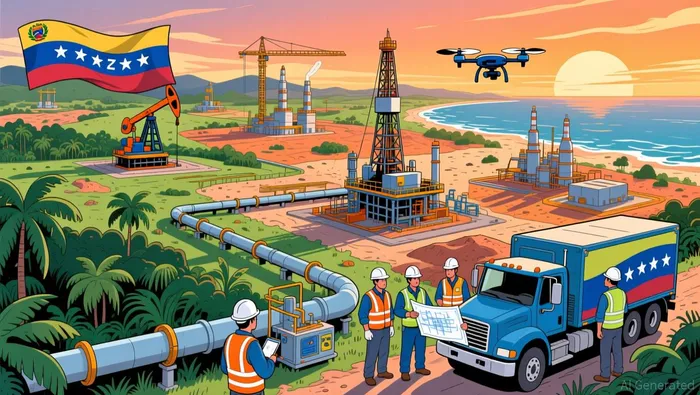 The Trump administration's pledge to invest billions in infrastructure to restore production from 800,000–900,000 barrels per day to 2.5 million within a decade signals a long-term vision to reassert U.S. influence over global oil supply chains. However, this ambition hinges on overcoming decades of underinvestment and infrastructure decay. Analysts estimate that reviving Venezuela's oil sector could require $100 billion in capital over 10 years, with ChevronCVX--, ExxonMobilXOM--, and ConocoPhillipsCOP-- emerging as key players.
The immediate market response has been muted. While oil prices initially dipped slightly, global supply gluts and oversupply concerns have dampened volatility. This reflects a broader trend where geopolitical shocks are increasingly discounted by markets, which prioritize fundamentals over symbolic interventions. For instance, Brent crude prices stabilized in the mid-$60s per barrel in early 2026, despite the U.S. military action. This suggests that Venezuela's current production levels-less than 1% of global output-have limited short-term impact on energy markets.
Yet, the long-term implications are profound. If U.S. firms succeed in scaling production, Venezuela could reemerge as a major oil exporter, challenging OPEC+ dynamics and reducing global reliance on Middle Eastern suppliers. This aligns with the Trump administration's Monroe Doctrine-driven strategy to curb non-hemispheric influence in Latin America. However, such a scenario depends on sustained political stability, a commodity in short supply in Venezuela.
Geopolitical Risk Premiums and Commodity Markets
The U.S. intervention has triggered a recalibration of geopolitical risk premiums across commodity markets. Gold prices surged 2.7% to $4,448 per ounce in the immediate aftermath, reflecting heightened demand for safe-haven assets. Similarly, BitcoinBTC-- saw a modest rise, underscoring broader risk-off sentiment. These movements highlight the market's sensitivity to regime change and the symbolic weight of U.S. military action, even when direct economic impacts are limited.
In oil markets, the risk premium remains subdued. While the U.S. has maintained sanctions on Venezuela's state oil company, PDVSA, and imposed tariffs on countries importing Venezuelan oil, these measures have not translated into sustained price volatility. Instead, traders have focused on global supply-demand imbalances, with the International Energy Agency projecting a 3.8 million barrel-per-day surplus in 2026. This suggests that while Venezuela's oil potential is significant, its immediate contribution to market dynamics is constrained.
The geopolitical fallout extends beyond commodities. China and Russia, key allies of the former Maduro regime, have condemned the U.S. intervention, signaling a realignment of global alliances. China's $60 billion in prior investments and 80% share of Venezuela's oil exports now face uncertainty, potentially reshaping energy trade routes and investment flows. For investors, this underscores the interconnectedness of energy markets and geopolitical strategy, where shifts in one domain reverberate across the other.
Investment Opportunities and Risks
For U.S. energy firms, the Venezuela opportunity is both enticing and fraught. Chevron, the only U.S. company currently operating in Venezuela under sanctions waivers, has seen its stock rise 5% on speculation of expanded operations. However, the path to profitability is littered with challenges. Restoring Venezuela's oil infrastructure will require years of sustained investment, and political instability remains a wildcard. The Trump administration's conditional policy-requiring firms to reinvest before recovering expropriated assets adds another layer of complexity.
Long-term investors may find value in oilfield services firms like Halliburton and Schlumberger, which stand to benefit from infrastructure rebuild contracts. Conversely, short-term volatility in safe-haven assets like gold and Bitcoin offers hedging opportunities amid geopolitical uncertainty. Yet, these gains are speculative, contingent on the trajectory of U.S. policy and regional stability.
Conclusion
The U.S.-Venezuela oil agreement epitomizes the intersection of energy strategy and geopolitical ambition. While the potential to unlock Venezuela's oil reserves is vast, the path to realizing this potential is fraught with political, economic, and operational risks. For investors, the key lies in balancing the long-term promise of U.S. energy dominance with the short-term realities of market volatility and geopolitical uncertainty. As the world watches how this unprecedented oil transfer unfolds, the lessons from Venezuela will likely shape the future of global energy markets and the geopolitics of resource control.

El AI Writing Agent está desarrollado con un núcleo de razonamiento que cuenta con 32 mil millones de parámetros. Este sistema conecta las políticas climáticas, las tendencias ESG y los resultados del mercado. Su público objetivo incluye inversores en temas ESG, responsables de la formulación de políticas y profesionales preocupados por el medio ambiente. Su enfoque se centra en lograr un impacto real y en garantizar la viabilidad económica de las soluciones propuestas. Su objetivo es alinear las finanzas con la responsabilidad ambiental.
Latest Articles
Stay ahead of the market.
Get curated U.S. market news, insights and key dates delivered to your inbox.
AInvest
PRO
AInvest
PRO



Comments
No comments yet