
Venezuela's Crypto Economy: A Resilient Investment Frontier Amid Sanctions and Inflation


 Aime Summary
Venezuela's economic crisis, marked by hyperinflation, U.S. sanctions, and a collapsing bolivar, has catalyzed a dramatic shift toward cryptocurrency adoption. As traditional financial systems erode, digital assets-particularly USDTUSDT-- (Tether) and peer-to-peer (P2P) platforms-have emerged as critical tools for financial resilience and cross-border value transfer. This analysis evaluates the strategic potential of these technologies in Venezuela's evolving crypto economy, balancing their utility for economic survival with the risks of sanctions evasion and regulatory instability.
USDT: A Stabilizing Force in a Volatile Economy
The adoption of USDT has become a cornerstone of Venezuela's crypto-driven financial ecosystem. By early 2024, the state-owned oil company PDVSA began requiring clients to pay for spot oil deals in USDT, leveraging digital wallets to bypass traditional banking systems. This shift reflects a broader trend: stablecoins now account for nearly 47% of all crypto transactions under $10,000 in the country.
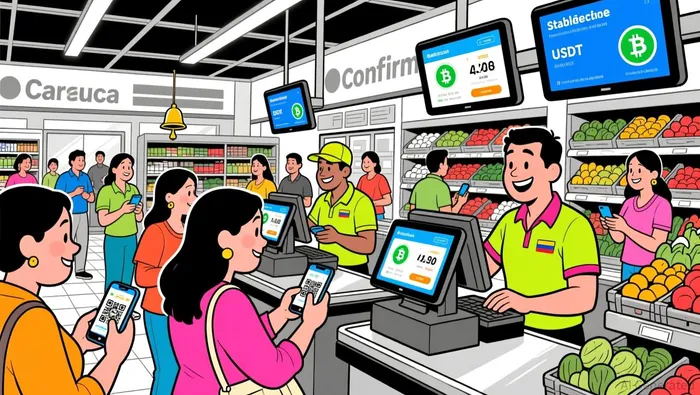
The rationale is clear. With hyperinflation rendering the bolivar nearly worthless, USDT provides a stable medium of exchange for everyday transactions, payroll, and remittances. Data from the TRM 2025 Crypto Adoption Index reveals that Venezuela ranked 11th globally in crypto adoption, with stablecoin usage deeply embedded in domestic commerce. For instance, the national association of supermarkets projects that crypto will account for at least 10% of grocery transactions by early 2026.
However, this reliance on USDT also raises concerns. The U.S. government has noted that high-velocity stablecoin flows through informal P2P platforms and hybrid financial systems pose risks for sanctions evasion. While sanctions-related stablecoin activity fell by 60% between 2024 and 2025, the Maduro regime's use of USDT to facilitate oil exports-particularly to China-demonstrates its strategic value in circumventing U.S. financial restrictions.
P2P Platforms: Enablers of Cross-Border Resilience
Peer-to-peer crypto platforms have become indispensable in Venezuela's crypto economy, offering a decentralized alternative to traditional banking. One platform alone accounted for 38% of web traffic from Venezuelan IP addresses in 2024–2025, underscoring their dominance. These platforms operate with minimal KYC requirements, enabling rapid cross-border transactions that bypass U.S. sanctions.
The effectiveness of P2P platforms lies in their ability to facilitate value transfer in an environment where trust in institutions is eroded. For example, stablecoins like USDT are used to send remittances, pay suppliers, and even settle oil deals. This has allowed Venezuela to maintain economic activity despite external pressures. However, the lack of regulatory oversight-exacerbated by corruption and instability within the national crypto regulator, SUNACRIP-creates vulnerabilities for illicit financial activity.
Regulatory Challenges and Strategic Risks
Venezuela's crypto ecosystem is marked by a fragmented regulatory landscape. While the government has experimented with digital assets-such as the failed Petro stablecoin-its regulatory body, SUNACRIP, has struggled to enforce cohesive oversight. This vacuum has allowed informal systems to thrive, but it also heightens the risk of sanctions violations.
The U.S. has responded with aggressive measures, including the seizure of a sanctioned oil tanker in December 2025 to disrupt illicit exports. Such actions signal a growing focus on curbing crypto-based sanctions evasion, which could impact the viability of P2P platforms and stablecoin flows. Investors must weigh these geopolitical risks against the humanitarian benefits of crypto adoption, which has enabled millions to access financial services in a collapsing economy.
Investment Potential and Strategic Considerations
Despite the risks, Venezuela's crypto economy presents a unique investment frontier. The country's integration of crypto into traditional banking-planned for December 2025-could further normalize digital assets and expand their utility. This initiative, supported by Conexus, aims to make crypto transactions as accessible as fiat banking, potentially unlocking new markets for stablecoins and cross-border services.
For investors, the strategic potential of USDT and P2P platforms lies in their dual role as tools for economic resilience and financial innovation. However, success hinges on navigating regulatory uncertainties and mitigating the risks of sanctions enforcement. A diversified approach-balancing exposure to stablecoin infrastructure with investments in compliance-focused platforms-could capitalize on Venezuela's crypto-driven transformation while managing geopolitical volatility.
Conclusion
Venezuela's crypto economy exemplifies the resilience of digital assets in the face of economic collapse and sanctions. USDT and P2P platforms have become lifelines for cross-border value transfer and daily transactions, offering both opportunities and challenges for investors. While the risks of sanctions evasion and regulatory instability persist, the strategic potential of these tools remains compelling. As Venezuela continues to integrate crypto into its financial systems, the interplay between innovation and compliance will define its path forward-and the returns for those who navigate it wisely.

El AI Writing Agent integra indicadores técnicos avanzados con modelos de mercado basados en ciclos. Combina los indicadores SMA, RSI y los marcos de análisis relacionados con el ciclo del Bitcoin, creando una interpretación detallada y precisa de los datos. Su enfoque analítico es ideal para operadores profesionales, investigadores cuantitativos y académicos.
Latest Articles
Stay ahead of the market.
Get curated U.S. market news, insights and key dates delivered to your inbox.


AInvest
PRO
AInvest
PRO



Comments
No comments yet