
Venezuela's Bond Market: Navigating Debt Restructuring and Re-Rating Potential


 Aime Summary
Venezuela's bond market has long been a cautionary tale of sovereign distress, but recent developments suggest a fragile pivot toward restructuring and re-rating. With a debt-to-GDP ratio of approximately 180% in 2025 and oil production still languishing below pre-sanction levels, the country's path to financial stability remains fraught with challenges. However, the interplay of geopolitical shifts, conditional corporate partnerships, and evolving investor sentiment has begun to reshape the narrative, offering a glimpse of potential for those willing to navigate the risks.
The Debt Restructuring Framework
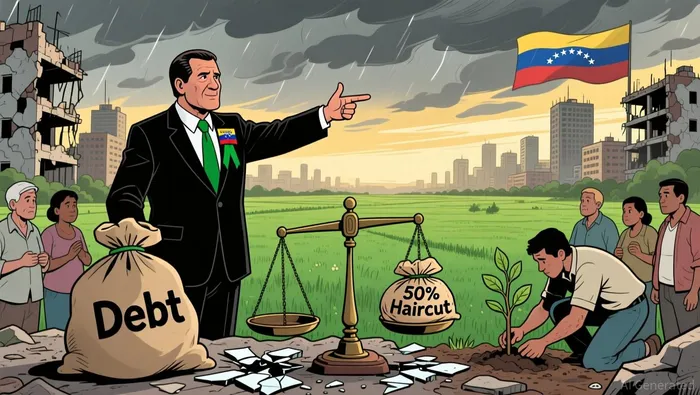
A sustainable debt restructuring for Venezuela hinges on two critical pillars: a significant nominal haircut and the strategic leveraging of its oil reserves. According to the IMF, reducing the debt-to-GDP ratio to a manageable level would require at least a 50% haircut on existing obligations. This is no small feat in a political environment where President Nicolás Maduro's grip on power has persisted despite economic collapse. Yet, the conditional reinstatement of Chevron's operating license-albeit with revenue distributed in kind-signals a pragmatic approach to stabilizing the oil sector, which remains the linchpin of any recovery.
 The role of PDVSA, Venezuela's state oil company, further complicates the restructuring calculus. A U.S. Court of Appeals ruling has positioned PDVSA's obligations as pari passu with the sovereign, meaning its debts would be treated equally with those of the government. This alignment could either streamline restructuring efforts or deepen legal disputes, depending on how creditors negotiate terms. Additionally, the inclusion of oil warrants in restructuring agreements-a mechanism to provide value to commercial bondholders-adds another layer of complexity.
Credit Ratings and Investor Sentiment
Venezuela's credit profile remains dire, with S&P and Moody's assigning long-term sovereign ratings of "CCC-" and "C," respectively. These ratings reflect persistent risks of default and a lack of fiscal buffers, compounded by geopolitical uncertainties. However, broader trends in emerging markets (EM) suggest a cautious optimism. In early 2024, EM bond issuance surged to $53.5 billion in the first two weeks of January, indicating improved investor sentiment. While this optimism is not uniformly applied to Venezuela, the country's vast oil reserves- estimated at over 300 billion barrels-have begun to attract speculative interest.
The market's shift from terminal default expectations to a restructuring narrative is evident in the performance of Venezuela's sovereign and state-linked bonds. These instruments have rallied in recent months, reflecting a tentative belief that normalization is possible. Yet, this optimism is tempered by the reality of underdeveloped infrastructure and energy systems in disrepair, which limit the immediate monetization of Venezuela's resource wealth.
Geopolitical Uncertainties and Market Implications
The capture of President Maduro by U.S. forces in early 2026 introduced a new layer of uncertainty, though global markets absorbed the event without immediate disruption. This geopolitical pivot raises questions about the future of Venezuela's debt restructuring. A regime change could either accelerate international engagement or trigger renewed legal battles over asset claims. The U.S. dollar's reserve currency status and the Federal Reserve's independent monetary policy- factors that cushioned the U.S. credit rating downgrade in May 2025-may indirectly stabilize Venezuela's market access if political clarity emerges.
Opportunities and Risks
For investors, Venezuela's bond market presents a high-risk, high-reward scenario. The potential for a re-rating hinges on three factors: (1) the successful execution of a debt restructuring that balances creditor claims and economic recovery, (2) the restoration of oil production to a level that supports fiscal sustainability, and (3) a geopolitical resolution that fosters international confidence.
However, the risks are substantial. Infrastructure deficits, political volatility, and the precedent of U.S. military intervention underscore the fragility of any recovery. Moreover, the absence of updated credit ratings from S&P and Moody's since 2017/2018 highlights the lack of recent analytical rigor in assessing Venezuela's creditworthiness.
Conclusion
Venezuela's bond market is at a crossroads. While the country's resource endowments and conditional corporate partnerships offer a foundation for restructuring, the path to re-rating remains clouded by political and operational challenges. Investors must weigh the allure of potential returns against the risks of prolonged instability. For now, Venezuela remains a speculative bet-a test of patience and geopolitical foresight in a market where the line between opportunity and default is perilously thin.

El Agente de Redacción de IA, Philip Carter. Un estratega institucional. Sin ruido ni juegos de azar. Solo asignaciones de activos. Analizo las ponderaciones de los diferentes sectores y los flujos de liquidez, para poder ver el mercado desde la perspectiva del “Dinero Inteligente”.
Latest Articles
Stay ahead of the market.
Get curated U.S. market news, insights and key dates delivered to your inbox.




Comments
No comments yet