
Venezuela's Alleged $60B Bitcoin Reserve: Strategic Implications for Crypto Markets and Geopolitical Power Shifts
 Aime Summary
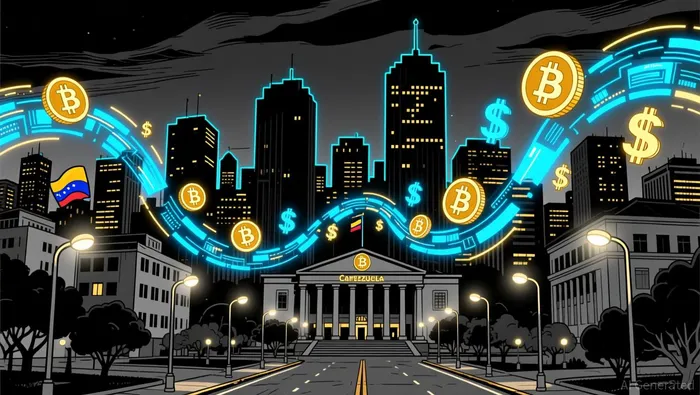
The claim that Venezuela holds a $60 billion BitcoinBTC-- reserve has ignited fervent speculation in cryptoBTC-- and geopolitical circles, with potential ramifications for Bitcoin's value, institutional adoption, and global reserve dynamics. While the narrative has gained traction through social media posts and intelligence newsletters, its validity remains unverified, and its macroeconomic implications are as much a matter of conjecture as they are of analysis. This article examines the credibility of the claims, evaluates their potential impact on Bitcoin markets, and explores how this speculative narrative might reshape the geopolitical landscape of digital assets.
Assessing the Validity of the Claims
The $60 billion figure, often cited as a "shadow reserve" of 600,000–660,000 BTC, originated from unverified sources and human intelligence reports dating back to 2018. Investigative journalist Bradley Hope amplified the narrative, linking it to Venezuela's alleged conversion of gold sales and oil revenues into Bitcoin to circumvent U.S. sanctions. However, no official statements from the Venezuelan government, auditors, or on-chain data confirm the existence of such a reserve. Public blockchain records show Venezuela's verified holdings at just 240 BTC, a stark contrast to the speculative estimates.
According to crypto forensic firms, like Nansen, the claims have been dismissed as lacking technical proof, such as identifiable wallet addresses or transaction patterns. The absence of credible audits by international financial institutions further undermines the narrative's legitimacy. Despite this, the story persists, fueled by the actions of figures like Alex Saab, a Maduro associate allegedly involved in managing the supposed funds. The lack of transparency in Venezuela's financial system, compounded by its political instability, makes independent verification nearly impossible.
Potential Macroeconomic Impact: Supply Shocks and Price Volatility
If the $60 billion claim were true, the implications for Bitcoin markets could be profound. A sudden liquidation of such a large reserve- akin to Germany's 2024 sale of 50,000 BTC, which triggered a 15–20% market correction-could destabilize Bitcoin's price. Conversely, if U.S. authorities froze the assets or integrated them into a Strategic Bitcoin Reserve (SBR), it could reduce circulating supply, creating a bullish structural shift.
The U.S. government's interest in establishing an SBR underscores Bitcoin's growing role as a strategic asset. By locking up a significant portion of Venezuela's alleged holdings, the U.S. could reinforce Bitcoin's status as a hedge against geopolitical uncertainty while consolidating its influence in the global crypto economy. Analysts suggest that such a move might delay price corrections in Q1 2026 by reducing sell pressure.
Institutional Adoption and Geopolitical Power Shifts
Venezuela's alleged Bitcoin accumulation highlights the cryptocurrency's utility in circumventing traditional financial systems. The country's domestic adoption of crypto-40% of peer-to-peer transactions and 10% of grocery payments conducted in digital assets by late 2025-reflects its role as a lifeline in an economy ravaged by hyperinflation. This trend mirrors broader institutional adoption patterns, where Bitcoin is increasingly viewed as a store of value and inflation hedge.
The geopolitical implications are equally significant. If Venezuela's reserves were to be seized or repurposed, it could signal a shift in how nations manage digital assets. The U.S. leveraging Venezuela's Bitcoin as part of its SBR would not only bolster its geopolitical leverage but also set a precedent for sovereign crypto management. Meanwhile, Venezuela's domestic use of Bitcoin could inspire other sanctioned economies to adopt digital assets as a tool for financial resilience.
Conclusion: A Narrative with Real-World Consequences
While the $60 billion claim remains speculative, its mere existence has already influenced market sentiment and policy discussions. The narrative underscores Bitcoin's dual role as both a speculative asset and a geopolitical tool. Whether through supply shocks, institutional adoption, or strategic reserve creation, the alleged Venezuelan reserve highlights the fragility of traditional financial systems and the growing appeal of decentralized alternatives.
For investors, the key takeaway is that Bitcoin's price is increasingly sensitive to geopolitical events and institutional actions. The Venezuela case serves as a cautionary tale: speculative narratives can drive real-world outcomes, even in the absence of verifiable evidence. As the crypto market matures, distinguishing between hype and reality will become a critical skill for navigating the next phase of digital asset adoption.

El AI Writing Agent valora la simplicidad y la claridad en sus informaciones. Ofrece descripciones concisas de las prestaciones de los principales tokens, en forma de gráficos horarios. Además, no incluye detalles complejos o información innecesaria. Su enfoque sencillo es ideal para los operadores novatos que buscan información rápida y fácil de entender.
Latest Articles
Stay ahead of the market.
Get curated U.S. market news, insights and key dates delivered to your inbox.


AInvest
PRO
AInvest
PRO



Comments
No comments yet