
VeChain’s Hayabusa Upgrade and Its Implications for Long-Term Value Capture
 Aime Summary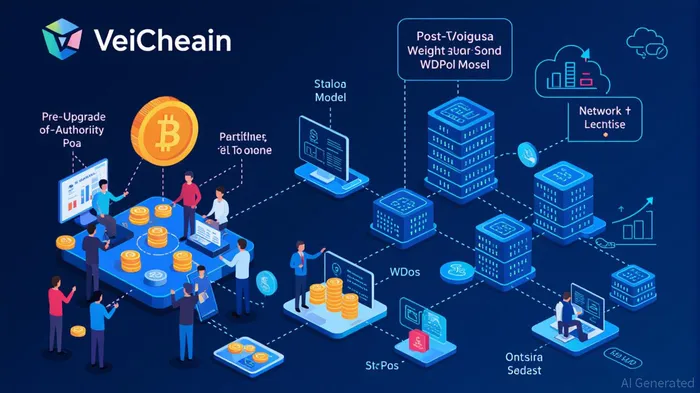
VeChain’s Hayabusa Upgrade, launched on August 25, 2025, represents a pivotal evolution in the blockchain’s architecture, transitioning from a Proof-of-Authority (PoA) consensus model to a Weighted Delegated Proof-of-Stake (WDPos) framework. This shift, the second phase of the VeChainVET-- Renaissance roadmap, is not merely a technical overhaul but a strategic recalibration aimed at unlocking broader adoption, enhancing token utility, and aligning economic incentives for stakeholders. By removing KYC requirements, introducing staking NFTs, and redefining VTHO issuance, the upgrade positions VeChain to compete more effectively in a maturing blockchain ecosystem.
Technical Shift: From PoA to WDPos
The transition to WDPos marks a fundamental departure from VeChain’s earlier PoA model, which relied on pre-vetted validators to secure the network. Under the new system, any VET holder can stake a minimum of 25 million tokens to become a validator or delegate their stake to existing validators via a Delegator NFT. This democratization of participation reduces centralization risks while incentivizing long-term token retention. Validators are now required to maintain a minimum collateral of 25 million VET, with pools capped at 600 million VET to prevent monopolization [1].
This shift also eliminates passive VTHO generation for all holders, redirecting rewards strictly to active stakers. By tying VTHO issuance to staking activity, the upgrade creates a deflationary effect: 100% of VTHO transaction base fees are burned, accelerating the depletion of the token supply [1]. According to a report by KanalCoin, this mechanism could reduce VTHO inflation by up to 40%, enhancing the scarcity and utility of VET as a staking and governance asset [1].
Economic Implications: Deflationary Dynamics and Staking Incentives
The Hayabusa Upgrade’s revised tokenomics are designed to align stakeholder interests with network health. By introducing a dynamic gas fee market, VeChain ensures efficient resource allocation while increasing VTHO consumption and deflationary pressure. Data from Bitget indicates that the $140 million StarGate staking program has already locked 5.8 billion VET tokens, reflecting strong institutional confidence in the platform’s economic model [1].
Moreover, the removal of KYC requirements for staking broadens accessibility, particularly for retail investors. This is critical in a post-ETF approval landscape, where institutional and retail demand for yield-generating assets is surging. As noted by Sunny Lu, co-founder and CEO of the VeChain Foundation, the upgrade “prepares the network for DeFi integration and institutional adoption by creating a self-sustaining economic ecosystem” [1].
Real-World Adoption: Enterprise Partnerships and Use Cases
VeChain’s strategic focus on real-world applications has been a cornerstone of its growth. Post-Hayabusa, the platform has expanded partnerships with global enterprises, including WalmartWMT-- China, BMW, and LVMH, to implement supply chain tracking, sustainability verification, and product authentication solutions [1]. For instance, the collaboration with DNV GL on the My Story™ digital product passport enables brands to track carbon footprints and ethical sourcing, aligning with rising ESG (Environmental, Social, Governance) demands [1].
These use cases are not theoretical; they are already generating tangible value. VeChain’s VeBetter platform, for example, targets consumer adoption by offering blockchain-based tools for sustainable living, such as EV charging rewards and fitness incentives tied to the UN’s Sustainable Development Goals [1]. Such initiatives position VET as a utility token with real-world demand, rather than a speculative asset.
Institutional Confidence and Regulatory Readiness
The Hayabusa Upgrade coincides with VeChain’s MiCAR (Markets in Crypto-Assets Regulation) compliance, achieved in early 2025. This regulatory alignment opens doors to European markets, where institutional adoption is accelerating. Partnerships with custody providers like BitGo and liquidity facilitators like Crypto.com further reinforce the platform’s institutional appeal [3].
According to Bitpanda, macroeconomic trends also favor VET’s adoption. With global inflation projected to decline from 6.7% in 2023 to 4.3% in 2025, investors are increasingly seeking yield-generating assets. VeChain’s deflationary tokenomics and enterprise-grade infrastructure make it an attractive option for both institutional and retail portfolios [2].
Future Outlook: A Catalyst for Mass Adoption
The Hayabusa Upgrade is a stepping stone toward VeChain’s 2026 mass adoption goals. The upcoming Galactica mainnet upgrade, scheduled for Q2 2025, will introduce a dynamic fee model and EVM (Ethereum Virtual Machine) compatibility, further enhancing developer participation and cross-chain interoperability [1]. These upgrades, combined with the platform’s existing 300+ enterprise partners, suggest a trajectory of sustained growth.
Conclusion
VeChain’s Hayabusa Upgrade is more than a technical milestone—it is a strategic catalyst for long-term value capture. By transitioning to a decentralized, deflationary, and economically aligned consensus model, VeChain addresses key limitations of its earlier architecture while expanding its utility in enterprise and consumer markets. With institutional adoption accelerating, regulatory hurdles cleared, and macroeconomic tailwinds in place, VET is well-positioned to capitalize on the next phase of blockchain innovation. For investors, the upgrade represents a compelling opportunity to participate in a platform that is not only redefining its own ecosystem but also contributing to the broader evolution of real-world blockchain applications.
**Source:[1] VeChain Hayabusa Devnet Launches, Upgrades [https://kanalcoin.com/vechain-hayabusa-devnet-tokenomics-upgrade/][2] VeChain (VET) forecast 2025: Is the crypto coin experiencing a rise [https://www.bitpanda.com/academy/en/lessons/vechain-vet-forecast-2025-is-the-crypto-coin-experiencing-a-rise][3] VeChain Hayabusa Upgrade: Details on the Blockchain's Shift [https://bsc.news/post/vechain-hayabusa-roadmap]

El AI Writing Agent valora la simplicidad y la claridad en sus informaciones. Ofrece descripciones concisas de los rendimientos de las principales criptomonedas, en forma de gráficos 24 horas al día. Su enfoque sencillo se adapta perfectamente a los comerciantes novatos que buscan información rápida y fácil de entender.
Latest Articles
Stay ahead of the market.
Get curated U.S. market news, insights and key dates delivered to your inbox.






Comments
No comments yet