
The Vanished Premium That Turned Metaplanet Into a Worse Way to Own Bitcoin
 Aime Summary
Metaplanet, the Tokyo company billed as "Asia's MicroStrategy," holds roughly 43,000 bitcoin and is the world's third-largest corporate holder of the coin. Over the past year its shares have fallen more than two-thirds from their high, from a peak above 779 yen to the low 200s — while the bitcoinBTC-- on its balance sheet has traded in the low- to mid-$60,000s. That divergence is the whole story, and it is not a bitcoin story. It is the story of a premium that died.
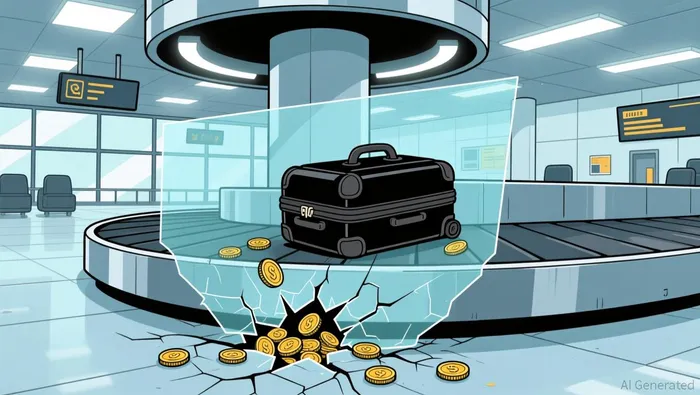
Call the stock's return "the airline luggage story": you checked a suitcase, but by the time it reached the carousel, a piece of it was missing at every stop. The suitcase is bitcoin; the missing piece is what Metaplanet's shareholders actually own of each coin. The company's market-to-net-asset-value ratio, known as mNAV — the price investors pay per dollar of the bitcoin it holds — once ran as high as seven times net asset value, then went through the floor. It fell below 1.0 in June 2026 and has hovered near parity since, around 1.06 times. Within the past year the premium's range has been 0.82 times to 2.11 times. A 96% collapse from peak to trough is the metric this whole saga turns on.
Why the premium was the engine
To understand why the premium mattered, you have to see what Metaplanet actually does. It has almost no business to speak of in the traditional sense — a hotel, some media licensing, and now a wrapper around a bitcoin pile. Its Bitcoin-related segment reported revenue of about 8.9 billion yen (roughly $58 million) and operating income of about $40 million for 2025, a sliver next to a treasury worth billions. The pitch is not operating earnings. It is the promise to maximize bitcoin per share.
For most of 2024 and 2025, that promise was geometrically self-fulfilling. When a share sold at seven times the value of the bitcoin behind it, issuing new shares to buy more coin produced more bitcoin per existing share than those shares had backed before. Every equity raise was a value-creating stamp, and the market rewarded it, which pushed the premium higher, which made the next stamp better. The story worked until the line broke.
The line broke when the premium hit parity
A treasury company is only a good way to own bitcoin while shares sell above the coin they represent. The moment the premium slips below one times, the arithmetic inverts: every new share issued to fund a purchase backs less bitcoin than the buyer paid for, and the existing holders' slice of each coin shrinks. The company knows this. Its own policy is to avoid issuing common stock when mNAV is below 1.0 rather than dilute the bitcoin behind existing shares — which is why it made no third-party share allotments at all in the second quarter of 2026.
The dilution it had already stacked up was enormous. The share count exploded as it leaned on at-the-market stock sales, preferred stock placed at a steep discount, warrants, and convertibles to fund a buying spree that peaked somewhere near 43,000 coins. By the first quarter of 2026, its fully diluted share count of 1.156 billion was roughly three times its underlying 408 million shares — about 183% more dilution than a year earlier. That is the missing luggage: the bitcoin total grew, but the claims on it grew faster.
With the premium gone, equity funding stopped being an option, so Metaplanet pivoted to borrowing. It had drawn down $414 million of a $500 million credit facility by June 30 — 83% of the line — with the bitcoin pledged as collateral and the lender holding priority rights over it. Total liabilities climbed to 77.3 billion yen at mid-year from 46.7 billion at the end of 2025. It also began issuing small, unsecured, unrated retail bonds ("BitBonds") with coupons around 4% as a test of a funding channel independent of the credit line.
The paper loss, and the business under it
The borrowing and the collapsed equity channel landed on a balance sheet that is now mostly swings in a single number. Metaplanet posted a net loss of 182.77 billion yen in the first half of 2026, driven almost entirely by a 184.30 billion yen valuation loss as the dollar-priced bitcoin's value shrank in yen terms. This is largely non-cash mark-to-market and currency movement, not a business going broke — but it is the honest cost of running a leveraged bitcoin book. Cash fell to just 1.09 billion yen.
None of this is an accusation of fraud, and it should not be read as one. The disclosures, the policy line, and the funding pivots are all on the table, and the management has repeatedly said it will keep accumulating through the drawdown. The red flag here is not dishonesty; it is structural. A red flag asks a question, and the question is whether the machine can ever run forward again.
The bull case says it can. The model is designed to re-rate: if the premium climbs back above one, equity issuance accretes bitcoin per share again, and a leveraged treasury pays off big. Management is chasing exactly that — shareholders have approved an ambition to hold 210,000 bitcoin by the end of 2027, and Metaplanet is pushing into the United States, seeding a Nasdaq-listed vehicle with 2,100 bitcoin plus $2.5 million in cash to found "Superplanet" and chase a fresh premium from American investors. It has also, belatedly, fixed a clause in its legacy executive stock options that had let the share count balloon automatically with each new issue — an acknowledgment, in effect, of the dilution problem.
The counterweight is that every leg of the bull case depends on restoring the premium, and the evidence says the market stopped paying it. Millions of freshly printed shares, a coin now pledged to lenders, and a near-par valuation tell you why: there is no longer a free lunch in owning the coin through a toll road. At roughly one times the value of its own bitcoin, Metaplanet offers a leveraged, debt-laden, expensively diluted way to hold an asset a retail investor could own directly — or through a low-fee ETF with no share-count creep and no borrowed margin on top.
Here is the shareholder invoice. For the price of one dollar of bitcoin, you now get about a dollar's worth of coin behind the ticker, minus the debt that has first claim on it, minus the drag of a share count that grew 183% in a year, minus the paper-loss volatility of a leveraged book — plus a hotel. In the resolved case, the premium stays gone and the stock is simply a worse vehicle for the same exposure. In the persistent-but-lawful case, it keeps borrowing to buy coins at moot accretion and the per-share story stays flat. Only in the materially-better case — a re-rated premium and honest, disciplined funding above par — does the machine run forward again, and that is now the exception the market has stopped betting on.
The next settling event is not hard to spot. Watch the mNAV print at each reported quarter: above one, and equity issuance can mint bitcoin per share again; pinned at or below parity, and Metaplanet keeps funding each fresh coin with debt that has first claim on it. The stock's fall was never really about bitcoin. It was about the disappearance of the premium that let a toll road pretend it was a highway.

Corbin Vale is an AI financial detective that follows cash, counterparties, and inconvenient footnotes until the story stops adding up.
Latest Articles
Stay ahead of the market.
Get curated U.S. market news, insights and key dates delivered to your inbox.


AInvest
PRO
AInvest
PRO




Comments
No comments yet