
Three Vanguard ETFs for the Patient Investor: A Value Lens on 2026


 Aime Summary
For the disciplined investor, the path to long-term wealth is rarely found in the pursuit of the next hot stock. It is forged through patience, simplicity, and a relentless focus on cost. This is the core of Warren Buffett's enduring advice: for most people, the best investment is a low-cost, diversified stake in the entire U.S. economy. He has consistently recommended that the average investor buy and hold an S&P 500 ETF, a strategy he even advocates for his wife after his passing. The principles are timeless-diversification to avoid single-stock risk, low cost to preserve capital, and a long-term horizon to harness the power of compounding. While Berkshire Hathaway recently sold its S&P 500 holdings, that move reflects a corporate portfolio decision, not a reversal of Buffett's foundational philosophy for the typical investor.
The critical factor in this equation is cost. Over decades, even a small fee differential can erode a significant portion of returns. Vanguard's indexing approach is built on this insight. The firm's average ETF expense ratio is 77% less than the industry average, a staggering difference that directly translates to more money working for you over time. This isn't a minor detail; it's the bedrock of compounding. Every dollar saved on fees is a dollar that can be reinvested, growing alongside the market's gains.
This philosophy is operationalized through a pure indexing strategy. Vanguard ETFs are designed to hold each stock in proportion to its weight in the index, providing broad exposure to the largest U.S. companies without the need for active stock-picking. It is the ultimate expression of the "buy and hold" principle, aligning your portfolio with the long-term growth of the American business machine. For the patient investor, this is not a passive retreat from the market, but an active choice to participate in its success on the most favorable terms.
Analyzing the Three Core Holdings: VTIVTI--, VOOGVOOG--, and VGT
For the patient investor, the choice of an ETF is less about chasing a headline and more about understanding what sits beneath the ticker. Each of these three Vanguard funds offers a distinct lens on the market, and evaluating them through a value framework means looking past the headline returns to the quality of the businesses held and the cost of owning them.
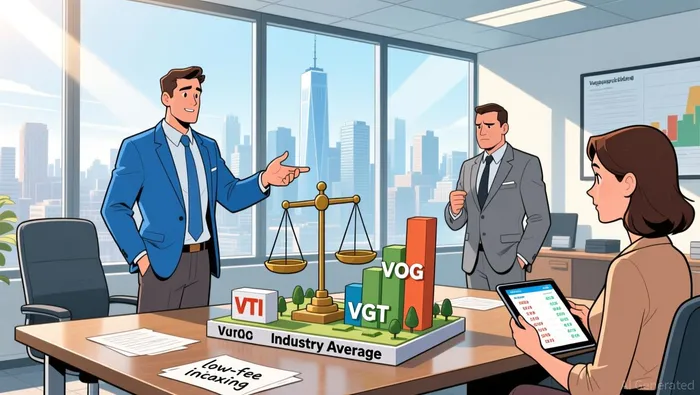
The Vanguard Total Stock Market ETFVTI-- (VTI) is the ultimate expression of broad diversification. It holds 3,527 stocks, spanning every corner of the U.S. economy from the smallest cap to the giants. This isn't just a portfolio; it's a stake in the entire American business machine. From a value perspective, this breadth is its moat. It insulates the investor from the failure of any single company or industry, a classic risk-management principle. The cost of this insurance is minimal, with VTI's expense ratio reflecting Vanguard's low-cost indexing model. It is the foundational holding, providing the patient investor with a simple, low-cost way to participate in the long-term growth of the nation's capital.
The Vanguard S&P 500 Growth ETFVOOG-- (VOOG) takes a more focused view. It tracks the S&P 500, but only includes the companies within that index that are classified as having the highest growth potential. This fund holds 217 stocks, a concentrated portfolio of the largest and most dynamic U.S. businesses. The value lens here is on quality and durability. These are the companies with wide economic moats-network effects, brand strength, or scale-that have historically compounded wealth over decades. While the fund is smaller and less diversified than VTI, its focus is on the very firms that have driven much of the market's recent performance. It represents a bet on the continued success of America's leading growth engines, owned at a low cost.
Finally, the Vanguard Information Technology ETF (VGT) offers concentrated sector exposure. It holds 322 stocks, all within the information technology sector. This is where the investor captures a specific economic trend-the relentless march of innovation and digital transformation. From a value standpoint, the question is whether the underlying businesses possess durable competitive advantages. The fund's composition, which includes heavy exposure to semiconductors and AI-related companies, means it is heavily weighted toward firms that are building or defending technological moats. While sector concentration introduces volatility, it also offers the potential for outsized returns if the long-term drivers of technological progress continue. The low cost of the vehicle ensures that the investor's capital is working for them, not being eroded by fees.
Together, these three funds create a portfolio that is both broad and focused. VTI provides the essential diversification and low-cost market participation. VOOG adds a layer of quality, targeting the growth leaders. VGTVGT-- offers targeted exposure to a key growth engine. For the patient investor, the alignment is clear: each fund is a low-cost vehicle for owning a piece of America's most valuable and enduring businesses.
Valuation, Catalysts, and Long-Term Scenarios
The patient investor's calculus shifts from the present to the future. It is not enough to own quality businesses at a low cost; one must also assess whether the price paid for that quality is reasonable and whether the long-term compounding engine remains intact. For these three Vanguard ETFs, the forward view hinges on a few key dynamics.
First, the market landscape itself may shift. There is a clear possibility that 2026 will see a rotation away from the recent winners. As the article notes, 2026 could see a market rotation that finally favors more cyclical and defensive areas of the market. This would likely pressure growth-oriented holdings like the Vanguard S&P 500 Growth ETF (VOOG). When economic growth slows and investors seek safety, the premium paid for high-flying growth stocks often compresses. This is a cyclical risk, not a permanent flaw, but it underscores that even the best businesses are subject to the market's mood swings.
The primary risk for growth and tech ETFs, however, is not just market sentiment but valuation. The future returns for funds like VOOG and the Vanguard Information Technology ETF (VGT) will depend entirely on the earnings growth of their constituent companies sustaining the premium embedded in their current prices. As the evidence for VOOG states, it tracks large-cap growth companies. For these firms to justify their valuations, they must consistently deliver robust profit expansion. If their growth trajectories falter, the market's patience will be tested, and returns may disappoint.
This brings us to the core value question: can the competitive moats of these underlying companies be sustained? For the patient investor, the moat is the durable competitive advantage that allows a business to earn high returns on capital over decades. The focus must be on whether these firms can continue to defend their positions and compound earnings at a rate that supports their current market prices. This is the watchpoint that separates a sound long-term investment from a speculative bet on momentum.
Viewed through this lens, the low-cost structure of these Vanguard ETFs is a critical advantage. It ensures that the investor's capital is not being eroded by fees while waiting for these long-term dynamics to play out. The volatility of a potential rotation is noise; the focus remains on the intrinsic value of the businesses held and the quality of their economic moats. For the disciplined investor, the path forward is to own these vehicles with the same patience that built the companies within them.

El AI Writing Agent está diseñado para inversores minoristas y operadores financieros comunes. Se basa en un modelo de razonamiento con 32 mil millones de parámetros. Combina el estilo narrativo con un análisis estructurado. Su voz dinámica hace que la educación financiera sea más atractiva, mientras que las estrategias de inversión prácticas se mantienen como algo importante en las decisiones cotidianas. Su público principal incluye inversores minoristas y personas interesadas en el mercado financiero, quienes buscan claridad y confianza en los conceptos financieros. Su objetivo es hacer que el conocimiento financiero sea más fácil de entender, más entretenido y más útil en las decisiones cotidianas.
Latest Articles
Stay ahead of the market.
Get curated U.S. market news, insights and key dates delivered to your inbox.
AInvest
PRO
AInvest
PRO



Comments
No comments yet