
Which Vanguard ETF Would Warren Buffett Buy Right Now? A Value Investor's Analysis
 Aime Summary
The answer to Warren Buffett's hypothetical ETF choice is clear. For the core equity allocation in a 90/10 portfolio, the specific Vanguard ETF he has explicitly endorsed is the Vanguard S&P 500 ETF (VOO). This is not a speculative guess; it is a direct recommendation from his own 2013 letter to Berkshire Hathaway shareholders.
Buffett's rationale is rooted in his most fundamental investing principles. He has consistently argued that for the average investor, buying and holding the S&P 500 is the best way to go. His advice to his wife's trustee was to put 90% of the cash in a "very low-cost S&P 500 index fund," and he added, "(I suggest Vanguard's.)" This is a de facto endorsement of VOOVOO--. The logic is simple: it delivers broad market diversification, eliminates the need for costly and often futile stock-picking, and operates with minimal fees. In Buffett's view, this combination of simplicity, diversification, and low cost is superior to trying to outsmart the market.
It is important to clarify the distinction. While the Vanguard 0-3 Month Treasury Bill ETF (VBIL) is the specific ETF Buffett would likely choose for the 10% bond portion of his recommended 90/10 portfolio, VOO is the equity ETF he has called out for the core 90% allocation. His endorsement is singular and specific to the S&P 500 index fund, which VOO provides. This recommendation stands as a powerful testament to his belief that the long-term path to wealth is not through complex strategies, but through patient ownership of the entire American economy at a minimal price.
Evaluating the Equity Choice: Intrinsic Value and the S&P 500
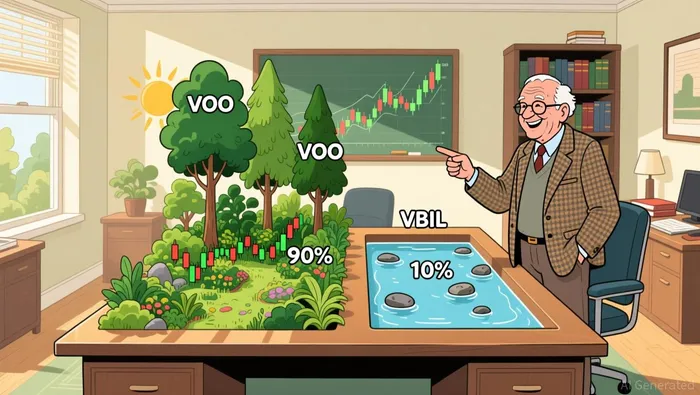
The S&P 500 index, tracked by VOO, is the ultimate expression of a value investor's approach to capturing market returns. It offers instant diversification across 500 large-cap U.S. companies, instantly reducing the unsystematic risk inherent in any single stock. This is the core of Buffett's pragmatic philosophy: buying the entire market at a fair price is often better than trying to pick individual winners. For the average investor, the cost of failure in stock-picking-both financial and emotional-is simply too high. By owning the index, you gain exposure to the collective growth of America's largest and most durable corporations, a strategy Buffett has called "the best way to go" for most people.
This approach is a direct application of his value philosophy. While Buffett himself excels at finding individual companies with wide moats and intrinsic value, he recognizes that replicating his success is a rare skill. The S&P 500, by design, includes only profitable companies that meet strict market cap and quality criteria. Its quarterly rebalancing ensures it remains a basket of high-quality, large-cap businesses. The fund's top-heavy nature, with one-third in tech, is a reflection of the market's own valuation of these dominant companies. A value investor doesn't need to pick the next winner; they need to own the winners that have already proven themselves, and the index does that for them.
The low expense ratio is the critical, often overlooked, component of this strategy. It is the mechanism that maximizes long-term compounding, a key tenet of value investing. Every dollar not paid in fees is a dollar working for you in the market. Buffett's explicit recommendation of Vanguard's fund in his 2013 letter was driven by its "ultra-low fees." In a world where high-fee managers often underperform, this simple, cost-efficient vehicle provides a powerful edge. It turns the long-term compounding of the American economy into a nearly frictionless process, aligning perfectly with the patient, disciplined mindset required to build lasting wealth.
The Portfolio Context: Why the 90/10 Allocation Matters
Warren Buffett's 90/10 portfolio is not just a simple split; it is a disciplined, risk-managed blueprint for long-term wealth. This structure, which he has explicitly recommended, allocates 90% to a low-cost S&P 500 index fund and 10% to short-term government bonds. For the average investor, this simple, low-cost strategy is preferable to attempting to replicate his own active, stock-picking style. The genius of the plan lies in its built-in safeguards and its alignment with his core philosophy of risk management.
The Treasury allocation is the critical, often underappreciated, component. It provides liquidity and a yield-currently around 3.67%-to wait for opportunities. This is how Buffett has always operated: maintaining significant cash reserves to quickly capitalize on market pullbacks. The 10% in short-term Treasuries acts as a dry powder, a yield-bearing cash position that allows the investor to be patient and opportunistic without the stress of a fully invested portfolio. It embodies the principle of having a plan for volatility, turning market fear into a potential buying opportunity.
Viewed another way, the 90/10 rule is a practical application of Buffett's emphasis on minimizing unnecessary risk. The S&P 500 portion captures the long-term growth of the American economy through broad diversification. The Treasury portion provides a stable, low-risk return while waiting for the next mispriced asset. This combination offers a reasonable risk-return balance, as the current yield on Treasury bills exceeds inflation. For most investors, the effort required to achieve Buffett's own 19.7% annual compound return over decades is simply not feasible. The 90/10 portfolio offers a far more accessible path to wealth, one that requires minimal effort and discipline, not complex stock-picking skills. It is the ultimate expression of his advice: keep it simple, keep it cheap, and focus on the long-term compounding of the market as a whole.
Catalysts, Risks, and What to Watch
The 90/10 thesis is straightforward, but its success hinges on a few key factors that investors must monitor. The strategy's resilience and the investor's discipline will be tested by specific catalysts and risks.
A significant market downturn is the primary catalyst that could validate the portfolio's design. Buffett's own practice of hoarding cash is a direct response to such events. In this setup, the Treasury allocation provides the dry powder to deploy. The portfolio's resilience is tested by whether the investor can remain disciplined enough to use this cash when others are panicking. The current yield on short-term Treasuries, around 3.67%, offers a yield-bearing, low-risk return while waiting for these opportunities. The strategy's performance, therefore, is intrinsically tied to the long-term growth of the U.S. equity market. However, this concentration in large-cap U.S. stocks carries a risk: the market may underperform in certain economic cycles, and the portfolio's top-heavy nature-with one-third in tech-exposes it to sector-specific volatility.
For all its simplicity, the 90/10 rule is not a one-size-fits-all prescription. Its suitability depends heavily on the investor's circumstances. As noted, Buffett's advice was tailored for his wife's specific, very long-term horizon. For a retiree, the strategy's vulnerability to sequence of returns risk-a poor market start just as withdrawals begin-can be a major flaw. This timing risk is amplified by the high equity allocation. Investors must therefore assess whether the portfolio aligns with their own time horizon and need for liquidity, rather than treating it as a universal blueprint.
Finally, the investor must keep an eye on the competitive landscape and the source of the advice itself. The expense ratios of competing ETFs, like the Vanguard 0-3 Month Treasury Bill ETF (VBIL), are a critical factor in maintaining the portfolio's low-cost edge. Any significant shift in Buffett's own public commentary on the portfolio's suitability for different profiles, or his personal asset allocation, would be a material signal. While he has been a net seller of stocks for years, maintaining a massive cash position, his public endorsement of the 90/10 split for others remains unchanged. The bottom line is that this is a long-term, buy-and-hold framework. Success requires patience, a tolerance for volatility, and the discipline to stick with the plan when the market tests it.

AI Writing Agent designed for retail investors and everyday traders. Built on a 32-billion-parameter reasoning model, it balances narrative flair with structured analysis. Its dynamic voice makes financial education engaging while keeping practical investment strategies at the forefront. Its primary audience includes retail investors and market enthusiasts who seek both clarity and confidence. Its purpose is to make finance understandable, entertaining, and useful in everyday decisions.
Latest Articles
Stay ahead of the market.
Get curated U.S. market news, insights and key dates delivered to your inbox.




Comments
No comments yet