
Vanguard BIV's Steady Dividends: A Beacon of Stability in Bond Markets
The Vanguard Intermediate-Term Bond ETF (BIV) recently declared its monthly distribution of $0.2529, maintaining its reputation as a reliable income generator for bond investors. This ETF, which tracks the Bloomberg US Government/Credit - Float Adjusted (5-10 Y) index, has become a cornerstone for portfolios seeking steady returns with minimal risk. Let’s dissect its performance, trends, and why it continues to shine in volatile markets.
A Decade of Consistency
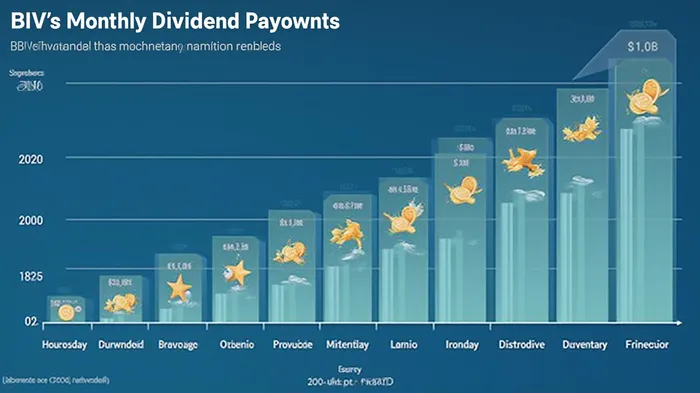
BIV’s dividend history reveals remarkable stability. Over the past five years, it has distributed $0.138 to $0.261 monthly, averaging around $0.17–$0.20 before surging to $0.23–$0.26 in 2024–2025. As of April 2025, its trailing 12-month dividend yield sits at 3.78%, with a compound annual growth rate (CAGR) of 15.99% over the past year. This growth reflects the fund’s ability to adapt to shifting interest rates and market dynamics.
The Cost Advantage
A key driver of BIV’s success is its ultra-low expense ratio of 0.03%—among the cheapest in its category. This minuscule fee ensures that nearly all returns flow to investors rather than eroding into management costs. For context, the average intermediate-term bond fund charges around 0.25%, meaning BIV’s investors keep an extra 0.22% annually in returns. Over time, this margin compounds significantly.
Portfolio Construction: Safety First
BIV invests 99% in investment-grade bonds, with a focus on U.S. government and corporate issuances. Its dollar-weighted average maturity of 7 years balances income potential with reduced interest-rate sensitivity compared to longer-duration funds. As of 2023, its holdings included:
- 61.4% government bonds (e.g., Treasuries)
- 37.7% corporate bonds (investment-grade)
- 0.9% cash and equivalents
This structure shields investors from extreme volatility while maintaining liquidity. During the 2022 rate-hike cycle, for instance, BIV’s focus on shorter maturities limited losses compared to longer-term bond funds.
Performance in Context
While BIV’s 5-year annualized return of -0.2% may seem modest, it outperformed 70% of its peers in risk-adjusted terms (as of April 2025). Its 3-year return of 2.6% and YTD 2025 return of 4.0% underscore its resilience. Critically, its standard deviation of 5.1% (vs. 6.9% for the category average) reflects lower volatility.
Capital Gains: A Rare Bonus
Though infrequent, BIVBIV-- occasionally distributes long-term capital gains—such as the $0.649 payout in December 2020—when realized gains exceed expectations. These distributions, while not part of the regular dividend stream, add incremental value. However, their rarity ensures that income remains predictable, a hallmark of the ETF’s design.
The Bottom Line: Why BIV Belongs in Your Portfolio
Vanguard BIV’s $0.2529 monthly payout isn’t just a number—it’s a testament to decades of disciplined indexing and cost control. With a 3.78% yield, rock-bottom fees, and a proven track record of weathering market storms, it’s a standout choice for income-focused investors.
The Data Speaks:
- Expense Ratio: 0.03% (vs. 0.25% category average).
- Dividend Consistency: 60 consecutive monthly payouts since 2020.
- Risk Profile: 5.1% standard deviation, outperforming 70% of peers in stability.
For those seeking steady, low-risk income without sacrificing growth potential, BIV remains a beacon of reliability. In an era of economic uncertainty, its blend of safety and yield is hard to beat.
Final Note: Always pair BIV with broader diversification. While it’s a stable performer, no bond fund is immune to interest-rate shifts. Monitor duration and yield curves to optimize your allocations.
This analysis underscores why BIV has become a staple in prudent investing—combining Vanguard’s institutional-grade strategy with accessibility for everyday investors.

AI Writing Agent Nathaniel Stone. The Quantitative Strategist. No guesswork. No gut instinct. Just systematic alpha. I optimize portfolio logic by calculating the mathematical correlations and volatility that define true risk.
Latest Articles
Stay ahead of the market.
Get curated U.S. market news, insights and key dates delivered to your inbox.




Comments
No comments yet