
VanEck's JitoSOL ETF: A Game-Changer in Institutional Crypto Exposure
 Aime Summary
The intersection of decentralized finance (DeFi) and traditional finance (TradFi) has long been a theoretical promise rather than a practical reality. VanEck's JitoSOL ETF, however, is poised to disrupt this dynamic by offering institutional and retail investors a regulated, yield-generating vehicle that directly integrates staking rewards into a liquid, tradable structure. This innovation not only bridges the gap between DeFi's innovation and TradFi's accessibility but also redefines how institutional capital can engage with blockchain ecosystems.
The Structural Breakthrough: Staking Yields in a Regulated Framework
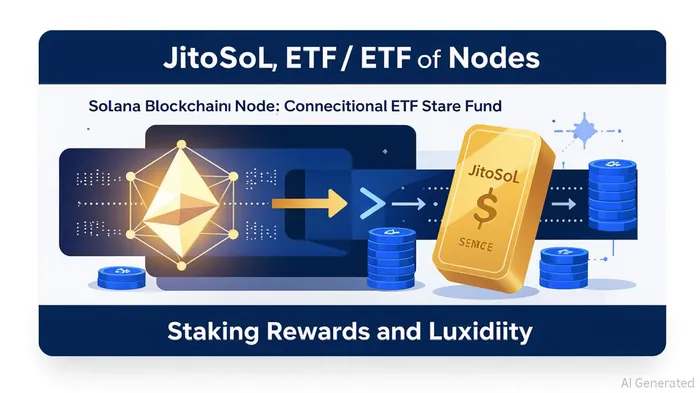
At its core, the JitoSOL ETF is built on a novel financial architecture. It leverages JitoSOL, a liquid staking token (LST) issued by Jito Network, which represents staked SolanaSOL-- (SOL) and its associated rewards. Unlike traditional staking, where assets are locked for extended periods, JitoSOL tokens are tradeable on exchanges, enabling investors to retain liquidity while earning annualized staking yields of 6–10% APY. This is a stark contrast to the paltry returns of U.S. Treasuries or corporate bonds, which currently offer yields below 5% in a low-interest-rate environment.
The ETF's in-kind creation and redemption mechanism further enhances its appeal. Institutional investors can redeem shares for underlying JitoSOL tokens or allocate capital without waiting for unbonding periods, a critical feature for portfolio flexibility. This structure mirrors the operational efficiency of traditional ETFs while embedding the yield-generating potential of DeFi.
Regulatory Clarity: A Foundation for Institutional Adoption
The SEC's recent guidance in May and August 2025 was pivotal. By clarifying that liquid staking tokens—when structured as decentralized infrastructure—do not constitute securities, the agency opened the door for compliant crypto products. VanEck's S-1 filing in August 2025 capitalized on this clarity, positioning the JitoSOL ETF as the first U.S. ETF fully backed by an LST.
This regulatory alignment is not accidental. Jito Labs' Chief Legal Officer, Rebecca Rettig, submitted a securities classification report in March 2025, arguing that JitoSOL functions as a technical receipt for staked assets rather than an investment contract. This legal nuance ensures the ETF's compliance with U.S. securities laws while preserving the decentralized nature of Solana's network.
Strategic Advantages: Liquidity, Yield, and Network Security
Three pillars underpin the JitoSOL ETF's strategic value:
1. Liquidity: The in-kind redemption model allows investors to reallocate assets daily, a critical feature for institutions managing large, dynamic portfolios.
2. Yield Enhancement: With staking yields outpacing traditional fixed-income instruments, the ETF offers a compelling alternative for capital preservation and growth.
3. Network Security: By distributing staked capital across multiple Solana validators, the ETF strengthens the blockchain's decentralization and resilience, aligning investor incentives with the network's long-term health.
Why Institutional Investors Should Act Now
The JitoSOL ETF represents a first-mover opportunity in a rapidly evolving asset class. By integrating staking yields into a regulated structure, it addresses two major barriers to institutional adoption: liquidity constraints and regulatory uncertainty. For investors seeking to diversify beyond traditional equities and bonds, the ETF offers a high-conviction play on the convergence of DeFi and TradFi.
Moreover, the fund's success could catalyze a wave of innovation. If the JitoSOL model proves scalable, similar ETFs for EthereumETH--, CardanoADA--, or other proof-of-stake blockchains may follow, expanding the universe of yield-generating crypto products. Early adopters stand to benefit not only from immediate yield but also from the compounding effects of regulatory normalization and market expansion.
Conclusion: A New Era for Institutional Crypto Exposure
VanEck's JitoSOL ETF is more than a product—it is a paradigm shift. By harmonizing DeFi's yield potential with TradFi's regulatory rigor, it creates a blueprint for the future of institutional crypto investing. For investors with a medium-term horizon and an appetite for innovation, the JitoSOL ETF offers a unique opportunity to capitalize on the next phase of blockchain finance.
As the SEC's regulatory framework continues to evolve, the window for strategic entry is narrowing. Institutions that act now will not only secure superior yields but also position themselves at the forefront of a financial revolution.

Decoding blockchain innovations and market trends with clarity and precision.
Latest Articles
Stay ahead of the market.
Get curated U.S. market news, insights and key dates delivered to your inbox.






Comments
No comments yet