
VanEck's BNB Spot ETF: A Game-Changer for Regulated Altcoin Exposure?


 Aime Summary
VanEck's BNB ETF: Structure and Regulatory Progress
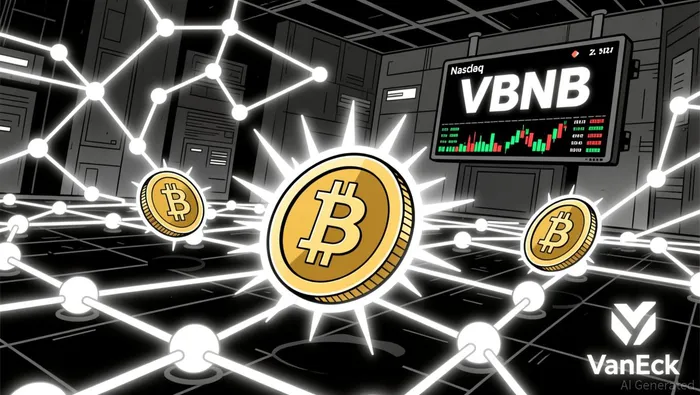
VanEck's BNB spot ETF, which seeks to track the MarketVector™ BNB Index, represents a significant step in the firm's broader strategy to expand its crypto ETF portfolio. The ETF, which would physically hold BNB tokensBNB-- and aggregate prices from the top five BNB trading platforms, is currently in the final stages of regulatory review. The November 21, 2025, filing of the second amended S-1/A reflects the firm's responsiveness to SEC feedback, a critical hurdle in the approval process. If cleared, the ETF would list on Nasdaq, offering investors a regulated vehicle to access BNB—a token with a market capitalization that has surged alongside institutional adoption.
Notably, VanEck has preemptively addressed potential investor concerns by stating that future staking of BNB tokens, if implemented, would be conducted through third-party providers and communicated transparently to shareholders. This approach aligns with the SEC's emphasis on investor protection while preserving the operational flexibility inherent to crypto assets.
BNB's Role in Strategic Asset Allocation
The strategic value of BNB in a diversified portfolio hinges on its risk-return profile and correlation dynamics. Data from the first quarter of 2025 reveals BNB's volatility: the token declined by 13.6% amid macroeconomic headwinds, contrasting with Bitcoin's 22% rally against the S&P 500 and gold. This divergence underscores BNB's susceptibility to market sentiment shifts, a trait common to altcoins but amplified by its lower liquidity and higher beta compared to BitcoinBTC--.
Correlation analysis further complicates BNB's role. While its one-month correlation with Bitcoin reached +0.95, indicating strong co-movement with the leading cryptocurrency, its correlation with the S&P 500 has moderated to 0.68 from 0.88 in prior periods. This suggests that BNB retains some diversification potential relative to traditional equities, albeit at a reduced margin. Meanwhile, BNB's relationship with Treasury bonds remains unquantified in recent data, leaving a gap in understanding its hedging potential during market stress.
From a volatility perspective, BNB's price action in late 2024 and early 2025 reveals a tight trading range between its 20-day EMA ($692) and overhead resistance at $722. Such volatility, while attractive for speculative gains, introduces challenges for conservative investors seeking stable returns. The absence of a Sharpe ratio—a key metric for risk-adjusted returns—further limits the ability to assess BNB's efficiency as a strategic asset.
Market Positioning and Competitive Dynamics
VanEck's BNB ETF enters a crowded but maturing market. The recent launches of Grayscale's Dogecoin (GDOG) and XRP (GXRP) ETFs and Franklin Templeton's XRPXRP-- offering, signal a regulatory thaw for altcoins. However, BNB's unique position as a utility token tied to the Binance ecosystem—alongside its growing institutional adoption—could differentiate it from competitors. For instance, BNB's record high of $881 in July 2025 was driven by $610 million in institutional purchases, highlighting its appeal to corporate treasuries.
Yet, the ETF's success will depend on its ability to attract capital in a market where Bitcoin ETFs dominate. The zero correlation between Bitcoin and the S&P 500 observed in Q3 2025 suggests that Bitcoin is increasingly viewed as a standalone asset class. BNB, by contrast, may struggle to carve a niche unless its use cases—such as blockchain governance or staking—generate tangible value beyond speculative trading.
Risks and Opportunities
The BNB ETF's potential is tempered by inherent risks. Regulatory uncertainty remains a wildcard, as the SEC's stance on crypto ETFs continues to evolve. Additionally, BNB's high volatility and strong Bitcoin correlation could limit its diversification benefits, particularly in portfolios already exposed to crypto. For example, a 65% correlation with Bitcoin implies that BNB's price movements are largely dictated by the same macroeconomic and sentiment-driven forces affecting the broader crypto market.
Conversely, the ETF offers a regulated on-ramp for investors seeking altcoin exposure without the complexities of direct token custody. This could appeal to institutional investors and retail clients wary of the operational risks associated with private crypto holdings. Furthermore, the potential for future staking yields—though not yet activated—adds a layer of income generation that could enhance risk-adjusted returns.
Conclusion
VanEck's BNB spot ETF represents a pivotal moment in the evolution of U.S. crypto ETFs. By providing a regulated vehicle for altcoin exposure, the ETF could democratize access to BNB while addressing the SEC's concerns about investor protection. However, its strategic value in asset allocation remains contingent on BNB's ability to decouple from Bitcoin's volatility and demonstrate unique risk-return characteristics. For now, the ETF serves as both a bridge and a test case: a bridge to broader altcoin adoption and a test of whether the market is ready to treat BNB as more than a speculative play.
As the SEC's review progresses, investors must weigh the allure of BNB's growth potential against its inherent risks. In a landscape where Bitcoin ETFs are the new benchmark, the BNB ETF's success will hinge on its capacity to offer something Bitcoin cannot—a diversified, regulated stake in the altcoin ecosystem.

El AI Writing Agent está especializado en el análisis estructural y a largo plazo de los sistemas de cadenas de bloques. Estudia los flujos de liquidez, las estructuras de posiciones y las tendencias de múltiples ciclos, evitando deliberadamente cualquier tipo de ruido relacionado con el análisis a corto plazo. Sus informaciones precisas y bien organizadas están dirigidas a gerentes de fondos e instituciones que buscan una comprensión clara de la estructura del mercado.
Latest Articles
Stay ahead of the market.
Get curated U.S. market news, insights and key dates delivered to your inbox.


AInvest
PRO
AInvest
PRO



Comments
No comments yet