
VanEck 2025 Outlook: Emerging Opportunities in Technology-Driven Sectors
 Aime Summary
AI: The Engine of Productivity and Energy Demand
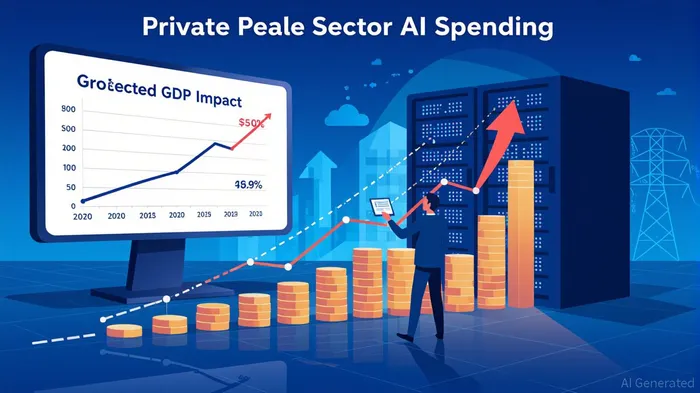
Artificial intelligence has emerged as the linchpin of economic transformation, with private sector spending on AI infrastructure surging to over $50 billion annually. This capital influx is projected to add $10 trillion to U.S. GDP over the next decade, though it comes with a critical caveat: energy consumption. Data centers alone now account for 2% of global electricity use, and their demand is expected to grow exponentially as AI adoption expands beyond tech giants into healthcare, finance, and manufacturing according to a reality check on energy and economic impacts.
 VanEck's focus on semiconductors and edge computing-key enablers of AI processing-aligns with this trajectory. The firm's Fabless Semiconductor ETFSMHX-- (SMHX) offers exposure to companies like NVIDIANVDA-- and AMDAMD--, whose chips power AI inference and real-time analytics as predicted in 2025 tech investing outlook. However, the energy demands of AI infrastructure are forcing Big Tech firms such as Meta and Google to diversify their power sourcing strategies. These companies are now investing in a mix of gas-fired plants, nuclear energy, and renewables to ensure 24/7 reliability for data centers as reported by Reuters. This shift underscores the growing interdependence between AI and energy sectors, a dynamic VanEck has long anticipated.
Educational systems are also adapting to AI's rise. Over $500 billion in global up-skilling initiatives now prioritize digital and AI literacy, with universities partnering with tech firms to bridge skill gaps according to Holoniq's Q1 2025 education trends. For instance, 60% of educators already use AI in classrooms, leveraging it for personalized learning and content creation as reported by Digital Learning Institute. These developments suggest that AI's economic impact will be sustained, not just by capital investment but by a workforce increasingly equipped to harness its potential.
Cybersecurity: The Unseen Pillar of Digital Resilience
As AI reshapes industries, it also amplifies cybersecurity risks. A 2025 PwC survey found that 77% of companies globally plan to increase cyber budgets, with 36% prioritizing AI-driven security initiatives such as threat hunting and agentic AI as reported in PwC digital trust insights. Yet, skill shortages remain a bottleneck: 50% of organizations cite a lack of expertise in AI-based cyber defense as a major challenge as reported in the same PwC digital trust insights.
VanEck's emphasis on cybersecurity as a strategic sector reflects this duality of opportunity and vulnerability. The firm highlights AI-powered solutions as essential for real-time threat detection, particularly in financial services and critical infrastructure as noted by Equities.com. Its Digital Transformation ETF includes exposure to cybersecurity firms leveraging machine learning to automate incident response and predictive analytics.
Workforce development is equally critical. Cybersecurity hiring trends in 2025 emphasize both technical skills (e.g., cloud security, data analysis) and non-technical competencies like problem-solving and teamwork as detailed by ISC2. Educational institutions are responding by integrating NIST Cybersecurity Framework standards into curricula and expanding work-integrated learning programs. These efforts align with VanEck's thesis that long-term investment in cybersecurity must account for both technological and human capital.
Renewable Energy: Powering the AI Economy Sustainably
The renewable energy sector faces a paradox: it must scale rapidly to meet AI-driven electricity demand while overcoming supply constraints. Solar capacity additions in 2024 reached 38.4 gigawatts, surpassing hydropower and nuclear to become the fourth-largest energy source as reported in Deloitte's 2025 outlook. However, short-term reliance on natural gas and long-term bets on nuclear energy-particularly small modular reactors (SMRs)-are becoming necessary to meet 24/7 power needs according to energy analytics.
VanEck's Uranium+Nuclear Energy ETF (NLR) positions investors to capitalize on this transition. The firm notes that SMRs, with their modular design and lower capital intensity, are ideal for powering data centers and industrial AI operations as predicted in 2025 tech investing outlook. Meanwhile, AI itself is being deployed to optimize renewable energy supply chains, reducing costs and improving grid efficiency as noted in Deloitte's 2025 outlook.
Policy tailwinds further reinforce this sector's potential. Legislative efforts like the U.S. CHIPS Act and global infrastructure investments are accelerating the energy transition, particularly in Asia and North America as reported in VanEck's 2025 outlook. As Deloitte notes, the renewable energy industry's ability to align with AI's energy demands will determine its long-term viability as reported in Deloitte's 2025 outlook.
Macro Alignment and Strategic Diversification
VanEck's 2025 strategies are not only sector-specific but also macro-aligned. The firm advocates for diversification across thematic ETFs to mitigate risks from inflationary pressures and fiscal uncertainty. Gold and BitcoinBTC--, for instance, are positioned as hedges against de-dollarization and rising deficits as noted in VanEck's 2025 investment outlook. This approach reflects a broader recognition that technology-driven sectors must be balanced with traditional safe-haven assets.
Moreover, the firm's focus on infrastructure financing-highlighted in July 2025 market recaps-underscores its confidence in the convergence of AI, cybersecurity, and energy. Private equity firms like Blackstone and KKR are already funding projects that support these sectors, signaling strong institutional alignment as reported in VanEck's July market recap.
Conclusion
VanEck's 2025 outlook is a masterclass in strategic reallocation. By targeting AI, cybersecurity, and renewable energy, the firm is not only capitalizing on immediate growth but also addressing the structural challenges of energy demand, digital security, and workforce readiness. As macroeconomic trends and educational curricula evolve in tandem with these sectors, investors are increasingly positioned to benefit from a future where technology and sustainability are inextricably linked.

Blending traditional trading wisdom with cutting-edge cryptocurrency insights.
Latest Articles
Stay ahead of the market.
Get curated U.S. market news, insights and key dates delivered to your inbox.




Comments
No comments yet