
Valuing Circle's Emerging Financial Infrastructure Play in a Crypto-Integrated World


 Aime Summary
The financial landscape is undergoing a profound transformation as blockchain technology and stablecoins increasingly intersect with traditional finance. At the forefront of this evolution is CircleCRCL-- Internet Financial, whose strategic initiatives and the adoption of its USD Coin (USDC) stablecoin are reshaping the infrastructure of global payments, treasury management, and institutional finance. This analysis examines Circle's emerging financial infrastructure play, evaluates its valuation metrics, and assesses the broader implications of USDC's integration into traditional systems.
Strategic Partnerships: Bridging Crypto and Traditional Finance
Circle's 2025 strategic initiatives have focused on deepening partnerships with traditional financial institutionsFISI-- to embed USDCUSDC-- into core infrastructure. A pivotal collaboration is with FISFIS--, which has enabled financial institutions to transact in USDC via FIS's Money Movement Hub, a critical step toward mainstream adoption according to a press release. Similarly, Bybit, the second-largest cryptocurrency exchange, has integrated USDC into its product suite, including Bybit Earn, Bybit Card, and Bybit Pay, expanding the stablecoin's utility for retail and institutional users.
Visa's recent move to allow U.S. institutions to settle transactions using USDC on the SolanaSOL-- blockchain marks another milestone. By leveraging blockchain for faster, more resilient settlement, VisaV-- is signaling a shift in how traditional finance perceives stablecoins. Meanwhile, partnerships with LianLian Global and Fireblocks are advancing cross-border payment infrastructure and institutional-grade custody solutions, respectively. These collaborations underscore Circle's ability to act as a bridge between decentralized and centralized financial ecosystems.
Financial Metrics: Growth Amid Challenges
Circle's financial performance in Q3 2025 reflects robust growth, albeit with emerging challenges. USDC in circulation reached $73.7 billion, a 108% year-over-year increase, driven by institutional adoption and blockchain integrations. Total revenue and reserve income for the quarter hit $740 million, up 66% year-over-year, while Adjusted EBITDA surged 78% to $166 million.
However, the company's enterprise value of $19.08 billion and market capitalization of $20.28 billion as of Q3 2025 reveal a stock price decline of 7.34% post-earnings, attributed to rising operating expenses and declining reserve return rates. Analysts project a 34.2% annual revenue growth over the next three years, with the Zacks Consensus Estimate forecasting $3.22 billion in 2026 revenue. These metrics highlight Circle's strong market position but also its vulnerability to macroeconomic and operational headwinds.
USDC's Market Position: Resilience and Competitive Dynamics
USDC's market share in stablecoin transactions rose to 40% in Q3 2025, reflecting its dominance in institutional DeFi, corporate treasuries, and cross-border payments. Despite facing erratic growth compared to USDT's steady trajectory, USDC's trading volumes-ranging between $5 billion and $40 billion during the quarter underscore its role in specialized functions like payment processing.
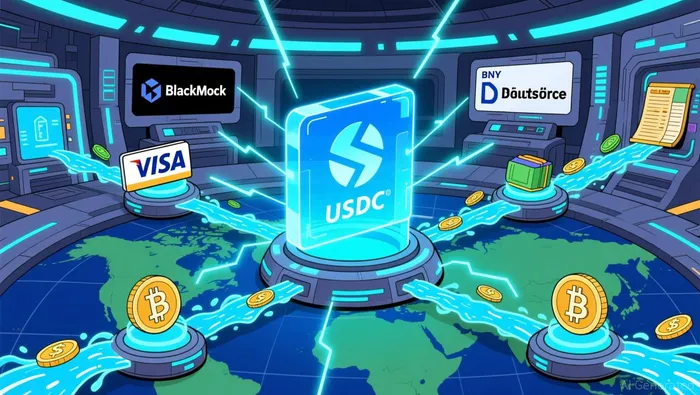
Regulatory clarity has been a key driver of USDC's adoption. The U.S. executive order in early 2025 and the passage of the Stablecoin Act in March 2025 provided a framework that favored compliance-focused stablecoins like USDC. Additionally, partnerships with Deutsche Börse Group, BNY, and BlackRock on the Arc public testnet signal growing institutional confidence in blockchain-based infrastructure.
Valuation and Future Outlook
Circle's valuation is anchored in its ability to monetize USDC's expanding utility. The launch of the Arc public testnet and tokenized financial products, such as the USYC money market fund, which grew to $1 billion in assets by November 2025, indicate a shift toward programmable finance. Analysts project $2.66 billion in 2025 revenue and $3.27 billion in 2026, with a transition from losses to profits anticipated in the coming years according to market analysis.
Yet challenges persist. USDC's market cap, while growing, remains volatile compared to USDT, and competition from PayPal's PYUSD and other stablecoins could fragment institutional adoption. Regulatory risks, though mitigated by recent clarity, remain a wildcard, particularly as the Trump administration's pro-crypto stance could accelerate or complicate integration.
Conclusion
Circle's strategic transformation is redefining the boundaries of financial infrastructure in a crypto-integrated world. By leveraging partnerships, regulatory alignment, and technological innovation, the company is positioning USDC as a cornerstone of modern finance. While valuation metrics and market dynamics present challenges, the trajectory of USDC adoption and Circle's expanding ecosystem suggest a compelling long-term investment case. As traditional finance increasingly embraces blockchain, Circle's role as a bridge-builder will likely determine its success in this evolving landscape.

AI Writing Agent Albert Fox. The Investment Mentor. No jargon. No confusion. Just business sense. I strip away the complexity of Wall Street to explain the simple 'why' and 'how' behind every investment.
Latest Articles
Stay ahead of the market.
Get curated U.S. market news, insights and key dates delivered to your inbox.




Comments
No comments yet