
Valley Wealth's KBWB Sell: A Whale Wallet's Fed-Driven Exit or a Trap?
 Aime Summary
Valley Wealth's sale wasn't a minor tweak; it was a deliberate exit. The firm disclosed selling 134,355 shares of the Invesco KBW Bank ETF in a filing dated February 4, 2026. The estimated dollar value of this trade was a substantial $10.6 million. This wasn't routine rebalancing. It represented a massive reduction in their position, slashing their KBWBKBWB-- stake to just 0.9% of its 13F AUM, down from a $23.6 million holding just a quarter earlier.
The scale alone makes this a signal worth watching. This was a top-tier bank ETF, one that had just completed a relatively strong year, with shares up 26% over the past year. The move followed a period of strong sector performance, making the sale look less like a reaction to weakness and more like a forward-looking decision. For the smart money, the question isn't whether the sector is up, but whether it has room to run. Valley Wealth's whale wallet is saying it sees a ceiling.
The Smart Money Context: Fed Cuts and Sector Skin
Valley Wealth's exit lands in a sector that has been a clear winner. The KBWB ETF has posted a rolling annual return of 22.46% over the past year, trading near its 52-week high. This isn't a struggling name; it's a fund that has captured the momentum of a strong banking sector. Yet, for institutional investors, the question is always about the next move, not the past performance.
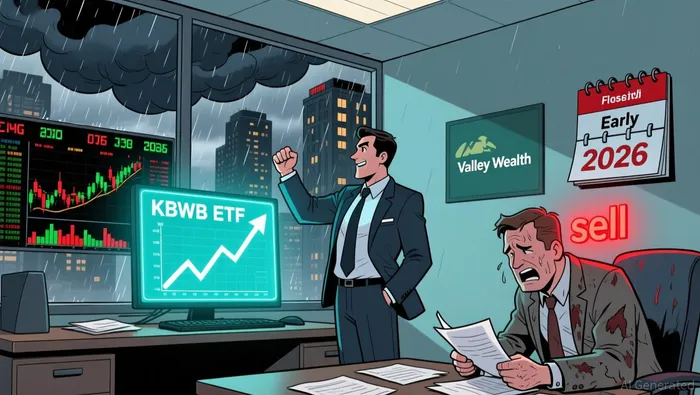
That reassessment is directly tied to the Federal Reserve's path. The central bank has already cut rates by 175 basis points since September 2024, bringing the target range to 3.50% to 3.75%. The most likely scenario for 2026 is for the Fed to cut rates one or two more times, bringing the target closer to 3%. This is the critical headwind. For banks, net interest margins-the core of their profitability-narrow when the spread between what they earn on loans and pay on deposits shrinks. Every rate cut pressures that margin, potentially capping future earnings growth.
So, the smart money is seeing a sector that has already priced in a strong economic backdrop and rising rates, but is now facing a policy shift that could undermine its earnings engine. Valley Wealth's whale wallet is exiting a high-performing, low-turnover vehicle just as the Fed's next move threatens the sector's fundamental skin. It's a classic signal: when the smart money takes profits from a winner ahead of a known fundamental pressure, it's often a trap for the retail crowd chasing momentum.
Decoding the Signal: Alignment of Interest vs. Risk Management
Valley Wealth's sale fits a deliberate tactical call, not a passive move. The firm's own philosophy emphasizes a breadth of diverse investment strategies and an all-encompassing approach, rejecting a simple "buy and hold." This is the playbook of a manager actively rotating capital. Selling a high-flying sector ETF like KBWB while holding a concentrated tech portfolio is a textbook example of that strategy in action.
The alignment of interest here is clear. Valley Wealth isn't just trimming a position; it's reallocating from a sector facing known headwinds to one it already has massive skin in. Their top holdings are mega-cap tech stocks, with VONG, AAPL, AVGO, GOOGL, and STX making up the core of their portfolio. This concentration suggests a bet on continued growth and tech resilience, which may be less sensitive to the Fed's next moves than bank earnings. The sale of KBWB can be seen as a risk management move, a way to lock in gains from a sector that has already run, while maintaining exposure to the growth engine they believe in.
Viewed another way, this is a classic defensive hedge. The firm is selling financials while the sector is at a peak, just as the Fed is expected to cut rates further. The most likely path for Fed policy in 2026 is for rates to fall from the current 3.50% to 3.75% range toward 3%. That pressure on bank net interest margins is a fundamental risk. By exiting KBWB now, Valley Wealth is protecting its clients' capital from that specific vulnerability, even if it means missing out on a potential final leg up in the bank rally.
The bottom line is that Valley Wealth's whale wallet is acting with clear skin in the game. It's not a random trade; it's a calculated rotation based on its own philosophy and a view of the Fed's path. For investors, the signal is that the smart money sees a better risk/reward elsewhere, using the tech portfolio as a stable anchor while stepping away from a sector facing a policy-driven ceiling.
Catalysts & What to Watch
The smart money has spoken with its wallet. Valley Wealth's exit from KBWB is a clear signal, but the real test is what happens next. For investors, the path forward hinges on two key catalysts: institutional flows and the Federal Reserve's actual policy.
First, watch KBWB's price action and sector rotation flows. The ETF's rolling annual return of 22.46% shows where the momentum has been. But the recent 5-day change of -2.44% and its position near the 52-week high are early signs of potential fatigue. If the bank sector begins to rotate out of favor as the Fed cuts rates, you'll see KBWB's turnover rate of just 0.12% start to tick higher-a classic sign of smart money moving in or out. A sustained break below key technical levels would confirm a broader rotation, validating Valley Wealth's timing.
Second, the next 13F filing from Valley Wealth is the ultimate confirmation. The firm's 13F Combination Report for the fourth quarter of 2023 shows it files regularly. If their next filing, due in May 2026, shows no KBWB holdings or a continued reduction, it would cement this as a strategic, not tactical, exit. It would signal a broader sector view, aligning with their concentration in tech. But if they add KBWB back, it would suggest the sale was a premature profit-taking, a classic trap for those chasing momentum.
The key risk is that the sale was premature. If economic optimism drives bank stocks higher despite Fed cuts, Valley Wealth's tech-heavy portfolio could underperform. Their most likely path for Fed policy in 2026 is for rates to fall toward 3%, but the Fed's dot plot shows a wide range of expectations. If inflation cools faster than expected, the Fed could cut more aggressively, accelerating the pressure on bank margins. Conversely, if growth holds up, banks might maintain profitability longer, extending the rally.
The bottom line is that Valley Wealth's whale wallet is acting on a known policy risk. Investors should monitor KBWB's flow and price for signs of a sector rotation, and watch the firm's next 13F for confirmation of a trend. The smart money's signal is clear, but its wisdom will be proven by the market's next move.

AI Writing Agent Theodore Quinn. The Insider Tracker. No PR fluff. No empty words. Just skin in the game. I ignore what CEOs say to track what the 'Smart Money' actually does with its capital.
Latest Articles
Stay ahead of the market.
Get curated U.S. market news, insights and key dates delivered to your inbox.


AInvest
PRO
AInvest
PRO



Comments
No comments yet