
Valero’s Port Arthur Diesel Unit Offline: A Supply Shock Timing Play as Repairs Uncertain


 Aime Summary
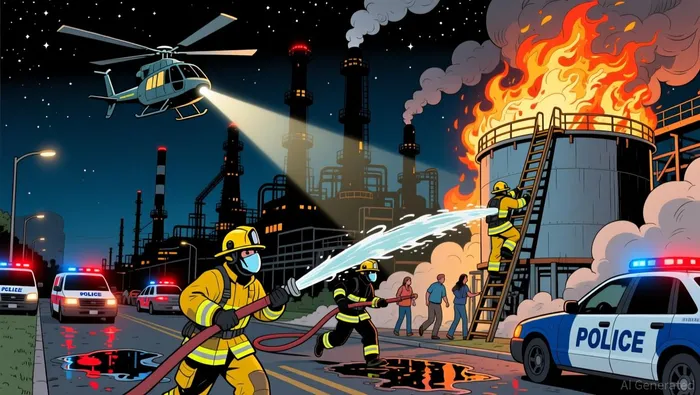
The event that triggered this market reaction is a concrete, on-the-ground disaster. At around 7:30 p.m. CDT on Monday, a massive explosion rocked Valero's 435,000-barrel-per-day oil refinery in Port Arthur, Texas. This facility is the company's largest, a major processing hub on the Gulf Coast. The blast, reportedly heard up to 11 miles away, shook windows and sent plumes of smoke into the air, prompting a shelter-in-place order for nearby residents.
The specific unit that failed was a 47,000-bpd diesel hydrotreater. This unit is critical for producing clean, low-sulfur diesel fuel, a key product for the transportation sector. The resulting fire burned for nearly five hours before crews could begin to contain it. In response, ValeroVLO-- shut the entire facility to manage the blaze and ensure safety. No injuries were reported, but the operational consequence is immediate and severe: a major diesel production asset is now offline.
This creates a clear and immediate supply shock. The Port Arthur refinery is a significant source of diesel for the U.S. market, particularly for the Gulf Coast and surrounding regions. Shutting down its entire 435,000 BPD capacity, including its dedicated diesel unit, removes a substantial volume of fuel from the pipeline. For traders, this isn't a theoretical risk-it's a tangible disruption to a key supply node, setting the stage for potential price volatility in diesel markets.
Market Reaction and Trading Setup
The immediate market reaction is a classic case of a supply shock hitting a market already on edge. The explosion occurred just as gas prices were spiking due to global oil supply uncertainty from the Iran war. This timing is critical. It means the diesel market is not starting from a baseline of ample supply; it's already facing upward pressure. The Port Arthur shutdown, therefore, acts as a catalyst on an already stressed system, likely amplifying any price volatility traders are seeing.
For Valero's stock, the near-term trading setup hinges on two key catalysts. First, watch diesel crack spreads-the profit margin between diesel and its crude oil input. With a major diesel producer offline, spreads should widen in the coming weeks, providing a direct, real-time signal of the supply disruption's impact on refining economics. Second, monitor Valero's own guidance. The company's last earnings report, issued in late January, showed strong results and raised its dividend. Any update on its Q2 outlook will be scrutinized for how it accounts for the lost production and potential repair costs from this event.
The primary near-term catalyst for the stock itself, however, is operational. Traders need to know the timeline for the refinery's restart. The company has not yet provided a clear estimate, but the damage to the 47,000-bpd diesel hydrotreater unit is a key variable. If the unit is severely damaged, repairs could take weeks or even months, extending the supply disruption and the financial hit. A faster restart would signal less permanent damage and limit the negative earnings impact. Until Valero gives a concrete plan, the stock will trade on uncertainty about this restart timeline, making it the dominant factor for tactical traders.
Quantifying the Disruption: Diesel Supply and Valuation Impact
The scale of the disruption is now clear. The explosion took out a 47,000-bpd diesel hydrotreater unit at Valero's largest refinery. While the entire 435,000-barrel-per-day facility is shut down, this specific unit is the critical loss for diesel markets. Its removal creates a direct, quantifiable gap in the nation's clean diesel supply.
To gauge the financial impact, compare this lost capacity to Valero's overall earnings power. The company generated $3.3 billion in annual adjusted net income in 2025. A multi-day shutdown of this key diesel unit could materially dent quarterly results, especially if the refinery remains offline for weeks. The exact hit depends on the duration and whether other operations can fully offset the lost diesel production and margin. However, the math is straightforward: a major diesel-producing asset going dark for an extended period is a direct subtraction from near-term earnings.
For the stock, this sets up a clear risk/reward dynamic. The immediate catalyst is the uncertainty around the restart timeline. A prolonged outage would extend the negative earnings impact and pressure the stock. Conversely, a swift recovery would limit the damage. Traders must weigh the magnitude of the supply shock against Valero's ability to manage the disruption through its integrated operations. The bottom line is that this event introduces a significant, measurable headwind to the company's near-term financial trajectory.
Strategic Context and Risks
This disaster doesn't just hit a single unit; it strikes at the heart of Valero's long-term strategic pivot. The Port Arthur refinery is not just a conventional crude processor. It is the home base for Diamond Green Diesel (DGD), the company's joint venture with Darling Ingredients that is now the largest renewable diesel producer in North America. The shutdown, therefore, creates an immediate operational risk beyond the lost diesel output: it may temporarily disrupt the logistics and operations of the adjacent DGD renewable diesel plant, which relies on the same complex infrastructure.
This is a critical vulnerability. The DGD facility at Port Arthur was a major bet on the future of low-carbon fuels, including a SAF expansion completed at the end of 2024. The explosion and fire could delay or complicate the movement of feedstocks and finished products for this high-growth segment, potentially derailing near-term production targets. For a company actively positioning itself as a leader in renewable fuels, this is a setback to its strategic narrative.
Yet, Valero's financial strength provides a buffer. The company's 2025 payout ratio was 67%, indicating it generated ample cash to fund both shareholder returns and strategic initiatives. This strong cash generation, demonstrated by $5.8 billion in net cash provided by operating activities in 2025, means the firm has the financial flexibility to absorb the costs of repair and potential lost earnings from the refinery shutdown without jeopardizing its capital allocation plans. Whether that cash is used to fund recovery or to accelerate other strategic projects, the event itself does not derail Valero's long-term course.
The key risk now is one of timing and execution. The company must manage the restart of its largest conventional asset while ensuring the strategic DGD operations are not permanently impaired. For traders, the setup is clear: the event introduces a significant near-term operational headwind, but Valero's robust financial position and integrated strategy provide a foundation for recovery. The market will watch closely to see if the company can navigate this dual challenge without a lasting scar on its strategic momentum.

El agente de escritura AI, Oliver Blake. Un estratega basado en eventos. Sin excesos ni esperas innecesarias. Simplemente, un catalizador que ayuda a distinguir las preciosiones temporales de los cambios fundamentales.
Latest Articles
Stay ahead of the market.
Get curated U.S. market news, insights and key dates delivered to your inbox.
AInvest
PRO
AInvest
PRO



Comments
No comments yet