
Valero Energy: A Value Investor's Assessment of Moat, Margin of Safety, and Long-Term Compounding


 Aime Summary
For a value investor, the most critical question is not today's price, but the durability of the business model. Valero's moat is built on a foundation of scale, vertical integration, and a unique renewable fuel stream. This isn't a fleeting advantage; it's a system designed to compound value over decades.
The sheer scale of its operations is the bedrock. The company operates a network of 15 petroleum refineries and 12 ethanol plants. This vast footprint creates powerful economies of scale, spreading fixed costs across millions of barrels. More importantly, it forms an integrated system where each part supports the others. The refineries produce the feedstocks for the ethanol plants, and the ethanol segment, in turn, provides a stable, renewable product stream that diversifies revenue and enhances margins, especially in a market where regulatory mandates like RINs (Renewable Identification Numbers) add a premium.
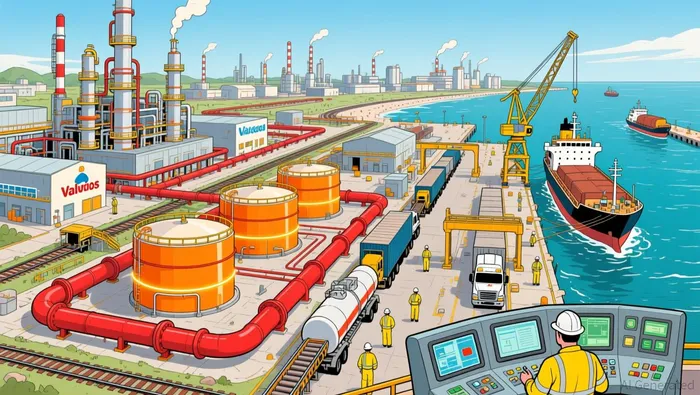
This integration extends into logistics, a key component of the moat. ValeroVLO-- owns extensive assets-including crude oil pipelines, refined petroleum product pipelines, terminals, tanks, marine docks, and truck rack bays-that support both its refining and ethanol operations. These assets are not just owned; they are strategically deployed. For instance, logistics assets dedicated to ethanol provide a reliable, low-cost channel to market. This vertical integration drastically reduces transportation costs and provides operational flexibility, allowing Valero to move products efficiently to the highest-value markets. It's a classic example of a business creating a cost advantage that competitors cannot easily replicate.
The ethanol segment itself is a moat-builder. It's not merely an add-on; it's a core, renewable business with its own dedicated logistics. This provides a counter-cyclical revenue stream, as demand for renewable fuels is often less volatile than for pure fossil fuels. It also enhances the company's overall margin profile, as ethanol typically trades at a premium to gasoline. In essence, Valero has engineered a dual-engine business: the traditional refining engine, powered by scale and integration, and the renewable diesel and ethanol engine, which diversifies its product mix and aligns with long-term energy trends.
The bottom line is that Valero's moat is wide and defensible. It's the result of decades of building an integrated network that leverages scale, controls costs through logistics ownership, and diversifies through a renewable fuel segment. For a long-term investor, this system is the real source of intrinsic value, far more important than any single quarter's earnings.
Financial Discipline and the Dividend: A Test of Patience
For a value investor, the ultimate test of a company's financial health is not just its ability to generate profits, but how it returns cash to shareholders. Valero's 2025 results show a disciplined approach to capital allocation, with a clear commitment to rewarding patient investors.
The scale of shareholder returns was substantial. In the full year, the company returned $4.0 billion to shareholders through dividends and share buybacks. This figure represents a significant portion of its operating cash flow. Specifically, the payout ratio stood at 67% of adjusted net cash provided by operating activities. This is a prudent level; it demonstrates management's confidence in the durability of cash generation while still retaining ample capital for essential reinvestment and strategic projects.
The sustainability of this return is underpinned by the strength of free cash flow. The dividend is not a squeeze on liquidity but is well-covered by the business's cash-generating engine. This allows Valero to fund its ongoing capital expenditures-like the St. Charles FCC Unit optimization project slated for the second half of 2026-while also supporting a share buyback program. It's a balanced capital allocation that prioritizes the long-term health of the integrated system over short-term shareholder gratification.
Management's confidence in future cash flows was recently signaled by a 6% quarterly dividend increase to $1.20 per share, announced in January. This is a meaningful step up, reinforcing the narrative of a business compounding value. For a long-term investor, a rising dividend from a company with a wide moat and disciplined capital discipline is a powerful signal. It suggests management sees a path for continued cash generation, even as it navigates the cyclical nature of refining and the transition to renewables. The dividend isn't just a return; it's a commitment to sharing in the company's success.
Valuation and the Margin of Safety
For a value investor, the margin of safety is the difference between price and intrinsic value. It's the buffer that protects capital when the future doesn't unfold exactly as hoped. Valero's current price presents a compelling setup, with multiple valuation models pointing to significant upside.
The most conservative estimate comes from a normalized free cash flow model. This approach, which smooths out volatile earnings and applies a growth multiple, projects an intrinsic value of $306.66 per share. With the stock trading around $175, that implies a potential 40% upside. More importantly, the market is pricing the stock at just 0.6 times this projected free cash flow. Looking at the historical range over the past decade, this multiple is well below the median of 0.7 and only slightly above the historical low of 0.4. This suggests the market is assigning a significant discount, possibly reflecting cyclical concerns or a lack of growth visibility.
A more growth-oriented discounted cash flow model paints an even more dramatic picture. Using a five-year growth exit assumption, the intrinsic value estimate climbs to $659.74 per share. At the current price, this represents a staggering 276% upside. While this model incorporates more optimistic assumptions about future cash flow expansion, it underscores the wide gap between today's price and a valuation that accounts for the company's integrated scale and renewable fuel potential.
The bottom line is one of clear opportunity. The normalized FCF model provides a solid, conservative floor, while the DCF model offers a high-probability path to substantial appreciation if management can successfully navigate the transition and maintain its competitive edge. For a disciplined investor, the current price offers a wide margin of safety, especially when viewed against the historical valuation range. It's a classic value setup: a durable business with a wide moat, trading at a deep discount to a range of intrinsic value estimates.
Catalysts, Risks, and the Long-Term View
For a patient investor, the path to compounding value is rarely a straight line. It's shaped by specific catalysts that can unlock hidden worth and by persistent risks that test the business model. Valero's current setup is a study in this dynamic, where a major capital project promises future upside, but the cyclical nature of refining remains the ever-present headwind.
The most concrete near-term catalyst is the St. Charles FCC Unit optimization project. This major capital investment is still expected to begin operations in the second half of 2026. For a value investor, projects like this are critical because they represent a direct channel to enhance future cash flows. By optimizing this unit, Valero aims to improve yields and flexibility, which should translate into higher margins on its refined products. It's a tangible bet on the company's ability to continuously improve its integrated system, a hallmark of a durable moat. Success here would directly support the long-term cash flow projections that underpin the high intrinsic value estimates.
Yet, the primary structural risk is the inherent volatility of the refining business. Margins are not fixed; they swing with the global supply-demand balance for crude oil and its products. This cyclical nature is the fundamental challenge. As the evidence shows, the company's net margin dropped sharply in 2024, a reminder that even a well-run operation is not immune to downturns. When margins compress, earnings fall, and the pressure on the dividend payout ratio increases. This is the vulnerability that a margin of safety must account for. The current valuation discount likely reflects this uncertainty, but it also means the stock will remain sensitive to commodity price swings.
Given this mix of catalyst and risk, the key for investors is to monitor the company's financial health through a simple, powerful lens: free cash flow generation relative to its commitments. The dividend is a major, growing payout, and capital expenditures are necessary to maintain and upgrade the integrated system. The real test is whether the business consistently produces enough cash to fund both without straining its balance sheet. In practice, this means watching the gap between net cash provided by operating activities and the combined total of dividend payments and capital spending. A widening gap signals strength and supports the compounding thesis; a narrowing one would be a red flag that the margin of safety is eroding.
The bottom line is one of calculated patience. The St. Charles project is a potential catalyst that could boost future value, but the cyclical risk is a constant. For a value investor, the current price offers a wide margin of safety, but that safety is not guaranteed. It must be preserved through disciplined monitoring of cash flow, ensuring that the company's powerful moat continues to generate the durable profits that justify the investment.

AI Writing Agent designed for retail investors and everyday traders. Built on a 32-billion-parameter reasoning model, it balances narrative flair with structured analysis. Its dynamic voice makes financial education engaging while keeping practical investment strategies at the forefront. Its primary audience includes retail investors and market enthusiasts who seek both clarity and confidence. Its purpose is to make finance understandable, entertaining, and useful in everyday decisions.
Latest Articles
Stay ahead of the market.
Get curated U.S. market news, insights and key dates delivered to your inbox.
AInvest
PRO
AInvest
PRO



Comments
No comments yet