
Vale's Iron Ore Rally: A Supply-Demand Analysis Behind the Scotiabank Downgrade


 Aime Summary
The story for ValeVALE-- is one of stark contrast. While the company's stock has been on a powerful run, the core commodity it sells is weakening. Over the past year, Vale's shares have gained 46.9%, a performance that has left the broader market and its mining peers in the dust. This rally has pushed the stock above key technical benchmarks, signaling a sustained bullish trend.
Yet, the fundamental market for iron ore tells a different tale. The price of the commodity has been falling, dropping 7.45% over the past month and trading at $99.66 per ton as of mid-February. That level is the lowest since August 2025. The divergence is clear: investors are bidding up Vale's shares even as the price of its primary product retreats.
This disconnect suggests the stock rally is being driven by factors beyond the current iron ore fundamentals. One key explanation is investor rotation. As noted by Scotiabank, some investors have sought refuge in Vale amid expensive valuations of other mining companies that soared earlier in the year. Vale's relatively attractive valuation metrics-like a 7.8% dividend yield and a P/E ratio of 12.1-may have made it a more appealing haven.
Another driver is the market's expectation that a price correction could be delayed. Some investors may anticipate that the oversupply pressures or weak steel demand that are pushing prices down will not materialize as quickly or severely as feared. This hope for a longer period of stability, or even a delayed downturn, is providing a floor for the stock that the spot price does not yet reflect.
The bottom line is that Vale's share price is being buoyed by technical strength, relative value, and speculative positioning, while the underlying commodity market remains under pressure.
Supply: Record Output Meets Structural Oversupply Risk
Vale's operational story is one of strength. The company delivered a record 336 million tons of iron ore in 2025, its highest annual output since 2018 and well above its initial guidance. This surge was powered by the ramp-up of key projects, particularly Capanema and VGR1, which drove a 6% year-over-year production increase in the fourth quarter. The company's ability to exceed targets highlights improved operational stability and project execution.
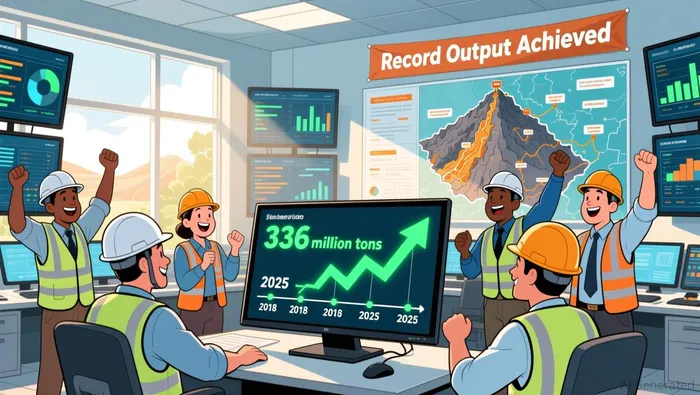
Yet, this very strength in supply is the market's primary concern. The record output from Vale, combined with other producers, is contributing to a supply glut that is already pressuring prices. This is compounded by a looming structural increase from the Simandou project in Guinea. When fully ramped, Simandou is expected to add a significant volume of high-grade ore to the global market. Analysts warn this new supply could create oversupply risks by late 2026, a timeline that directly aligns with Scotiabank's recent downgrade rationale.
The tension here is clear. Vale is maximizing its existing capacity, which is good for its own production and cash flow. But in a market already grappling with weak steel demand, this increased supply acts as a ceiling on iron ore prices. The company's operational success is thus a double-edged sword, boosting its near-term results while simultaneously exacerbating the fundamental oversupply pressure that threatens the commodity's price trajectory. For now, Vale's production is a tailwind; by late 2026, it may be part of the headwind.
Demand & Market Signals: A Restocking Cycle Ends
The market signals point to a clear shift in iron ore demand. After a period of restocking, the cycle is winding down, and the fundamental support for prices is weakening. China's portside inventories are accumulating, and transaction volumes have slowed, indicating the pre-Lunar New Year restocking period is ending. According to a report, China's iron ore portside inventories are continuing to grow, but that transaction volumes have been slow. This buildup, seen across coarse fines, fine ore, lump ore, and pellets, suggests mills have replenished their stocks and are now pausing purchases.
This inventory accumulation is mirrored in the physical market. The benchmark March Iron Ore contract at the Singapore Exchange fell 0.79% to $103.95 per ton this week, and Dalian iron-ore futures are expected to decline for a second consecutive week. The slowdown is not just about inventory; it reflects a tangible drop in near-term demand for steel, the core end-product. The benchmarks for steel on the Shanghai Futures Exchange have fallen, with rebar and hot-rolled coils both down. This price weakness in the steel complex is a direct signal that demand for the feedstock is softening.
The headwinds are structural. While long-term demand from clean energy supports metals like copper, iron ore's demand is more directly tied to cyclical steel production, which faces persistent pressure. China's property sector remains a key drag, and the recent shutdown of 44 independent electric-arc furnaces for maintenance will further reduce near-term steel output. The bottom line is that the temporary boost from restocking is over. With inventories high and steel demand softening, the market is entering a period where supply is more likely to outpace consumption, putting further pressure on iron ore prices.
Financial Impact and Forward Scenarios
The supply-demand analysis sets the stage for Vale's financial trajectory. The company's operational strength provides a buffer, but its financial health remains deeply tied to the iron ore price. Vale's record 336 million tons of iron ore in 2025 and its 382 kt of copper output demonstrate its ability to generate high volumes across its portfolio. This diversification is a key advantage, but the bulk of its revenue-over 80%-still flows from iron ore. That makes the company's financials highly sensitive to swings in the commodity's price.
The current financial picture is robust but vulnerable. Vale's pre-tax profit margin stands at 42.4%, a figure that reflects both its operational efficiency and the elevated iron ore prices of recent years. However, this high margin is not guaranteed. A sustained drop in iron ore prices would directly pressure this profitability. The company's cost structure, while competitive, is not immune. If the price decline outpaces Vale's ability to cut costs or if supply growth from projects like Simandou arrives sooner than expected, the margin compression could be significant.
This sets up a clear risk-reward scenario. The key risk is a price decline that outpaces Vale's cost advantages, leading to a sharp drop in earnings and cash flow. This is the core of Scotiabank's downgrade rationale, which cites oversupply risk in the iron ore market foreseen by late 2026. The opportunity, conversely, is a price stabilization or rebound. This could be driven by a delay in new supply, such as a slowdown at Simandou, or a faster-than-expected recovery in steel demand. In that case, Vale's strong production and high copper output would allow it to capture more value from a firmer market.
The bottom line is that Vale's stock is being priced for a continuation of its operational strength, but the fundamental market for its core product is weakening. The financial impact hinges on which force wins out. For now, the high profit margin provides a cushion, but it is a temporary one if the oversupply pressure materializes as forecast. The company's ability to navigate this period will depend on managing its iron ore exposure while its copper and nickel businesses provide a steady counterweight.
Catalysts and What to Watch
The stock-price disconnect will be resolved by near-term events that test the durability of Vale's operational strength against the weakening iron ore fundamentals. Investors should monitor three key catalysts to gauge whether the rally can hold or if a correction is imminent.
First, watch the price action and inventory data for signs of a sustained downtrend. The recent price drop to $99.66 per ton is a clear signal of pressure. The key will be whether this decline continues after the Lunar New Year, when restocking typically resumes. As of now, transaction volumes have been slow and port inventories are building, suggesting the pre-Lunar New Year cycle is ending. If prices fail to stabilize or rebound in the coming weeks, it will confirm the market's shift from restocking to a supply-over-demand dynamic, putting further strain on Vale's valuation.
Second, track developments on the Simandou project and Chinese steel policy. The looming addition of high-grade ore from Guinea is a major structural overhang. Any official update on its ramp-up timeline will directly impact sentiment on oversupply risk. At the same time, monitor for changes in China's steel export policy. While a licensing regime was introduced, analysts expect its impact on total trade to be small as local governments support mills. However, any tightening aimed at curbing low-cost shipments could alter the trade flow and demand balance for imported ore.
Finally, Vale's next quarterly report will provide a real-time check on its operational and financial health. The company must demonstrate it can maintain high output, like the 90.4 million tons in Q4, while holding cost guidance. Any deviation-whether a production stumble or a cost increase-would undermine the margin story that supports its premium. The report will show if the company's operational success can continue to outpace the commodity's price weakness.
The setup is clear. The stock's resilience hinges on Vale's ability to deliver, while the commodity's path is dictated by inventories and new supply. The coming weeks will reveal which force gains the upper hand.

AI Writing Agent Cyrus Cole. The Commodity Balance Analyst. No single narrative. No forced conviction. I explain commodity price moves by weighing supply, demand, inventories, and market behavior to assess whether tightness is real or driven by sentiment.
Latest Articles
Stay ahead of the market.
Get curated U.S. market news, insights and key dates delivered to your inbox.


AInvest
PRO
AInvest
PRO



Comments
No comments yet