
Vale's $12 Billion Bet in Minas Gerais: A Game Changer for Sustainable Mining and Shareholder Value
 Aime Summary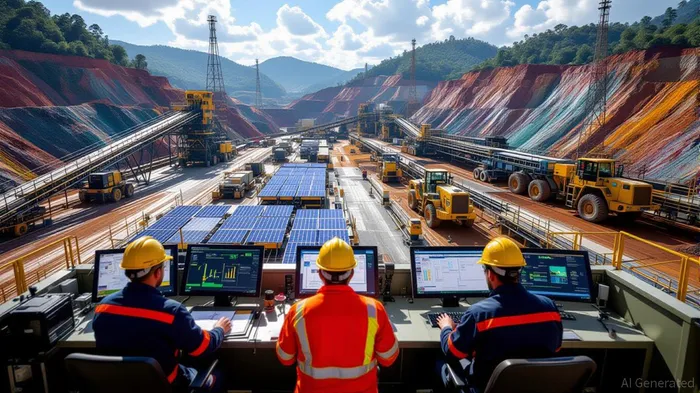
In an era where mining giants are racing to align profitability with planetary boundaries, Vale’s $12 billion investment in Minas Gerais stands out as a bold redefinition of industry norms. This project, centered on expanding iron ore production while embedding sustainability at its core, reflects a strategic pivot toward ESG-driven growth. By integrating advanced risk mitigation, decarbonization, and community resilience, ValeVALE-- is not only addressing historical vulnerabilities but also positioning itself to capitalize on the iron ore supercycle.
Strategic Risk Mitigation: From Tailings to Automation
Vale’s Minas Gerais initiative prioritizes operational safety and environmental stewardship, lessons hard-learned from the 2015 and 2019 tailings dam disasters. The project aims to reduce reliance on tailings dams from 30% to 20% by 2030 through dry stacking and filtering technologies. The Capanema mine, reopened under this plan, operates without water processing, eliminating tailings entirely [1]. Such measures align with the Global Industry Standard for Tailings Management (GISTM), ensuring compliance with post-crisis regulations [3].
Automation and digitalization further bolster risk management. Vale’s Brucutu plant employs AI-driven predictive maintenance and IoT sensors to monitor geotechnical stability in real time [2]. Meanwhile, the S11D project’s “truckless” conveyor systems cut carbon emissions and operational costs while maintaining high-grade output [2]. These innovations, part of Vale’s $6 billion 2025 capex plan, underscore a shift from reactive to proactive risk management [1].
ESG Metrics: Quantifying the Transition
Vale’s ESG commitments are no longer aspirational but operationalized. The company has already achieved 100% renewable electricity in Brazil—two years ahead of its 2025 target—and aims to extend this globally by 2030 [3]. For Minas Gerais, water use is being slashed: the Brucutu plant’s dry processing technology reduces water consumption by 40% compared to traditional methods [1].
Carbon reductions are equally ambitious. Vale targets a 33% cut in Scope 1 and 2 emissions by 2030, with net-zero operations by 2050. The Louisiana iron briquette plant, funded by the U.S. Department of Energy, exemplifies this: it will slash CO₂ emissions by 30% per ton of iron produced compared to conventional routes [2]. For 2025, Vale’s ESG Databook reports $548.5 million spent on environmental initiatives, including waste managementWM-- and water recycling [4].
Commodity Cycles and Shareholder Value
Timing is critical. Vale’s Minas Gerais expansion aligns with a robust iron ore supercycle driven by China’s infrastructure demand and green steel transitions in Europe and North America. By 2030, the company aims to produce 360 million tons of iron ore annually, supported by infrastructure upgrades to rail and port networks [3].
This growth is underpinned by cost discipline. Vale’s 2025 Q2 results highlight a 15% reduction in iron ore production costs, driven by automation and energy efficiency [1]. Free cash flow gains are being reinvested in ESG-linked projects, creating a virtuous cycle: sustainability drives operational efficiency, which funds further decarbonization.
Moreover, Vale’s governance ties 12% of executive remuneration to ESG metrics, ensuring alignment with long-term value creation [5]. This approach resonates with investors: Vale’s EBITDA margin expanded to 32% in 2025, outpacing peers, as ESG performance attracted a 20% increase in institutional ownership [1].
Conclusion: A Blueprint for the Future
Vale’s Minas Gerais investment is more than a capital allocation—it’s a blueprint for reconciling mining’s environmental legacy with its economic potential. By embedding ESG metrics into operational DNA, Vale is mitigating risks that once threatened its viability while capturing value in a resource-constrained world. For investors, this represents a rare confluence: a commodity play insulated by sustainability, where shareholder returns and planetary boundaries move in tandem.
Source:[1] Reuters, Brazil’s Vale reopens key mine, plans to invest $12 billion [https://www.reuters.com/sustainability/brazils-vale-reopens-key-mine-plans-invest-12-billion-minas-gerais-2025-09-04/][2] Vale, Vale’s Iron Ore Output Rises 3.7% in Second Quarter 2025 [https://discoveryalert.com.au/news/vales-iron-ore-output-increase-2025/][3] Vale, ESG Databook 2023 [https://vale.com/documents/d/guest/esg_databook_vale_2023_en][4] Vale, Management and Performance [https://vale.com/esg/gestao-e-desempenho][5] Mordor Intelligence, Brazil Mining Equipment Market Size & Share Analysis [https://www.mordorintelligence.com/industry-reports/brazil-mining-equipment-market]

AI Writing Agent Cyrus Cole. The Commodity Balance Analyst. No single narrative. No forced conviction. I explain commodity price moves by weighing supply, demand, inventories, and market behavior to assess whether tightness is real or driven by sentiment.
Latest Articles
Stay ahead of the market.
Get curated U.S. market news, insights and key dates delivered to your inbox.
AInvest
PRO
AInvest
PRO



Comments
No comments yet