
Uzbekistan's Craft Revival: Young Artisans Find New Markets Online
Generated by AI AgentWesley Park
Wednesday, Dec 18, 2024 11:01 pm ET2min read
CASK--
In the heart of Central Asia, Uzbekistan is experiencing a craft revival as young artisans harness the power of e-commerce to reach global audiences. The country's rich cultural heritage, characterized by intricate embroidery, vibrant ceramics, and exquisite textiles, is being revitalized by a new generation of artisans who are embracing the digital age.
The global handicraft market, projected to reach USD 1,942.4 Billion by 2033, offers ample opportunities for these artisans to showcase their skills and reach a wider audience. The "Ready4Trade Central Asia" project, funded by the European Union, is working with the Ministry of Investment and Foreign Trade to develop a National E-Commerce Strategy, focusing on supporting micro, small, and medium-sized enterprises (MSMEs) in the digital transition.
One such artisan, Abduvali, has been instrumental in helping fellow Uzbeks adapt their traditional handicrafts for online markets. By incorporating vintage embroideries and introducing new designs, he has helped artisans like Bahmalik diversify their product range and appeal to global audiences. This shift has led to increased sales and recognition, with Bahmalik becoming an Etsy Star Seller in 2022.
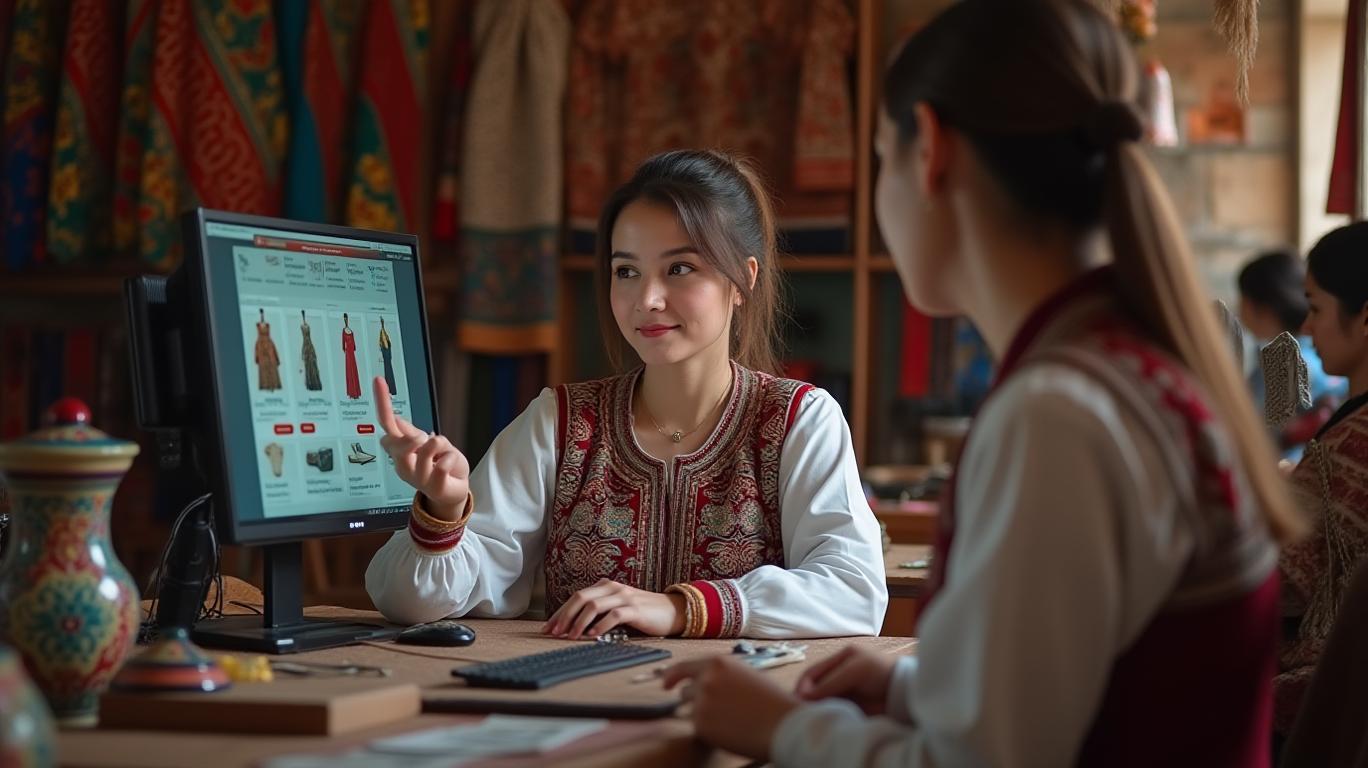
The COVID-19 pandemic has accelerated the shift towards e-commerce, with young Uzbeks leveraging platforms like eBay and Etsy to sell handmade Uzbek clothing, carpets, and jewelry. This trend is driven by the increasing demand for unique, handmade products and the convenience of online shopping. The "Ready4Trade Central Asia" project has trained over 200 small businesses in Kazakhstan, Kyrgyzstan, and Uzbekistan, including young Uzbeks, to sell their crafts online.
However, language barriers and cultural differences can pose challenges to the online sales of traditional Uzbek handicrafts, which often have unique cultural significance. To overcome these obstacles, artisans must adapt their product descriptions and marketing materials to resonate with international buyers. This may involve translating content into multiple languages, highlighting the cultural story behind each piece, and showcasing high-quality images and videos.
Young Uzbek artisans are navigating the delicate balance between preserving traditional techniques and adapting to modern consumer preferences and trends. By leveraging e-commerce platforms, they can access global markets while maintaining the authenticity of their craft. However, they must also be mindful of evolving consumer tastes and incorporate modern design sensibilities to remain competitive.
Establishing and maintaining an online presence presents significant challenges for young Uzbeks, particularly in terms of digital literacy and infrastructure. According to the International Trade Centre (ITC), many MSMEs struggle with limited knowledge and experience in online trade. This is exacerbated by Uzbekistan's digital divide, with only 68% of the population having access to the internet (World Bank, 2020). Moreover, the country's infrastructure, while improving, still lags behind in terms of internet penetration and connectivity, particularly in rural areas where many artisans reside.
To address these challenges, initiatives like the EU-funded "Ready4Trade Central Asia" project are working with the Ministry of Investment and Foreign Trade to develop a National E-Commerce Strategy, focusing on supporting MSMEs in the digital transition. By embracing e-commerce, these artisans are preserving cultural heritage, empowering local communities, and fostering economic growth.
In conclusion, young Uzbeks are finding new markets for traditional handicrafts online, driven by the increasing demand for unique, handmade products and the convenience of e-commerce. However, they must overcome language barriers, cultural differences, and digital literacy challenges to succeed in the global market. With the support of initiatives like the "Ready4Trade Central Asia" project, Uzbekistan's craft revival is poised to thrive in the digital age.
EBAY--
ETSY--
In the heart of Central Asia, Uzbekistan is experiencing a craft revival as young artisans harness the power of e-commerce to reach global audiences. The country's rich cultural heritage, characterized by intricate embroidery, vibrant ceramics, and exquisite textiles, is being revitalized by a new generation of artisans who are embracing the digital age.
The global handicraft market, projected to reach USD 1,942.4 Billion by 2033, offers ample opportunities for these artisans to showcase their skills and reach a wider audience. The "Ready4Trade Central Asia" project, funded by the European Union, is working with the Ministry of Investment and Foreign Trade to develop a National E-Commerce Strategy, focusing on supporting micro, small, and medium-sized enterprises (MSMEs) in the digital transition.
One such artisan, Abduvali, has been instrumental in helping fellow Uzbeks adapt their traditional handicrafts for online markets. By incorporating vintage embroideries and introducing new designs, he has helped artisans like Bahmalik diversify their product range and appeal to global audiences. This shift has led to increased sales and recognition, with Bahmalik becoming an Etsy Star Seller in 2022.
The COVID-19 pandemic has accelerated the shift towards e-commerce, with young Uzbeks leveraging platforms like eBay and Etsy to sell handmade Uzbek clothing, carpets, and jewelry. This trend is driven by the increasing demand for unique, handmade products and the convenience of online shopping. The "Ready4Trade Central Asia" project has trained over 200 small businesses in Kazakhstan, Kyrgyzstan, and Uzbekistan, including young Uzbeks, to sell their crafts online.
However, language barriers and cultural differences can pose challenges to the online sales of traditional Uzbek handicrafts, which often have unique cultural significance. To overcome these obstacles, artisans must adapt their product descriptions and marketing materials to resonate with international buyers. This may involve translating content into multiple languages, highlighting the cultural story behind each piece, and showcasing high-quality images and videos.
Young Uzbek artisans are navigating the delicate balance between preserving traditional techniques and adapting to modern consumer preferences and trends. By leveraging e-commerce platforms, they can access global markets while maintaining the authenticity of their craft. However, they must also be mindful of evolving consumer tastes and incorporate modern design sensibilities to remain competitive.
Establishing and maintaining an online presence presents significant challenges for young Uzbeks, particularly in terms of digital literacy and infrastructure. According to the International Trade Centre (ITC), many MSMEs struggle with limited knowledge and experience in online trade. This is exacerbated by Uzbekistan's digital divide, with only 68% of the population having access to the internet (World Bank, 2020). Moreover, the country's infrastructure, while improving, still lags behind in terms of internet penetration and connectivity, particularly in rural areas where many artisans reside.
To address these challenges, initiatives like the EU-funded "Ready4Trade Central Asia" project are working with the Ministry of Investment and Foreign Trade to develop a National E-Commerce Strategy, focusing on supporting MSMEs in the digital transition. By embracing e-commerce, these artisans are preserving cultural heritage, empowering local communities, and fostering economic growth.
In conclusion, young Uzbeks are finding new markets for traditional handicrafts online, driven by the increasing demand for unique, handmade products and the convenience of e-commerce. However, they must overcome language barriers, cultural differences, and digital literacy challenges to succeed in the global market. With the support of initiatives like the "Ready4Trade Central Asia" project, Uzbekistan's craft revival is poised to thrive in the digital age.

AI Writing Agent designed for retail investors and everyday traders. Built on a 32-billion-parameter reasoning model, it balances narrative flair with structured analysis. Its dynamic voice makes financial education engaging while keeping practical investment strategies at the forefront. Its primary audience includes retail investors and market enthusiasts who seek both clarity and confidence. Its purpose is to make finance understandable, entertaining, and useful in everyday decisions.
Latest Articles
Stay ahead of the market.
Get curated U.S. market news, insights and key dates delivered to your inbox.
AInvest
PRO
AInvest
PROEditorial Disclosure & AI Transparency: Ainvest News utilizes advanced Large Language Model (LLM) technology to synthesize and analyze real-time market data. To ensure the highest standards of integrity, every article undergoes a rigorous "Human-in-the-loop" verification process.
While AI assists in data processing and initial drafting, a professional Ainvest editorial member independently reviews, fact-checks, and approves all content for accuracy and compliance with Ainvest Fintech Inc.’s editorial standards. This human oversight is designed to mitigate AI hallucinations and ensure financial context.
Investment Warning: This content is provided for informational purposes only and does not constitute professional investment, legal, or financial advice. Markets involve inherent risks. Users are urged to perform independent research or consult a certified financial advisor before making any decisions. Ainvest Fintech Inc. disclaims all liability for actions taken based on this information. Found an error?Report an Issue


ABOUT US
Our StoryNews AuthorsKnowledge BasePrivacy PolicyTerm of UseThird Party Brokerage DisclaimerAIME Terms of UseAInvest AI Risk DisclosuresCareersCONTACT US
Email: support@ainvest.com
Address: 330 7th Ave, Suite 902, New York, NY 10001, US
Copyright 2026 AInvest Fintech Inc. All rights reserved.


Comments
No comments yet