
Uzbekistan's Emerging Role in Central Asian Energy Markets: A Golden Opportunity for Strategic Investors


 Aime Summary
Uzbekistan is no longer a hidden gem-it's a seismic shift in Central Asia's energy landscape. With a perfect storm of infrastructure investments, geopolitical realignment, and renewable energy ambition, this nation is fast becoming the linchpin of a region poised for explosive growth. For investors, the message is clear: Uzbekistan's energy story is not just about power-it's about power in the most literal and lucrative sense.
A Surge in Infrastructure: The EBRD and ADB Bet Big
Let's start with the numbers.
According to a report by the EBRD, the institution invested a staggering €938 million in Uzbekistan in 2024 alone, targeting renewable energy and grid modernization. That includes a 200 MW solar photovoltaic plant and a 501 MWh battery energy storage system in Tashkent-a project that's not just clean energy but a blueprint for future storage scalability. Meanwhile,
the EBRD also funded a 230 km, 500 kV transmission line in Navoi, a critical artery for integrating renewables into the national grid.
But the EBRD isn't the only heavyweight player.
The ADB and its partners have mobilized over $1.2 billion for the Samarkand 1 and 2 Solar PV and BESS Projects, which will add 1,000 MW of solar capacity and 1,336 MWh of storage-enough to power 600,000 homes and slash 1.3 million tons of CO₂ annually.
The ADB's $140 million financing package, paired with $85 million in credit guarantees, is a masterstroke of risk mitigation, backed by the Uzbek government itself. This isn't just a project; it's a signal that Uzbekistan's regulatory environment is now investor-friendly enough to attract multilateral bets.
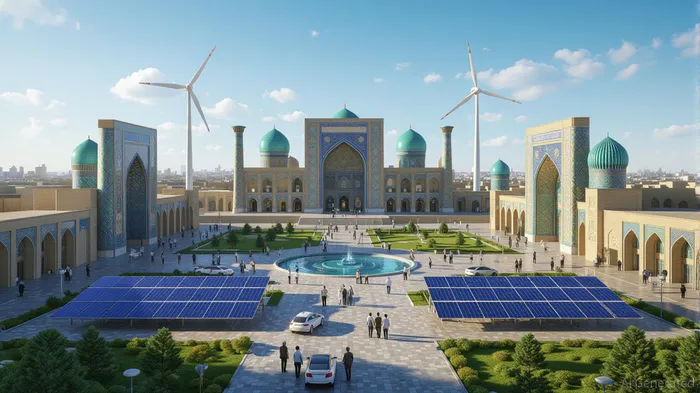
China's Solar Stampede: 2,000 MW and Counting
While Western institutions are laying the groundwork, China is turning up the heat.
Energy China's $2 billion commitment to build 2,000 MW of solar plants in Kashkadarya, Bukhara, and Samarkand provinces is a game-changer. Add to that
a 500 MW plant in Jizzakh by China Poly Group and a 300 MW solar-plus-storage project in Navoi by Sinoma EC International, and you've got a solar revolution on the horizon. These projects aren't just about scale-they're about speed. With Chinese engineering and capital, Uzbekistan is fast-tracking its renewable ambitions, bypassing the bureaucratic lags that have plagued other emerging markets.
Strategic Partnerships: From Azerbaijan to the Caspian Corridor
Here's where Uzbekistan's geopolitical chess comes into play.
A landmark production sharing agreement with Azerbaijan's SOCAR in the Ustyurt region is rewriting the rules of the game. By allowing SOCAR to explore and develop advanced geological fields, Uzbekistan isn't just securing energy-it's building a new axis of regional collaboration. This deal,
as noted in a report by , signals a deliberate pivot away from overreliance on Russian and Chinese energy corridors.
But the real wildcard is the Caspian Green Energy Corridor-a trilateral initiative with Kazakhstan and Azerbaijan to export renewables to Europe.
Imagine Uzbekistan's solar power flowing westward, bypassing traditional bottlenecks and tapping into Europe's insatiable demand for clean energy. This isn't just regional cooperation; it's a strategic hedge against global economic fragmentation.
Why This Matters for Investors
Let's cut through the jargon: Uzbekistan is a rare blend of high-impact infrastructure, geopolitical agility, and policy reform. The government's restructuring of state-owned utilities and its push for public-private partnerships (PPPs) are creating a fertile ground for private capital. For investors, this means lower risk and higher returns. The ADB's credit guarantees and the EBRD's record-breaking investments are proof that the world's top development banks see Uzbekistan not as a gamble, but as a growth engine.
And let's not forget the climate angle. With projects offsetting millions of tons of CO₂ annually, Uzbekistan is aligning with global decarbonization trends-a critical factor for ESG-focused portfolios.
The Bottom Line
Uzbekistan's energy story is still in its early chapters, but the plot is already compelling. From Chinese solar plants to ADB-backed storage systems and a new energy axis with Azerbaijan, this nation is rewriting Central Asia's energy playbook. For investors with a long-term horizon, the message is simple: The lights are turning on in Uzbekistan-and the electricity is just getting started.

Stay ahead of the market.
Get curated U.S. market news, insights and key dates delivered to your inbox.


AInvest
PRO
AInvest
PRO



Comments
No comments yet