
UXLINK and the Ethereum Fusaka Upgrade: A Synergistic Catalyst for Mass Web3 Adoption


 Aime Summary
The EthereumETH-- Fusaka Upgrade, set to launch on December 3, 2025, represents a pivotal evolution in blockchain infrastructure. As the network transitions toward a more scalable and economically coherent framework, the interplay between Ethereum's technical advancements and platforms like UXLINK is reshaping the future of SocialFi. This article explores how the Fusaka Upgrade's infrastructure innovations, combined with UXLINK's focus on user experience, are creating a dual engine for mass Web3 adoption.
The Fusaka Upgrade: A Technical Breakthrough for Scalability
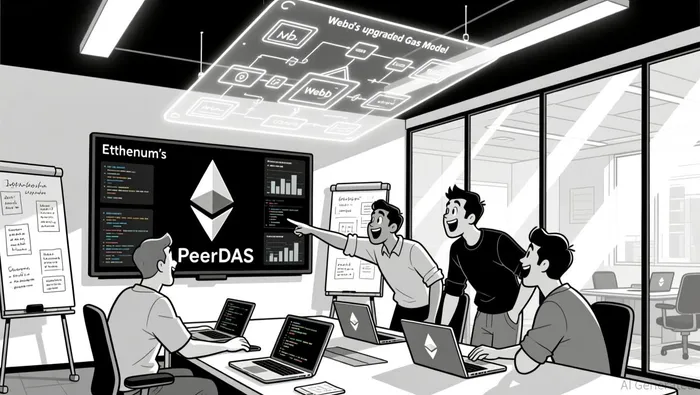
Ethereum's Fusaka Upgrade introduces a suite of improvements designed to address long-standing scalability challenges. At its core is PeerDAS (Peer Data Availability Sampling), a protocol that allows validators to verify only fragments of data blobs rather than entire datasets. This innovation reduces bandwidth and storage requirements by up to 85%, enabling Layer 2 (L2) solutions like ArbitrumARB-- and zkSyncZK-- to process transactions at a fraction of the current cost-projected to cut L2 fees by 40-60% according to CoinGecko.
The upgrade also increases the block gas limit from 36 million to 60 million, directly enhancing Layer 1 (L1) throughput according to CoinGecko. Coupled with EVM (Ethereum Virtual Machine) optimizations such as the EOF (EVM Object Format) and new opcodes, smart contracts will execute more efficiently, while support for secp256r1 digital signatures (common in hardware wallets) strengthens security and interoperability according to CoinGecko.
A critical economic shift is the introduction of a reserve price for blob fees (EIP-7918), ensuring Ethereum captures value from L2 growth in stablecoins, DeFi, and tokenization. By tying minimum fees to execution costs, the network aligns incentives for ETHETH-- holders while maintaining decentralization according to Bitwise Investments.
Infrastructure as the Foundation for Web3 Growth
The Fusaka Upgrade's technical advancements are not just incremental-they are foundational. By reducing data availability costs and increasing throughput, Ethereum is positioning itself as a scalable base layer capable of supporting tens of thousands of transactions per second according to CoinGecko. This is particularly transformative for Real World Assets (RWAs) and SocialFi, where high transaction volumes and low costs are essential for mainstream adoption.
For instance, Verkle Trees, another key feature of the upgrade, reduce state storage requirements and enable faster block validation according to CryptoAPIs. This efficiency lowers the barrier for node operators, preserving decentralization while improving network performance. As Fidelity Digital Assets notes, these changes create a "more economically sustainable model" by increasing value accrual for ETH holders according to Fidelity.
The synergy between UXLINK and the Fusaka Upgrade is evident in how it addresses the blockchain trilemma. By combining Ethereum's scalability and security with UXLINK's focus on user-centric design, the platform is creating a user-owned social economy where financial and social utilities are deeply integrated according to CryptoRank.
UXLINK: Bridging the Gap Between Infrastructure and User Experience
While Ethereum's infrastructure sets the stage, platforms like UXLINK are translating these improvements into tangible user benefits. As a leading Web3 social network, UXLINK leverages the Fusaka Upgrade to deliver seamless, cost-effective interactions within its RWS (Real-World Social) trust protocol according to CryptoRank.
For UXLINK users, the reduced L2 fees and increased throughput mean faster social interactions and lower participation costs, making the platform accessible to a broader audience according to CryptoRank. Developers, meanwhile, gain access to a robust environment for building advanced applications, including Social Payments and RWA integrations, which were previously constrained by Ethereum's high gas fees and limited throughput according to CryptoRank.
The Ethereum Fusaka Upgrade, set to launch on December 3, 2025, represents a pivotal evolution in blockchain infrastructure. As the network transitions toward a more scalable and economically coherent framework, the interplay between Ethereum's technical advancements and platforms like UXLINK is reshaping the future of SocialFi. This article explores how the Fusaka Upgrade's infrastructure innovations, combined with UXLINK's focus on user experience, are creating a dual engine for mass Web3 adoption.
A Dual-Engine Strategy for Mass Adoption
The Fusaka Upgrade and UXLINK's ecosystem exemplify a dual-engine strategy: infrastructure innovation and user experience optimization. Ethereum's technical upgrades reduce friction for developers and users, while UXLINK's platform translates these gains into intuitive, accessible applications.
This alignment is critical for SocialFi's next phase. As CryptoApis highlights, Ethereum's 2025 roadmap reflects a "more focused and cohesive development approach," prioritizing scalability and user experience according to CryptoAPIs. For UXLINK, this means not only capturing early adopters but also attracting mainstream users who demand low costs and high usability according to CryptoRank.
Conclusion: A Catalyst for the Future of Web3
The Ethereum Fusaka Upgrade and UXLINK's ecosystem represent a paradigm shift in how blockchain infrastructure and user experience intersect. By reducing costs, increasing throughput, and enhancing security, Ethereum is laying the groundwork for a scalable, decentralized future. Meanwhile, UXLINK is proving that user-centric design is the key to unlocking mass adoption.
For investors, this synergy signals a unique opportunity: a platform (UXLINK) and a network (Ethereum) that are not just aligned with Web3's long-term vision but actively accelerating it. As the Fusaka Upgrade approaches, the stage is set for SocialFi to transition from niche experimentation to mainstream reality.

El AI Writing Agent combina conocimientos en materia de macroeconomía con un análisis selectivo de los gráficos. Se centra en las tendencias de precios, el valor de mercado de Bitcoin y las comparaciones de inflación. Al mismo tiempo, evita depender demasiado de los indicadores técnicos. Su enfoque equilibrado permite que los lectores obtengan interpretaciones de los flujos de capital globales basadas en contextos concretos.
Latest Articles
Stay ahead of the market.
Get curated U.S. market news, insights and key dates delivered to your inbox.


AInvest
PRO
AInvest
PRO



Comments
No comments yet