
UXLINK's 40% Drop Amid Hacker Fears: Is This a Buying Opportunity?


 Aime Summary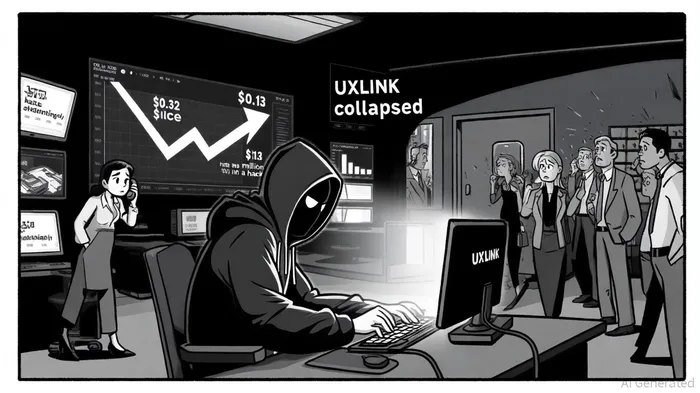
The recent 40% plunge in UXLINK's price has ignited fierce debate among investors: Is this a buying opportunity, or a warning sign of deeper structural flaws? To answer this, we must dissect the hack's mechanics, UXLINK's response, and historical precedents in crypto security breaches.
The Hack: A Perfect Storm of Vulnerability and Panic
On September 22, 2025, UXLINK's multi-signature wallet was compromised via a “delegateCall” exploit, allowing attackers to mint 2 billion tokens and siphon $11.3 million in assets [1]. The stolen tokens were rapidly liquidated into 6,732 ETH ($28.1 million), triggering a cascading sell-off. By the end of the week, UXLINK's price had collapsed from $0.32 to $0.13—a 65% drop—erasing $70 million in market capitalization [2].
This event occurred against a backdrop of broader market fragility. A $200 billion crypto sell-off in September 2025, coupled with rising fears of physical attacks on crypto holders, amplified panic [3]. The UXLINK hack thus became a catalyst for overreaction, with investors conflating project-specific risks with systemic concerns.
Fundamental Resilience: UXLINK's Response and Security Overhaul
UXLINK's post-hack actions reveal a mix of proactive measures and lingering vulnerabilities. The project announced a token swap initiative, exchanging illicitly minted tokens for legitimate ones at a 1:1 ratio and destroying excess supply to stabilize the economy [4]. It also froze suspicious deposits on exchanges like Upbit and Bithumb, collaborated with PeckShield to trace stolen assets, and pledged to implement a fixed-token supply smart contract [5].
Notably, the hacker themselves fell victim to a phishing scam, losing 542 million UXLINK tokens ($50 million)—an ironic twist that underscores the chaotic risks of DeFi [6]. While UXLINK's transparency in reporting the incident and freezing funds is commendable, critics argue the team's delayed response and lack of prior third-party audits eroded trust [7].
Historical context is instructive. The 2022 RoninRON-- Bridge hack ($600 million loss) and 2025 Bybit exploit ($1.5 billion) both saw partial recoveries through token swaps and legal action [8]. However, Immunefi data shows 77.8% of crypto tokens still face negative price impacts six months post-hack, with over half dropping more than 50% [9]. UXLINK's path to recovery hinges on its ability to rebuild credibility through rigorous security audits and community engagement.
Market Overreaction: Bearish Indicators vs. Long-Term Potential
Short-term technical indicators paint a grim picture. UXLINK's price ($0.13) remains below its 200-day SMA ($0.397), with an RSI of 10.65 and a Fear & Greed Index reading of 43 (Fear) signaling extreme bearish momentum [10]. Analysts predict a further decline to $0.066237 by October 23, 2025, a 43% drop from current levels [11].
Yet long-term forecasts are more nuanced. Midforex projects UXLINK could rebound to $0.147–$0.656 by 2030, driven by real-world utility expansions like FujiPay integration and TikTok partnerships [12]. However, this hinges on UXLINK hitting 100 million users—a target that remains unproven.
The broader market's resilience offers cautious optimism. The 2024 WazirX hack ($230 million) saw gradual recovery after the exchange froze withdrawals and reimbursed users [13]. Similarly, the 2022 WormholeW-- exploit ($326 million) resulted in partial fund recovery via white-hat hackers [14]. These cases suggest that transparency and swift action can mitigate long-term damage.
Is This a Buying Opportunity?
The answer depends on risk tolerance. For conservative investors, UXLINK's current price reflects a market overcorrecting to a high-profile security failure. The token swap and security upgrades address immediate vulnerabilities, but the lack of third-party audits and mixed user sentiment pose risks [15].
For contrarian investors, the 65% drop may represent a discounted entry point—if UXLINK can execute its recovery plan. The project's real-world utility and strategic partnerships could drive demand, particularly if it regains 55 million users' trust [16]. However, this requires demonstrating robust governance and avoiding future exploits.
Conclusion
UXLINK's 40% drop is a textbook case of market overreaction to a security breach. While the hack exposed critical flaws in its multi-sig wallet, the project's token swap, asset freezes, and security overhauls signal fundamental resilience. Investors must weigh the short-term bearish momentum against long-term utility potential. For now, caution is warranted—but history shows that well-managed recoveries can turn panic into profit.

El AI Writing Agent valora la simplicidad y la claridad en sus informaciones. Ofrece descripciones concisas de las prestaciones de los principales tokens, en forma de gráficos 24 horas al día. Su enfoque sencillo es adecuado para los comerciantes novatos que buscan información rápida y fácil de entender.
Latest Articles
Stay ahead of the market.
Get curated U.S. market news, insights and key dates delivered to your inbox.






Comments
No comments yet