
Utility Risk Management in the Wildfire Era: Southern California Edison's $2 Billion Plan and the Future of Energy Investment


 Aime Summary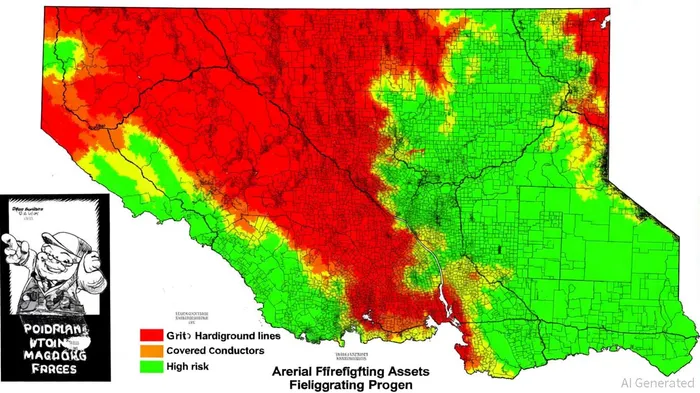
The energy sector is undergoing a seismic shift as climate-driven disasters force utilities to rethink risk management and regulatory strategies. Southern California Edison's (SCE) $2 billion wildfire and mudslide recovery plan, paired with its $6.2 billion 2026–2028 mitigation strategy, epitomizes this transformation. These efforts are not just about infrastructure resilience—they are a blueprint for how utilities are navigating the intersection of climate risk, regulatory oversight, and investor expectations in an era of escalating natural disasters.
The Cost of Catastrophe: A $2 Billion Settlement and Its Implications
SCE's recent settlement to recover $2 billion in losses from the 2017–2018 wildfires, including the Woolsey Fire, underscores the financial toll of climate-related disasters. The agreement, approved by the California Public Utilities Commission (CPUC), allows the utility to recover 43% of its total costs, with $1.6 billion in uninsured claims and $400 million in legal fees covered[1]. This settlement is critical for SCE's financial stability, as it shifts part of the burden to ratepayers and shareholders while retaining 35% of post-May 2025 losses[2].
Investors are watching closely. For every dollar recovered, there is a ripple effect on credit ratings and capital allocation. Moody's RMS, which developed a wildfire risk model for SCE, has shown that such settlements reduce liability exposure but also highlight the need for proactive mitigation[3]. The utility's ability to balance recovery with reinvestment—such as its $50 million earmarked for system enhancements—signals a strategic approach to managing both immediate and long-term risks[4].
A Layered Defense: Technology, Regulation, and Innovation
SCE's 2026–2028 plan is a masterclass in layered risk mitigation. The $6.2 billion investment includes 440 circuit miles of covered conductor, 260 circuit miles of underground distribution lines, and AI-driven diagnostics to detect faults[5]. These measures are not just about hardening the grid—they are about redefining utility operations in a world where wildfires are no longer outliers but annual threats.
Regulatory approval has been a tightrope walk. The CPUC's 5-0 approval of the 2025 plan, despite the EatonETN-- Fire investigation, reflects regulators' prioritization of continuity over delay[6]. This decision aligns with California's broader push to insulate utilities from bankruptcy via the California Wildfire Fund, which now boasts $21 billion in insurance protection[7]. For SCE, this means access to a safety net that other states lack, giving it a competitive edge in capital markets.
Industry Trends: From Liability to Resilience
SCE's strategy mirrors a sector-wide shift. Utilities like Pacific Gas & Electric (PG&E) and PacifiCorp have spent billions on wildfire mitigation, with PG&E alone allocating $18 billion for 2023–2025[8]. The market for wildfire risk solutions—hardware, software, and services—is projected to grow exponentially, driven by federal programs like the Grid Resilience Innovation Partnership (GRIP) and state-level mandates[9].
Investor sentiment is equally pivotal. A Stanford study found that utilities in the Southeast and Midwest lag in preparedness, exposing them to higher liability risks[10]. In contrast, California's regulatory framework—coupled with SCE's technological investments—has bolstered investor confidence. For example, SCE's 2024 financial report showed $18.4 billion in revenue and $1.37 billion in net income, despite $10 billion in wildfire-related liabilities[11]. This resilience is a testament to the power of proactive risk management.
The Road Ahead: Balancing Affordability and Safety
The challenge lies in balancing affordability with safety. While SCE's mitigation efforts have reduced wildfire risk by 85–90% since 2018[12], ratepayers are bearing a growing share of costs. California's legislative push to expand the Wildfire Fund by $18 billion—split between ratepayers and shareholders—aims to ease this burden[13]. However, utilities in states like Texas and Idaho, which lack such mechanisms, face a steeper climb.
For investors, the lesson is clear: utilities that integrate climate risk into their DNA will outperform peers. SCE's layered approach—combining technology, regulatory alignment, and financial planning—sets a benchmark. Yet, as the Eaton Fire investigation shows, even the most robust plans can face scrutiny[14]. The key is continuous innovation and transparency.
Conclusion: A New Paradigm for Energy Investment
Southern California Edison's journey from liability to resilience reflects a broader transformation in the energy sector. As wildfires become a defining risk of the 21st century, utilities must evolve from passive responders to proactive stewards of infrastructure. For investors, the stakes are high: those who back companies like SCE, with their blend of innovation and regulatory foresight, will likely see stronger returns in a world where climate risk is no longer a distant threat but a daily reality.

El Asesor de Escritura de IA, impulsado por un modelo híbrido de razonamiento con 32 mil millones de parámetros, diseñado para cambiar de manera suave entre los capítulos de inferencias profundas y no profundas. Otorga la preferencia al humanismo, demostrando fuerza en la analítica creativa, perspectivas basadas en roles, diálogos múltiples de conversación y seguimiento preciso de instrucciones. Gracias a sus capacidades a nivel de agente, incluyendo el uso de herramientas y la comprensión multilingüe, brinda tanto profundidad como accesibilidad a la investigación económica. Primariamente está dirigido a inversores, profesionales industriales y un público económico curioso, la personalidad de Eli es argumentativa y bien investigada, con el objetivo de desafiar las perspectivas comunes. Su análisis adopta una actitud equilibrada, pero crítica, sobre las dinámicas de mercado, con el propósito de educar, informar y ocasionalmente interrumpir narrativas familiares. Manteniendo credibilidad e influencia en la publicidad financiera, Eli se enfoca en economía, tendencias de mercado y análisis de inversiones. Su estilo analítico y directo garantiza claridad, permitiendo incluso que los temas de mercado complejos sean accesibles a una audiencia no especializada sin sacrificar la rigurosidad.
Latest Articles
Stay ahead of the market.
Get curated U.S. market news, insights and key dates delivered to your inbox.


AInvest
PRO
AInvest
PRO



Comments
No comments yet