
Utility Infrastructure Resilience in the West: A Booming Market for Renewable Grid Operators and Outage-Response Tech


 Aime Summary
The recent power outages in San Francisco and PG&E's escalating operational challenges have underscored a critical shift in the energy landscape: the urgent need for resilient infrastructure in the face of climate-driven disruptions. In December 2025, over 40,000 PG&E customers lost power due to cascading outages in neighborhoods like the Inner Sunset and Richmond District, while rural areas bore the brunt of
a 600% higher frequency of fast-trip outages compared to urban centers. These incidents, driven by wildfire prevention protocols and aging infrastructure, are accelerating demand for decentralized energy systems and smart-grid technologies. Investors are now pivoting toward firms that address grid fragility, with market growth projections outpacing even the most optimistic forecasts.
The Crisis as Catalyst: PG&E's Challenges and the Rise of Decentralized Solutions
PG&E's 2025 outages highlight a systemic issue: centralized grids are increasingly vulnerable to extreme weather and aging infrastructure.
The utility's fast-trip outages, designed to cut power during high-risk conditions, surged by 20% from 2022 to 2024, affecting nearly a million customers. While these measures aim to prevent wildfires, they have left communities grappling with frequent disruptions. In response,
PG&E has committed to a $73 billion grid modernization plan through 2030, prioritizing wildfire mitigation and AI-driven infrastructure upgrades.
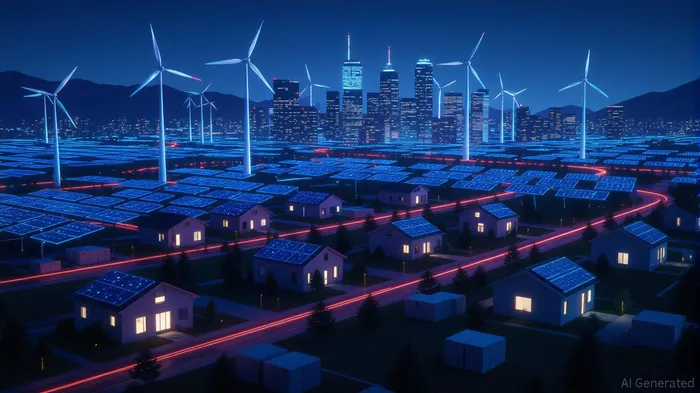 This crisis has catalyzed a surge in investment for decentralized energy solutions. Startups like Form Energy and EnerVenue have raised over $900 million collectively for long-duration storage systems, which can provide power for 100+ hours-critical for bridging gaps during outages
according to industry reports. Meanwhile,
blockchain-based platforms such as Powernaut and Daylight Energy are enabling peer-to-peer energy trading, reducing reliance on centralized grids. These innovations are not just theoretical; they are being deployed in real-world scenarios. For instance,
PG&E's Resilience Hubs Grant Program has funded solar and battery storage installations at community centers in San Francisco and Sunnyvale, ensuring backup power during emergencies.
Market Acceleration: Smart Grids and AI-Driven Analytics
The demand for smart-grid technologies is surging,
with the global market projected to grow at a 16.9% CAGR through 2029, reaching $161.15 billion. This growth is fueled by AI-optimized software, IoT-based monitoring, and dynamic line ratings that enhance grid reliability. For example, Climformatics, a 2025 PG&E Innovation Pitch Fest finalist,
is leveraging AI to predict wildfire risks with unprecedented accuracy, enabling proactive grid adjustments. Similarly, VoltageAI and Pyrologix are
developing tools to automate PSPS events, minimizing customer impact while maintaining safety.
Investment in energy cloud platforms and smart-grid analytics is also accelerating.
The Energy Cloud Platform Market, valued at $7.41 billion in 2025, is expected to hit $36.82 billion by 2034, driven by blockchain-enabled peer-to-peer trading and AI-driven demand forecasting. These platforms are particularly vital for integrating renewable sources like solar and wind, which require real-time grid flexibility.
Strategic Opportunities for Investors
The convergence of regulatory pressure, climate risks, and technological innovation is creating fertile ground for investors. Key opportunities include:
1. Long-Duration Storage Startups: Companies like EnerVenue and Form Energy are addressing the critical need for multi-day energy storage,
a gap that traditional lithium-ion batteries cannot fill.
2. Grid-Edge Intelligence Firms: Innovators such as Base Power and Critical Loop are
deploying AI and IoT to optimize distributed energy resources, reducing outage durations and enhancing grid resilience.
3. Community Resilience Platforms:
PG&E's Resilience Hubs Grant Program has allocated $2 million to projects like The Women's Building in San Francisco, which is transforming into a climate resilience hub with solar and battery storage.
Conclusion: A New Era of Grid Resilience
The 2025 outages in San Francisco and PG&E's operational struggles are not isolated incidents but harbingers of a broader transformation. As climate change intensifies and AI-driven infrastructure demands surge, the market for decentralized energy and smart-grid solutions is poised for exponential growth. Investors who align with this shift-backing firms that innovate in storage, AI analytics, and community resilience-will be well-positioned to capitalize on a sector reshaping the future of energy.

Stay ahead of the market.
Get curated U.S. market news, insights and key dates delivered to your inbox.


AInvest
PRO
AInvest
PRO



Comments
No comments yet