
How USPS Holiday Service Changes Shape Retail Stock Volatility in 2025


 Aime Summary
The holiday season is a make-or-break period for retailers, with logistics efficiency directly influencing consumer satisfaction and corporate earnings. In 2025, the U.S. Postal Service (USPS) introduced significant service timing adjustments and pricing changes, creating both opportunities and risks for the retail sector. For investors, understanding how these logistical shifts interact with market dynamics is critical to navigating short-term stock volatility and identifying resilient players in the retail landscape.
USPS 2025 Holiday Service Adjustments: A Double-Edged Sword
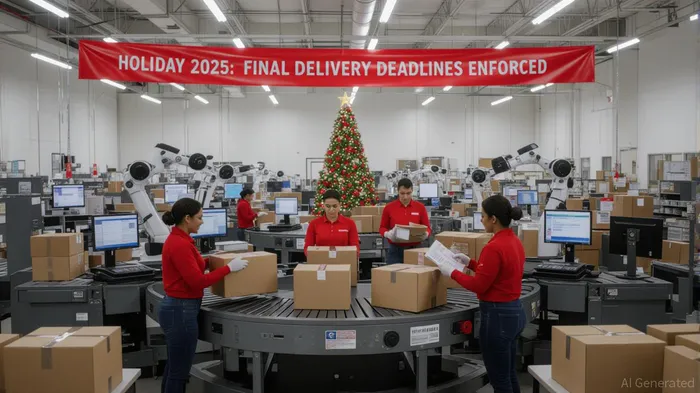
The USPS outlined strict delivery deadlines for the 2025 holiday season to ensure packages arrive before Christmas. For contiguous U.S. destinations, the final shipping dates include December 20 for Priority Mail Express, December 17 for First-Class Mail and Priority Mail, and December 16 for USPS Ground Advantage
according to the logistics update. However, weather disruptions in the Midwest and Northeast, coupled with the shutdown of 10 Roads Express-a major mail hauler-raised concerns about potential bottlenecks
as reported by industry analysts. To mitigate these risks, USPS expanded its delivery network, adding 600 package sorters and 106,480 new delivery vehicles
as detailed in the logistics report.
 Simultaneously, the USPS implemented temporary price increases for key services from October 5 to January 18, 2026. These hikes
averaged 5.1% for Ground Advantage, 5.6% for Priority Mail, and 5.7% for Priority Mail Express. The adjustments aim to offset rising labor and transportation costs but have added pressure on retailers reliant on cost-effective shipping solutions.
Retail Operational Challenges and Financial Implications
The logistical and pricing changes have created a complex environment for retailers. For example,
the 5–6% rate hikes for Priority Mail and Ground Advantage services could elevate logistics expenses, squeezing profit margins for e-commerce and mail-order businesses. A report by BCG notes that retailers are already grappling with macroeconomic headwinds, including rising tariffs and shifting consumer behavior, compounding the impact of USPS's adjustments
according to the BCG analysis.
Moreover, the risk of weather-related delays and high-volume surges-highlighted by
USPS's 97.2% on-time delivery rate during the 2025 holiday rush-introduces uncertainty for retailers managing inventory and customer expectations. Analysts warn that even minor disruptions could lead to customer dissatisfaction, returns, or lost sales, all of which could pressure quarterly earnings.
Market Volatility and Retail Stock Performance
The interplay between USPS's service changes and retail operations has directly influenced stock market dynamics.
According to Supply Chain Dive, the USPS's temporary pricing strategy aligns with broader industry trends but could amplify retail stock volatility as companies adjust to higher logistics costs. For instance,
the average rate increase of 5.2% for USPS Ground Advantage services may disproportionately affect small and mid-sized retailers with limited pricing power, leading to divergent stock performances within the sector.
Additionally, the USPS's fiscal year 2025 results-marked by a $9 billion net loss despite a 1.2% revenue increase-underscore the postal service's financial fragility
as reported in the official release. This instability raises concerns about the sustainability of its service improvements, prompting investors to scrutinize retailers' contingency plans for alternative shipping partners or cost-recovery strategies.
Investment Implications and Strategic Considerations
For investors, the key lies in differentiating between retailers with robust logistics partnerships and those overly reliant on USPS. Companies with diversified shipping networks or strong in-house fulfillment capabilities may outperform peers during periods of postal service volatility. Conversely, those with thin margins and limited flexibility could face heightened earnings surprises or trading volume spikes as market sentiment shifts.
Analysts also emphasize the importance of monitoring consumer behavior. With holiday spending projected to grow by only 1.2% in 2025-far below the 4.3% growth of 2024-retailers must balance inventory management with pricing strategies to avoid markdown losses
according to BCG's analysis. Those leveraging omnichannel approaches to mitigate postal service risks may see more stable stock performance.
Conclusion
The USPS's 2025 holiday service changes highlight the delicate balance between logistical efficiency and financial sustainability. While the postal service's investments in infrastructure and pricing adjustments aim to stabilize operations, the ripple effects on retail earnings and stock volatility remain significant. For investors, a nuanced understanding of these dynamics-coupled with a focus on retailers' adaptive strategies-will be essential in navigating the holiday season's market turbulence.

Stay ahead of the market.
Get curated U.S. market news, insights and key dates delivered to your inbox.


AInvest
PRO
AInvest
PRO



Comments
No comments yet