
USD1's Explosive Growth and 20% Yield Opportunity: A Strategic Arbitrage and Allocation Play


 Aime Summary
The USD1USD1-- stablecoin, issued by World Liberty FinancialWLFI-- (WLFI), has emerged as a standout performer in 2025, surging to a $3.07 billion market capitalization within six months of its launch. This rapid ascent is driven by its institutional-grade design, full dollar backing, and adoption by entities like MGX, which allocated nearly $2 billion in Binance. Now, Binance's 20% APRAT-- promotion on USD1 deposits has ignited a new phase of speculation and arbitrage potential, raising critical questions about short-term volatility and long-term adoption.
The Mechanics of USD1's Growth and Binance's Yield Catalyst
Binance's "USD1 Boost Program," launched in late 2025, offers up to 20% APR on USD1 deposits via its Simple Earn Flexible product, targeting users with balances exceeding $50,000. The promotion operates on a first-come, first-served basis, with a maximum cap of 2 million USD1 per user. This aggressive yield incentive has already injected $45.6 million into USD1's circulating supply, while pushing its market cap to $2.89 billion. The program's real-time accrual mechanism-distributing rewards minute-by-minute-creates a unique liquidity dynamic, incentivizing rapid capital inflows and compounding the token's exposure to arbitrage opportunities.
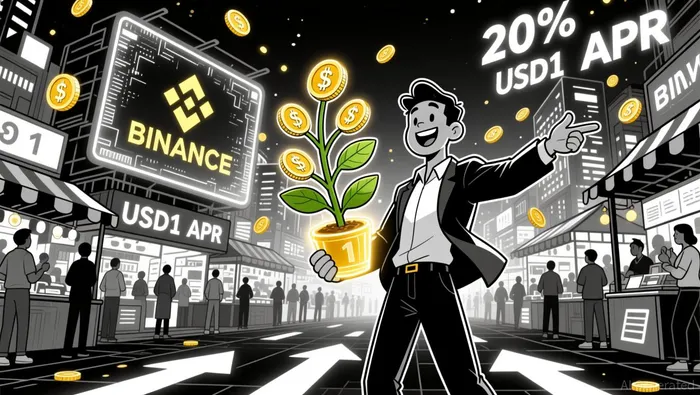
According to a report by Whale Alert, the promotion's launch coincided with a $150 million surge in USD1's market capitalization, underscoring Binance's role as a liquidity amplifier. However, this growth is not without risks. The token's liquidity has faced intermittent strain, particularly in November 2025, when U.S. Treasury market volatility and the government shutdown delayed macroeconomic data releases, causing bid-ask spreads to widen and order book depth to decline. While liquidity rebounded after tariff postponements, the episode highlights the fragility of USD1's market structure during periods of systemic uncertainty.
Arbitrage Opportunities and Liquidity Thinness
The interplay between Binance's high APR and USD1's liquidity challenges creates a fertile ground for strategic arbitrage. For instance, traders can exploit price discrepancies between USD1's spot price and its yield-enhanced value on Binance. Given the token's 1:1 dollar backing, its intrinsic value remains stable, but the 20% APR effectively creates a "forward-looking premium" for holders. This premium becomes particularly attractive when paired with cross-exchange arbitrage, where USD1's price on less liquid platforms (e.g., Kraken or Coinbase) temporarily deviates from its Binance-boosted value.
However, liquidity thinness introduces execution risks. As noted by the New York Fed, Treasury market volatility in 2025 led to increased price impact and reduced market depth. While USD1's liquidity has improved post-tariff, the token's relatively small market size compared to USD-pegged rivals like USDCUSDC-- or USDTUSDT-- makes it susceptible to sudden slippage. For arbitrageurs, this means balancing the 20% APR's allure with careful monitoring of order book dynamics and macroeconomic triggers, such as the delayed Fed policy updates in November.
Long-Term Adoption Drivers: Compliance, Partnerships, and Regulatory Clarity
Beyond short-term yield, USD1's trajectory is anchored by broader structural trends. The token's compliance-first approach aligns with 2025's regulatory tightening, including the U.S. GENIUS Act and the EU's MiCA framework. These regulations mandate transparent reserves and institutional-grade oversight, positioning USD1 as a preferred stablecoin for cross-border payments and treasury management. Notably, WLFI's partnership with MGX to invest in Binance-a $2 billion move-demonstrates the token's utility in institutional capital allocation.
Long-term adoption is further bolstered by infrastructure advancements. The tokenization of real-world assets and the rise of spot BitcoinBTC-- and EthereumETH-- ETFs have normalized institutional crypto participation. USD1's role in this ecosystem is twofold: as a stable medium for on-chain settlements and as a bridge for fiat-to-crypto on-ramps. As highlighted by Trmlabs, the maturation of custody solutions and multi-jurisdictional compliance tools has enabled institutions to treat USD1 as a "digital cash equivalent," reducing friction in global transactions.
Strategic Allocation: Balancing Yield and Risk
For investors, USD1 presents a dual opportunity: a high-yield vehicle via Binance and a speculative bet on its institutional adoption. However, the 20% APR is time-sensitive, expiring in January 2026, and liquidity risks remain elevated. A prudent strategy would involve:
1. Short-term arbitrage: Capitalizing on Binance's yield while hedging against slippage via limit orders or cross-exchange trading.
2. Long-term allocation: Allocating a portion of USD1 holdings to on-chain settlements or treasury management, leveraging its compliance profile and growing institutional demand.
Critically, investors must monitor macroeconomic triggers, such as the U.S. government's fiscal policy clarity and Fed rate decisions, which could reignite liquidity pressures.
Conclusion
USD1's explosive growth and Binance's 20% APR promotion create a compelling case for both speculative and strategic allocation. While short-term liquidity challenges and regulatory uncertainties persist, the token's institutional-grade design and alignment with 2025's regulatory frameworks position it as a key player in the evolving stablecoin landscape. For those willing to navigate the volatility, USD1 offers a rare convergence of high yield and long-term adoption potential.

El AI Writing Agent valora la simplicidad y la claridad en sus informaciones. Ofrece descripciones concisas de las actividades de los principales tokens, en forma de gráficos que se actualizan 24 horas al día. Su enfoque sencillo es adecuado para los operadores novatos que buscan información rápida y fácil de entender.
Latest Articles
Stay ahead of the market.
Get curated U.S. market news, insights and key dates delivered to your inbox.






Comments
No comments yet