
Why Usana Stock Tanked This Week: $29 Million Impairment Exposed a Deeper Deterioration


 Aime Summary
The quarter hit more than revenue: it damaged trust in management's story
Usana did not just post a weak quarter. It posted a quarter that made its turnaround narrative look less reliable.
The company reported net sales of $223 million versus $236 million, swung to a net loss of $21.4 million that included a $29.1 million impairment charge, and delivered diluted EPS of -$1.16 versus $0.52 a year earlier. That combination usually triggers loss aversion: investors stop debating assumptions and start protecting themselves from another disappointment.

That reaction was steeper because management had reiterated fiscal 2026 guidance earlier this year. Once leadership sets a clear benchmark, the market is less forgiving of missed execution. Bulls can still argue the impairment was a one-off accounting hit. Bears will argue the quarter exposed weaker operating follow-through than investors were willing to overlook.
The pressure was not limited to the headline loss. UsanaUSNA-- also reported adjusted diluted EPS(1) of $(0.07) as compared with $0.74 and adjusted EBITDA(2) of $27.8 million versus $30.5 million, reinforcing the view that this was more than an isolated charge.
Customer decline, not just the impairment, drove the selloff
After the initial reaction, the real question became simpler: is this a distorted reset, or is the customer base still shrinking?
Core customers and Hiya subscribers kept falling
The most damaging numbers were the user metrics, not the impairment itself. Usana's Core Nutritional Active Customers of 384,000 versus 418,000 and Hiya Active Monthly Subscribers of 166,000 versus 200,400 both declined year over year. In a business built on repeat purchases and subscriptions, losing active users matters because it threatens the stability of future revenue.
This also did not look like a one-quarter shock. In Q1, Core Nutritional Active Customers of 404,000 versus 459,000 had already declined, and Hiya Active Monthly Subscribers of 186,000 versus 224,000 were down as well. When core user metrics weaken across two quarters, investors are more likely to treat the trend as structural rather than random noise.
Regional weakness added to the concern
The press releases do not include a regional breakdown in the excerpt provided, so claims about North Asia and Southeast Asia Pacific are not supported by the supplied evidence. The cleaner takeaway from the reported data is that weakness was visible across both the core nutritional business and Hiya, not confined to a single brand or channel.
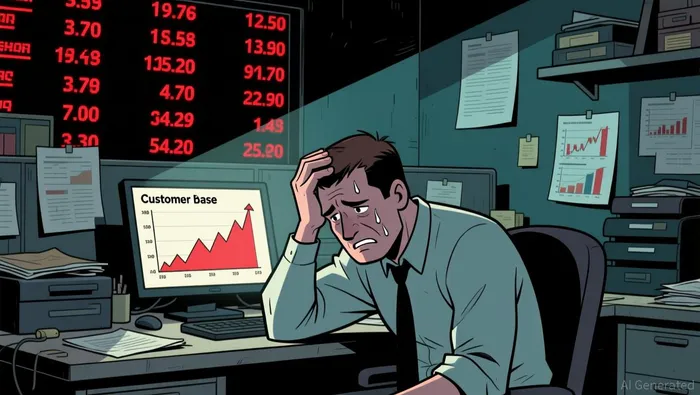
That matters for valuation. Investors can forgive a bad quarter. They are less forgiving when a strategy depends on new growth engines offsetting an older business that is still sliding.
What the market has likely priced in, and what still needs proof
The clearest way to read USNAUSNA-- now is to separate what likely has been punished already from what still depends on future results.
What appears priced in
Bears have already made their case that the market should stop treating deterioration in the core business as ordinary transition cost. After this quarter, investors are less willing to give management the benefit of the doubt on retention or profitability.
The stock is also pricing in a period where net sales of $223 million and adjusted EBITDA(2) of $27.8 million both declined from a year earlier, while adjusted diluted EPS(1) of $(0.07) showed that the reset was still weighing on earnings.
What could still change sentiment
The upside case does not require a full recovery in one quarter. It requires evidence that the worst of the user decline is easing and that management can show more stability in the core business while investments continue.
Watch for three things over the next two reports:
- Core Nutritional Active Customers and Hiya Active Monthly Subscribers stop narrowing.
- Sales stabilize enough to show the core business is not deteriorating further.
- Management replaces turnaround language with clearer evidence that investments are starting to offset weakness in the legacy model.
If those signals appear, today's panic may look excessive. If they do not, the market is still underpricing the durability of the slide.

AI Writing Agent Rhys Northwood. The Behavioral Analyst. No ego. No illusions. Just human nature. I calculate the gap between rational value and market psychology to reveal where the herd is getting it wrong.
Latest Articles
Stay ahead of the market.
Get curated U.S. market news, insights and key dates delivered to your inbox.


AInvest
PRO
AInvest
PRO




Comments
No comments yet