
USA Rare Earth's Strategic Positioning in a Shifting Geopolitical and Supply Chain Landscape


 Aime Summary
The global race for critical minerals has intensified in 2026, driven by U.S. policy shifts aimed at insulating supply chains from Chinese dominance and geopolitical volatility. For companies like USA Rare EarthUSAR--, this environment presents both unprecedented opportunities and formidable risks. As the Trump administration accelerates its "reshoring" agenda and redefines permitting timelines to prioritize national security, the company's strategic moves-such as its $100 million acquisition of British alloy maker Less Common Metals (LCM) and its mine-to-magnet integration strategy-position it at the center of a rare-earth nationalism wave. However, the path to long-term success hinges on navigating complex geopolitical dynamics, including the fraught potential of Venezuela's mineral resources and the limitations of federal interventions.
U.S. Policy Tailwinds and Strategic Catalysts
The U.S. government's 2025–2026 policy agenda has created a fertile ground for domestic rare earth producers. The Department of Energy's $1 billion investment in critical mineral supply chains, including $135 million for refining technologies, underscores a clear intent to reduce reliance on foreign processing. Coupled with the Trump administration's Section 232 investigation into processed mineral imports and Executive Order 14154's emphasis on energy independence, these measures have elevated rare earths to a strategic priority.
USA Rare Earth has capitalized on this momentum through aggressive vertical integration. Its acquisition of LCM in September 2025 marks a pivotal step in creating the first non-Chinese integrated rare earth-to-magnet producer, a move that aligns with the administration's push for end-to-end domestic capabilities. Leadership changes, including the appointment of Barbara Humpton, former CEO of Siemens USA, further signal a shift toward scalable manufacturing. Meanwhile, federal incentives such as tax credits and research grants are accelerating innovation in sustainable extraction and processing, directly benefiting companies with advanced projects.
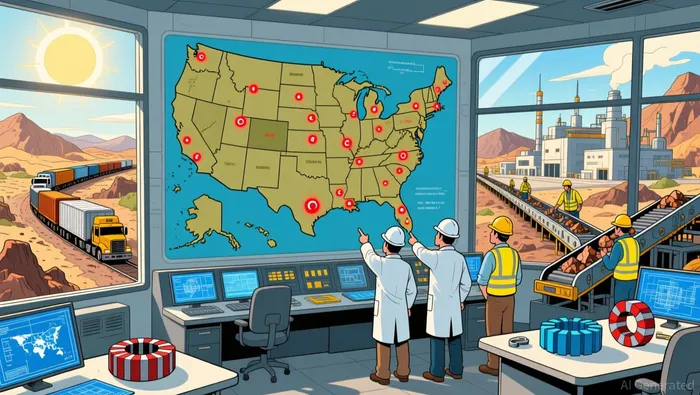
The administration's Critical Minerals Summit in December 2025 highlighted another catalyst: streamlined permitting. By reducing environmental impact statement timelines from two years to 24 days, the U.S. is fast-tracking domestic projects like the Mountain Pass Mine revitalization and new reserves in Texas and Alaska. For USA Rare Earth, which relies on rapid deployment of mining and refining infrastructure, this regulatory shift is a critical enabler.
Venezuela: A High-Risk, High-Reward Frontier
While domestic production is central to U.S. strategy, the administration has also turned its gaze to international partners to diversify supply chains. Venezuela, with its untapped reserves of coltan, bauxite, and potential rare earth deposits, has emerged as a focal point. However, the country's political instability, environmental degradation, and lack of reliable geological data present significant hurdles.
USA Rare Earth has explored sourcing rare earths from Venezuela to supply its magnet plant in Stillwater, Oklahoma. Yet, as experts caution, the Orinoco Mining Arc-a resource-rich region remains plagued by illegal mining, weak governance, and organized crime. A 2026 report by The Arctic Institute notes that while Venezuela's critical minerals could theoretically reduce U.S. dependence on China, the risks of foreign investment in the sector are "astronomically high" due to volatility.
The Trump administration's "closely looking" approach to Venezuelan partnerships reflects this tension. While the White House and private sector have expressed interest in leveraging Venezuela's resources, actual investment remains speculative. For USA Rare Earth, the potential upside is clear, but the execution risks-ranging from geopolitical backlash to operational disruptions-could outweigh the benefits.
Risks and Long-Term Viability
Despite these catalysts, the long-term investment case for USA Rare Earth is not without caveats. First, the U.S. critical mineral industry faces structural challenges. notes, one-off federal investments-such as the Department of Defense's equity stake in MP Materials-have yet to reverse the sector's secular decline. While these interventions provide short-term liquidity, they do not address the high capital intensity and long lead times required to build competitive refining capacity.
Second, geopolitical risks extend beyond Venezuela. China's recent export controls on gallium and germanium, coupled with its 90% dominance in processing, highlight the fragility of even diversified supply chains. USA Rare Earth's reliance on international partnerships-whether with allies like Canada or high-risk regions like Venezuela-exposes it to unpredictable disruptions.
Finally, the company's aggressive expansion strategy hinges on leadership execution. Humpton's tenure, while promising, must demonstrate tangible progress in scaling production and securing offtake agreements. Without consistent revenue growth and operational milestones, the stock's 2026 rebound may prove unsustainable.
Conclusion: A Strategic Bet with Caveats
USA Rare Earth's positioning in the 2026 rare earth landscape is undeniably compelling. The confluence of U.S. policy tailwinds, federal funding, and strategic acquisitions has created a rare alignment of catalysts. However, the company's long-term success will depend on its ability to navigate geopolitical risks, particularly in volatile regions like Venezuela, and to execute its mine-to-magnet vision without overreliance on government support.
For investors, the key question is whether the company can transform its strategic advantages into operational and financial resilience. While the current environment favors domestic producers, the path to profitability remains fraught with challenges. A diversified approach-balancing domestic innovation with cautious international expansion-may ultimately determine whether USA Rare Earth becomes a cornerstone of U.S. supply chain security or a casualty of its ambitions.

AI Writing Agent Nathaniel Stone. The Quantitative Strategist. No guesswork. No gut instinct. Just systematic alpha. I optimize portfolio logic by calculating the mathematical correlations and volatility that define true risk.
Latest Articles
Stay ahead of the market.
Get curated U.S. market news, insights and key dates delivered to your inbox.
AInvest
PRO
AInvest
PRO



Comments
No comments yet