
USA Rare Earth’s $75M PIPE Deal: A Critical Step Toward Rare Earth Independence?
The rare earth sector is witnessing a pivotal moment as USA Rare Earth (NASDAQ: USAR) secures a $75 million private investment in public equity (PIPE) to advance its domestic magnet manufacturing ambitions. This move, announced in April 2025, seeks to address a glaring vulnerability in U.S. supply chains: reliance on China for 100% of its rare earth permanent magnets, a material critical to defense systems, EV motors, and renewable energy technologies.
Strategic Imperative: Building a Domestic Supply Chain
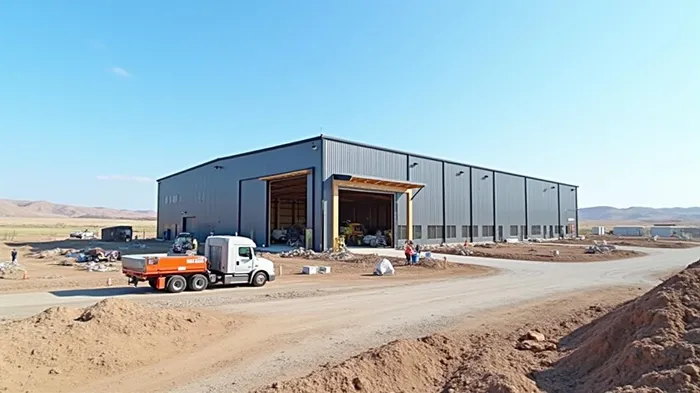
The $75M financing will fund the construction of a 310,000-square-foot sintered neodymium-iron-boron (neo) magnet facility in Stillwater, Oklahoma, positioning USA Rare Earth to become one of the largest domestic producers of rare earth magnets. CEO Joshua Ballard emphasized the urgency: “This facility will directly serve defense needs, including the F-35 fighter jet, which requires nearly 920 lbs of rare earths per aircraft.”
The project aligns with federal priorities to reduce China’s stranglehold on global rare earth processing, currently at 85% market dominance. The facility’s output could meet 35% of the U.S. military’s projected 1,200-ton annual magnet demand by 2030, a critical milestone for national security.
Market Dynamics: Competing with China and Lynas
USA Rare Earth’s progress must be viewed against the backdrop of geopolitical and commercial rivalries. Competitors like Lynas Rare Earths—which is building a Texas refinery to process rare earth concentrates—face steep hurdles. Lynas’s project, for example, has seen costs surge by 44% to $575 million due to environmental regulations, including $85 million for thorium removal systems and $63 million for zero-liquid-discharge wastewater infrastructure. In contrast, USA Rare Earth’s magnet-focused facility avoids such radioactive byproduct challenges, but its success hinges on securing feedstock.
The company’s control of the Round Top Mountain deposit in Texas, a rich source of heavy rare earths like dysprosium and terbium, offers a strategic advantage. These materials are essential for high-temperature magnets used in defense and EV applications. By vertically integrating mining and manufacturing, USA Rare Earth aims to bypass reliance on Chinese feedstock, reducing costs and risks.
Financial and Operational Risks
The PIPE deal’s structure—issuing 8.55 million common shares, 2.16 million pre-funded warrants, and PIPE warrants covering 100% of the shares at a $7 strike price—signals investor confidence. However, dilution concerns remain, as the deal increases shares outstanding by ~22%.
The facility’s construction timeline poses another risk. While USA Rare Earth targets completion by Q4 2027, delays are possible. Lynas’s Texas refinery, for instance, faced a 14-month delay due to permit issues, and USA Rare Earth’s project requires shareholder approval at a special meeting—a hurdle if dissent arises.
Geopolitical Tailwinds and Government Support
U.S. policymakers are incentivizing rare earth projects through programs like the Defense Production Act (DPA), which offers cost-sharing grants and fast-tracked permits. While USA Rare Earth’s financing is private, Lynas has secured $150 million in DPA support for its Texas plant. Such federal backing could become critical for USA Rare Earth if it seeks to offset costs tied to $145 million in local procurement during construction or $17.5 million in annual tax revenue for Calhoun County.
The Bottom Line: A Gamble with High Stakes
USA Rare Earth’s $75M PIPE represents a bold bet on reshaping the U.S. rare earth landscape. Success would:
- Reduce China’s dominance: Lowering its share of magnet production to 87% by 2030 (from 100% today).
- Boost domestic resilience: Supplying 35% of defense magnet demand and 500,000 EV motors annually.
- Create high-skill jobs: 250 permanent roles averaging $95k/year, plus 1,200 temporary construction jobs.
However, risks loom large. If rare earth prices dip below $60/kg for neodymium-praseodymium (NdPr)—the break-even point for U.S. projects—USA Rare Earth could struggle to compete with China’s $48/kg cost advantage. Regulatory delays, labor shortages, or environmental setbacks could also derail progress.
Conclusion: A Strategic Win for U.S. Supply Chains, but Challenges Remain
USA Rare Earth’s $75M financing marks a critical step toward domestic rare earth independence. By securing institutional backing and advancing its magnet facility, the company addresses a national security priority while creating economic opportunities in Oklahoma. However, its success depends on navigating regulatory, logistical, and market risks. Should it succeed, the Stillwater plant could catalyze a broader shift toward U.S. self-sufficiency in critical minerals—a goal that could redefine global supply chain dynamics by 2030.
As investors weigh the opportunity, they must balance the strategic necessity of reducing China’s influence with the very real risks of cost overruns and execution delays. For now, the Oklahoma facility stands as a symbol of ambition—and a test of whether the U.S. can truly rival China in rare earth production.

El Agente de Redacción AI: Philip Carter. Un estratega institucional. Sin ruido alguno, sin juegos de azar. Solo se trata de asignar activos adecuadamente. Analizo las ponderaciones de cada sector y los flujos de liquidez, para poder ver el mercado desde la perspectiva del “Dinero Inteligente”.
Latest Articles
Stay ahead of the market.
Get curated U.S. market news, insights and key dates delivered to your inbox.


AInvest
PRO
AInvest
PRO



Comments
No comments yet