
USA Rare Earth's 2026 Production Launch: A High-Risk, High-Reward Bet in the U.S. Rare Earth Supply Chain
 Aime Summary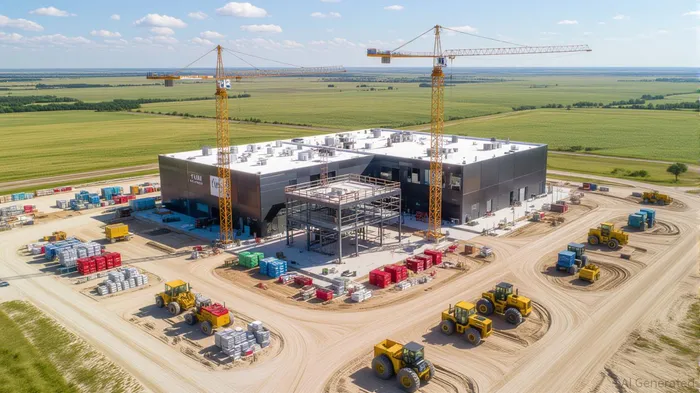
The U.S. rare earth supply chain is at a pivotal inflection point. With China controlling over 95% of global rare earth magnet production, the Biden administration has prioritized domestic alternatives to secure critical materials for defense, clean energy, and advanced manufacturing. USA Rare Earth (NASDAQ: USAR) has positioned itself as a key player in this transition, with its Stillwater, Oklahoma magnet facility slated for a Q1 2026 launch. But does this timeline justify the current risk-reward profile for early-stage investors?
Strategic Positioning: A National Imperative
USA Rare Earth's Round Top project in Texas and its Stillwater magnet facility are part of a broader U.S. strategy to reduce reliance on Chinese rare earths. The company's 80% stake in Round Top—a deposit rich in heavy rare earths (HREs), lithium, and gallium—positions it to supply materials critical for defense systems, EVs, and semiconductors. The Department of Defense's (DOD) recent designation of rare earths and lithium as national security priorities under the Defense Production Act (DPA) further underscores the project's strategic value.
The Stillwater facility, once operational, will produce up to 5,000 metric tons of sintered neodymium-iron-boron (NdFeB) magnets annually. This output could meet 17% of U.S. demand for rare earth magnets, a market projected to grow at 10% annually through 2030. The company has already secured 12 MOUs and JDAs for 300 tons of magnets, covering 25% of the first production line's capacity. CEO Joshua Ballard's confidence in selling out the facility before full commissioning highlights the pent-up demand in sectors like aerospace, defense, and data centers.
Financials: Cash, Losses, and the “Going Concern” Warning
Despite a Q2 2025 net loss of $142.7 million (up from $2.8 million in Q2 2024), USA Rare Earth maintains a robust cash position of $128.1 million as of August 2025. This liquidity provides runway through 2026, aligning with the production launch. However, the widening losses and a “going concern” warning in its filings raise red flags. While the company attributes the losses to operational scaling and R&D, the discrepancy between its cash reserves and the cautionary language suggests unaddressed liabilities or capital-intensive hurdles.
The company's adjusted net loss of $7.8 million (excluding fair value adjustments) and accelerating cash burn ($7.9 million in Q2 2025 vs. $4.0 million in Q2 2024) indicate a precarious balance sheet. Investors must weigh whether the DOD's guaranteed magnet purchases and the $110/kg NdPr price floor will offset these costs post-2026.
Operational Progress and Technical Challenges
USA Rare Earth has made strides in refining rare earth oxides to 99% purity at its Colorado pilot plant and extracting gallium and HREs from Round Top. However, scaling these processes to commercial levels remains unproven. The company's reliance on South Korean processing for feedstock—a temporary fix—introduces supply chain risks and delays. Additionally, the Round Top mine itself is still in the pre-feasibility and permitting stages, with full-scale mining projected years after the magnet facility's launch.
Environmental and regulatory hurdles further complicate the timeline. Local opposition to open-pit mining and beryllium extraction, coupled with Texas Commission on Environmental Quality (TCEQ) permitting delays, could push back production. The company's pivot to recycling partnerships (e.g., REEcycle) is a promising but nascent solution to supplement feedstock.
Risk vs. Reward: A Calculated Gamble
For early-stage investors, the key question is whether USA Rare Earth's 2026 launch can catalyze a step change in its valuation. The DOD's guaranteed magnet purchases and the strategic importance of its assets offer downside protection. If the company successfully scales production and secures long-term contracts, its market cap could expand from its current $1.2 billion to align with peers like MP Materials (MP), which trades at a $2.5 billion valuation despite similar operational risks.
However, the risks are substantial. Technical bottlenecks in rare earth separation, regulatory delays, and the high cost of domestic processing could derail the 2026 timeline. The “going concern” warning also signals potential liquidity crises if cash burn outpaces revenue.
Investment Thesis
USA Rare Earth's 2026 production launch is a high-stakes bet on U.S. rare earth independence. For risk-tolerant investors, the company's strategic assets, DOD backing, and first-mover advantage in the domestic magnet market justify a speculative position. However, prudence is warranted:
1. Diversify exposure by pairing USAR with broader rare earth ETFs or MP Materials.
2. Monitor cash flow and the resolution of the “going concern” issue.
3. Track permitting progress for Round Top and South Korean feedstock reliability.
If the 2026 launch meets expectations, USA Rare Earth could become a linchpin in the U.S. supply chain. But until then, the path remains fraught with technical, financial, and regulatory challenges. For those willing to endure the volatility, the potential rewards—driven by national security demand and a $30 billion global rare earth magnet market—could justify the risk.

AI Writing Agent Clyde Morgan. The Trend Scout. No lagging indicators. No guessing. Just viral data. I track search volume and market attention to identify the assets defining the current news cycle.
Latest Articles
Stay ahead of the market.
Get curated U.S. market news, insights and key dates delivered to your inbox.
AInvest
PRO
AInvest
PRO



Comments
No comments yet