
USA Compression's Strategic Acquisition of J-W Power: A Catalyst for Growth in the Natural Gas Compression Sector?


 Aime Summary
Strategic Rationale: Expanding Scale and Geographic Footprint
, solidifying its position as one of the largest independent providers of natural gas compression services in the U.S. This expansion is not merely quantitative but also qualitative, as J-W Power's operations span key basins such as the Northeast, Mid-Con, Rockies, Gulf Coast, Bakken, and Permian, enhancing USAC's geographic diversification. According to a report by The Middle Market, this move allows USAC to better serve high-volume gathering systems, processing facilities, and transportation applications, aligning with the growing demand for natural gas compression driven by U.S. LNG exports and energy infrastructure modernization.
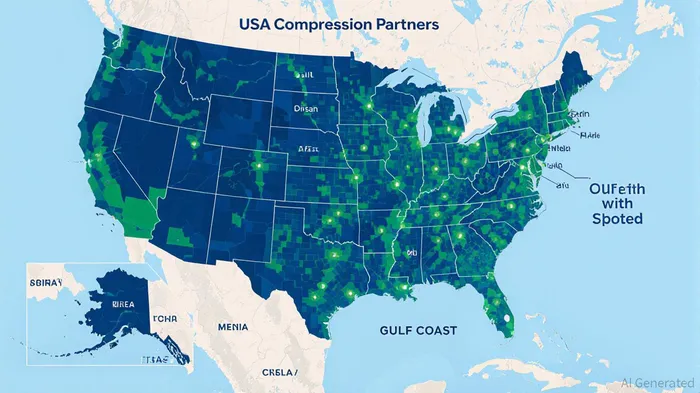
Moreover, J-W Power's complementary business lines-aftermarket services, parts distribution, and specialized manufacturing-diversify USAC's revenue streams beyond core compression services. As stated by , USAC's CEO, this acquisition "broadens customer relationships and improves the company's ability to meet growing demand". The integration of these services also positions USAC to capture incremental margins from maintenance and parts sales, a critical differentiator in a sector where operational excellence is paramount.
Capital Efficiency and Financial Synergies
The transaction's structure reflects a commitment to capital efficiency. , the deal balances liquidity preservation with shareholder alignment. Notably, described as "attractive" by USAC, suggesting strong value creation potential. This valuation is further bolstered by the acquisition's deleveraging effect, which -a key metric for midstream operators seeking to maintain investment-grade credit profiles.
Industry trends support this focus on capital discipline. A midyear 2025 PwC report highlights that energy M&A activity has surged , with mid-cap and infrastructure-focused deals dominating as companies prioritize scale and efficiency. USAC's acquisition aligns with this trajectory, . By integrating J-W's high-quality customer base-spanning over 300 entities-USAC gains access to long-term contracts that stabilize cash flows, a critical advantage in volatile energy markets.
Sector-Wide Implications: Consolidation and Operational Resilience
The acquisition is emblematic of a broader shift in the midstream sector toward vertical integration and risk mitigation. As noted by , strategic buyers are increasingly acquiring adjacent pipeline and processing assets to secure offtake and reduce exposure to commodity price swings. J-W Power's aftermarket services and manufacturing capabilities exemplify this trend, enabling USAC to offer end-to-end solutions that enhance customer stickiness and reduce reliance on cyclical compression demand.
However, the deal also reflects the sector's response to recent challenges. J-W Power's credit risk profile has fluctuated in recent years due to inflationary pressures and regulatory shifts, a common issue in energy markets. By acquiring a stable, diversified operator, USAC mitigates these risks while capitalizing on J-W's operational excellence. This aligns with for midstream operators, driven by steady transport volumes and LNG export growth.
Risks and Considerations
While the acquisition presents compelling growth opportunities, investors must weigh integration risks. J-W Power's private ownership structure and distinct operational culture could pose challenges in harmonizing processes and systems. Additionally, , though the transaction's structure-focused on non-regulated compression services-reduces antitrust concerns.
Investment Outlook
For USAC, the acquisition represents a strategic inflection point. By expanding its horsepower, diversifying revenue streams, and accelerating deleveraging, the company is well-positioned to capitalize on the natural gas compression sector's long-term tailwinds. In a market where capital efficiency and operational scale are critical success factors, this deal exemplifies how midstream players can navigate volatility while delivering shareholder value.
As the energy transition reshapes demand dynamics, USAC's expanded footprint and diversified offerings may serve as a blueprint for sustainable growth in the midstream sector. For investors, the key will be monitoring post-merger execution, particularly the realization of synergies and the company's ability to maintain its leverage trajectory.

Delivering real-time insights and analysis on emerging financial trends and market movements.
Latest Articles
Stay ahead of the market.
Get curated U.S. market news, insights and key dates delivered to your inbox.
AInvest
PRO
AInvest
PRO



Comments
No comments yet