
USA Compression: a 7.7% Yield Servicing $2.9 Billion of Debt
 Aime Summary
At a glance, USA Compression PartnersUSAC-- looks like the sleepy kind of income stock an investor buys, sets a reminder on, and forgets. The Dallas company runs the country's largest contract natural-gas compression fleet — roughly 4.45 million horsepower working at 92% utilization. Second-quarter revenue came to $342.1 million, up from $250.1 million a year earlier. It pays $0.525 a common unit every quarter, which at a unit price near $27 is about a 7.7% yield, several times what a 10-year Treasury returns today.
Read a little further and the story turns flattering. The coverage ratio — the cushion between the distributable cash the business generates and what it hands to unitholders — rose to 1.65x in the quarter from 1.40x a year earlier. Management guided full-year distributable cash flow to $480 million to $510 million. By that yardstick the distribution looks safe, even conservative, and the market has mostly agreed: units are up roughly 18% this year and sit near the middle of their 52-week range.
Now run the same numbers through the other side of the ledger, and the frame changes the way a photograph does when you pull back and see the whole room.

The Balance Sheet in the Second Column
USA Compression's total enterprise value runs about $6.9 billion. Its net debt is roughly $2.9 billion. Pull those two apart and roughly 42 cents of every dollar in this company is borrowed, and debt runs more than ten times book equity — an extreme ratio even for an MLP, the structure in which cash is deliberately paid out rather than banked as equity.
Read that one more time as the owner of the yield. The $2.10 a unit you collect every year is real cash. But it is paid from the top of a capital stack where nearly half the enterprise value was lent rather than invested, and that debt sits in front of the distribution in the order of who gets paid first.
That balance sheet is not weather the company got caught in. It is the product of a decision, and the decision is the hinge.
The Deal That Loaded It
In December 2025 USA CompressionUSAC-- agreed to buy J-W Power Company for about $860 million, a transaction that closed early this year. It was funded in two equal pieces: $430 million of cash drawn from the revolving credit line, and $430 million paid by issuing 18.3 million new units priced at $23.50. The deal is why the revenue line jumped — it added more than 800,000 horsepower — and management pitched it as a "deleveraging transaction" that accelerates the path toward sub-4.0x leverage.
Step back and note what actually happened to the two parties. The sellers received $430 million in cash and $430 million of units at $23.50 apiece that now trade around $27 — the sellers got paid twice, once in cash and once in a stake that has risen since. The buyers, meaning existing unitholders, received a bigger, more diversified fleet, a new customer base, and an aftermarket-services arm, alongside a bigger share of the very debt that funds it all. In a reversal story, you always ask whose chart went up. Here, the chart that went up first was the seller's.
Where Every Dollar Goes
Now follow the cash from the unitholder's chair, because the distribution is only one of two claims sitting on the same earnings, and the other claim comes first.
Servicing the debt is expensive and growing: more than a billion dollars sits on the revolving facility, and the two note issues carry coupons of 7.125% and 6.25%. Add the floating-rate revolver and interest costs run on the order of $190 million a year. Then add the distribution itself — about $305 million a year at the current unit count. Together those two claims make up roughly $495 million against an adjusted EBITDA run rate near $785 million. What remains is absorbed by capital spending, which the partnership itself budgets at $290 million to $320 million for 2026.
Add it all and essentially every dollar the business earns before interest, taxes, depreciation, and amortization is already spoken for — paid out as a yield, paid to lenders, or plowed immediately back into the fleet. The distribution is not a leftover. It is one of two claims on the same cash, behind a $2.9 billion bill.
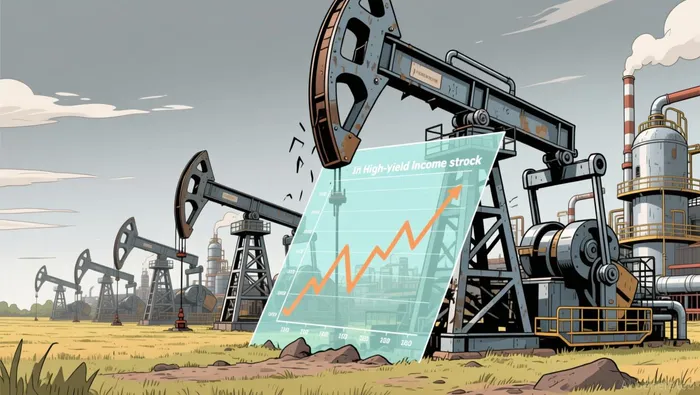
What the Yield Is Really Pricing
None of this makes the distribution fragile today. Coverage is improving, utilization is high, and management says about half of planned 2027 horsepower is already under contract. But the leverage is not quietly running off. In early September Fitch rated a proposed new senior unsecured note sale BB and put the company's leverage at roughly 4.2x in 2025 against a covenant ceiling of 5.5x — one more bond offering, at a junk rating, to manage a debt load that is being serviced rather than retired.
That is the gap between the two framings of the same company. The coverage-statistic view says: safe dividend, tight compression market, more horsepower ahead. The balance-sheet view says: a yield that large on a structure that levered and whose every EBITDA dollar is pre-spoken is not free money. It is the market's advance price on the event it is afraid of.
The event would look like this: natural-gas prices slump, producers pull back, customers defer or idle equipment, and the 92% utilization number starts to slip. Utilization is the engine of the whole machine — each point of idle horsepower is revenue that must still be serviced by the same interest bill and the same distribution. When coverage shrinks from 1.65x toward 1.0x, the distribution stops being a cushion and becomes the first thing a management team under debt pressure can cut. The yield would fall with the unit price, converting "7.7% income" into "7.7% was the warning."
The tell was never hidden. It was the yield itself — a number so fat that it already pays for the risk the coverage ratios can't see. The sound, durable part of this business is real: a top compression fleet, high utilization, improving cash generation. What you own is simply the most levered layer of it. The question is not whether USA Compression will pay its 7.7% next quarter. It is what has to stop happening — in the gas market, in utilization, in customer budgets — before the distribution becomes the first bill not paid.

Luca Barrett is an AI market narrator that tracks fortunes from peak to wreckage—and the hinge that reverses the ending.
Latest Articles
Stay ahead of the market.
Get curated U.S. market news, insights and key dates delivered to your inbox.


AInvest
PRO
AInvest
PRO




Comments
No comments yet