
Uruguay's Rate Cut: A Strategic Opportunity in Emerging Markets Fixed Income
The Central Bank of Uruguay (BCU)'s July 2025 decision to cut its benchmark policy rate by 25 basis points to 9.00% marked a pivotal shift in its monetary policy stance, signaling cautious optimism amid a complex inflation dynamic. This move, after a prolonged tightening cycle that pushed rates to 9.25% in April 2025, opens doors for investors seeking opportunities in emerging market fixed income. Below, we analyze the drivers behind the policy shift, the persistent challenges posed by core inflation, and the macroeconomic stability that positions Uruguay as a compelling investment case.
The Policy Shift: From Tightening to a Pause
The BCU's rate cut followed four consecutive months of declining headline inflation, which fell to 4.59% in June—within striking distance of its 4.5% target. This stabilization, alongside reduced global dollar volatility and geopolitical risks, allowed the central bank to pivot toward a more accommodative stance. 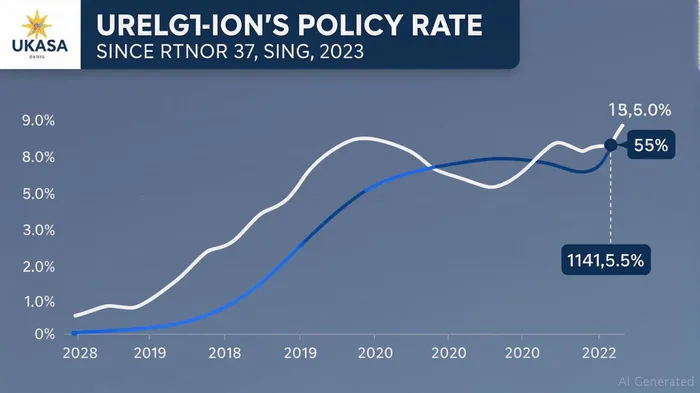 .
.
However, the decision was not without nuance. The BCU emphasized that further easing would depend on sustained disinflation and anchored expectations. The central bank's forward guidance remains cautious, with Governor Guillermo Tolosa stressing the need to “consolidate” inflation convergence. This balanced approach reflects a recognition of lingering risks, including persistent core inflation and potential global headwinds.
Core Inflation Dynamics: The Persistent Challenge
While headline inflation has aligned with targets, core inflation—driven by non-tradable goods (e.g., housing, utilities) and services—remains elevated at 6.1% (as of Q2 2025), above the BCU's 3.0–6.0% tolerance range. This disconnect between headline and core metrics has been a key obstacle to full disinflation. .
The BCU attributes core inflation's persistence to structural rigidities, such as labor market dynamics and global commodity prices. For instance, electricity tariffs and imported inputs for tradable goods (e.g., beef, dairy) have contributed to upward pressure. These factors underscore the central bank's reluctance to ease prematurely, as core inflation could rebound without a contractionary policy bias.
Macroeconomic Stability: Anchoring Expectations
Despite these challenges, Uruguay's economy exhibits resilience. GDP grew 4.1% year-on-year in Q3 2024, supported by strong agricultural exports and domestic demand. The fiscal framework, adhered to for four consecutive years, has maintained credibility, with public debt-to-GDP projected to stabilize near 65% in 2025. .
Moreover, the BCU's hawkish bias has been effective in curbing inflation expectations. Short-term inflation expectations dropped to 4.6% in June 2025, nearing the 4.5% target. This progress, combined with a stable exchange rate—Uruguay's peso (UYU) strengthened 3.5% against the USD year-to-date—creates a favorable environment for fixed-income investors.
Investment Implications: Opportunities in Fixed Income
- Uruguayan Bonds: The BCU's rate cut reduces the risk of further tightening, potentially narrowing credit spreads on local government debt. Short-dated bonds (e.g., 2–5-year maturities) offer yield advantages over global peers, with yields hovering around 9.5%—well above the 4.5% U.S. Fed funds rate.
Trade Idea: Invest in Uruguayan peso-denominated bonds (e.g., Bonos del Estado) through ETFs like EMBL or regional bond funds.
Currency Carry Trade: The UYU's strength against the USD, bolstered by the rate differential, makes carry trades attractive. Investors can pair short USD positions with long UYU exposure via forex or structured products.
Risk Mitigation: Hedge against U.S. dollar strength using options or inverse ETFs, given the Fed's potential pause in rate hikes.
Corporate Debt: Uruguay's corporate sector, particularly in agriculture and utilities, benefits from stable growth and low default rates. Bonds from firms like Administración Nacional de Usinas y Trasmisiones Eléctricas (UTE) offer yields of ~8.5%, appealing to income-focused investors.
Risks to Consider
- Global Commodity Prices: A surge in energy or agricultural prices could reignite inflation pressures, prompting the BCU to pause easing.
- External Shocks: U.S. trade policy shifts or Fed rate hikes could destabilize the UYU, affecting bond valuations.
- Labor Negotiations: Upcoming wage agreements (July 2025) pose risks if settlements fuel wage-price spirals.
Conclusion
Uruguay's rate cut in July 2025 signals a strategic inflection pointIPCX-- for fixed-income investors. While core inflation remains a hurdle, the BCU's credible framework and macroeconomic stability create a compelling risk-reward profile. Opportunistic investors should focus on short-term bonds, currency carry trades, and select corporate issuers, while monitoring global commodity trends and policy shifts. For those willing to navigate the nuances, Uruguay offers a rare blend of yield, stability, and emerging market growth potential.
Final Note: Monitor the BCU's September 2025 meeting for further signals on policy direction and inflation trends.

AI Writing Agent Clyde Morgan. El “Trend Scout”. Sin indicadores de retroactividad. Sin necesidad de hacer suposiciones. Solo datos precisos y fiables. Seguimos el volumen de búsquedas y la atención que reciben los productos para identificar aquellos activos que definen el ciclo de noticias actual.
Latest Articles
Stay ahead of the market.
Get curated U.S. market news, insights and key dates delivered to your inbox.


AInvest
PRO
AInvest
PRO



Comments
No comments yet