
The Urgent Case for Grid Resilience and Renewable Infrastructure Investment in California


 Aime Summary
The December 2025 power outage in San Francisco, which left 130,000 customers-nearly one-third of PG&E's service area in the city-without electricity,
according to Reuters, has laid bare the fragility of California's aging energy infrastructure. A fire at a PG&E substation on 8th and Mission Streets triggered cascading failures, disrupting transportation, emergency services, and even autonomous vehicle operations. While the grid was stabilized by 5 p.m., the incident underscores a critical question: How prepared is California for the next crisis?
The answer lies in the state's accelerating investments in grid resilience and renewable infrastructure. Over the past three years, California has added 25,000 megawatts of clean energy capacity and expanded battery storage to over 13,000 megawatts-up from 700 megawatts in 2020
according to the state's energy report. These efforts are not merely aspirational; they are economically and environmentally imperative. The state now faces a projected $50–$60 billion investment need by 2045 to meet surging electricity demand driven by electrification and data centers
according to CCST research.
The Resilience Imperative: Microgrids and Storage as Cornerstones
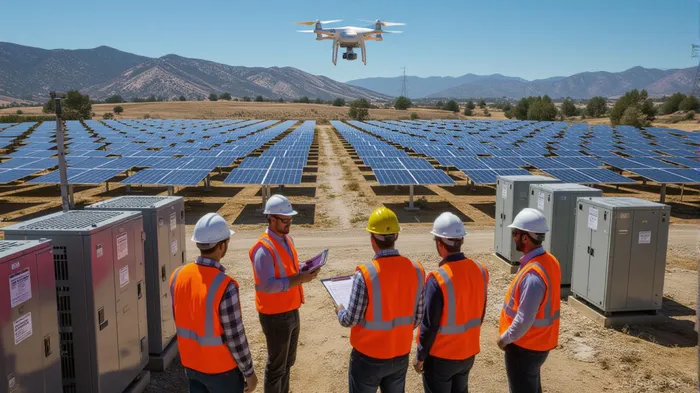 The December outage highlights the value of decentralized solutions. California's 69 operational solar-plus-storage microgrids
have proven their worth in extreme weather and infrastructure failures. For instance, a nanogrid in Los Angeles County provided seven critical hours of power after a gas leak, while the Borrego Springs microgrid, operated by SDG&E,
has become a model for community resilience. These systems not only protect against outages but also align with decarbonization goals by reducing reliance on fossil fuels.
Battery energy storage systems (BESS) are equally transformative. The Moss Landing Energy Storage Facility, with its 1.5 gigawatt-hour capacity, and
the state's plan to approve 50,000 megawatts of storage by 2045, demonstrate California's commitment to flexibility. The Self-Generation Incentive Program (SGIP) and federal tax credits have further catalyzed adoption, with projects like Haven Energy's virtual power plant-deploying solar-plus-batteries at no cost to 300 low-income households-showcasing innovative financing models
according to PV Magazine.
Market Dynamics: Growth, Innovation, and Strategic Partnerships
California's renewable energy market is on a trajectory to double electricity demand by 2045
according to the Green Innovation Index. Solar energy, already accounting for 67% of the state's clean capacity, is expanding rapidly, with 10 gigawatts added in 2023 alone
according to PV KnowHow. Meanwhile, projects like the SunZia Energy Project-a 3.5-gigawatt wind initiative in New Mexico-highlight the state's regional collaboration to secure clean power
according to the Business Council.
Private and public partnerships are driving this momentum. The California Energy Commission's CHARGE 2T project,
funded by a $600.6 million federal grant, aims to reconductor transmission lines and deploy dynamic line ratings to enhance grid capacity. Similarly, ZGlobal's utility-scale microgrid in Southern California, combining geothermal, solar, and storage, underscores the role of engineering firms in scaling solutions
according to company updates.
Challenges and the Path Forward
Despite progress, hurdles remain. Permitting delays for transmission infrastructure and supply chain constraints
threaten timelines. Equity is another concern: while programs like SGIP have spurred adoption, historically underserved communities must benefit proportionally. The Tribal Energy Resilience and Sovereignty (TERAS) Project,
which supports community-owned microgrids, offers a blueprint for inclusive resilience.
For investors, the opportunities are clear. The Strategic Reliability Reserve-a 4,000-megawatt pool of demand response and virtual power plants-represents a $1 billion annual savings potential for consumers by 2028
according to the Business Council. AI-driven grid optimization and advanced analytics are also attracting capital,
according to the same analysis, enabling efficiency gains without new infrastructure.
Conclusion: A Defensible Investment
The December 2025 outage was a stark reminder: grid resilience is no longer a niche concern but a foundational requirement for economic stability. California's blend of policy innovation, private-sector ingenuity, and public funding creates a fertile ground for investors. From microgrids to BESS to regional energy markets, the state is proving that a reliable, decarbonized grid is not only achievable but economically advantageous. As Sorkin might frame it, this is not just an energy transition-it's a market transformation waiting to be capitalized.

Stay ahead of the market.
Get curated U.S. market news, insights and key dates delivered to your inbox.


AInvest
PRO
AInvest
PRO



Comments
No comments yet