
Urban Utility Resilience: Navigating Risk and Opportunity in the Post-Outage Era


 Aime Summary
The December 2025 San Francisco power outage, triggered by a fire at a PG&E substation, exposed critical vulnerabilities in urban utility infrastructure. Affecting 130,000 customers and disrupting transportation, commerce, and emergency services, the event underscored the fragility of aging systems in high-density markets
according to reports. For investors, the incident and subsequent regulatory and capital reallocation trends highlight both the urgency and complexity of modernizing utility infrastructure. This analysis examines the evolving landscape of urban grid resilience, focusing on investment risks and opportunities in the wake of such disruptions.
Regulatory Reforms and Their Implications
California's regulatory response to the outage and broader infrastructure challenges has been twofold: tightening operational standards while recalibrating financial incentives. The California Public Utilities Commission (CPUC)
reduced the return on equity for major utilities by 0.3 percentage points in December 2025, aiming to balance ratepayer affordability with the need for infrastructure investment. While this adjustment may temper short-term profitability, it signals a regulatory commitment to ensuring utilities prioritize resilience. For instance, PG&E's $73-billion capital investment plan through 2030-$10 billion more than its previous framework-
reflects this pressure, with a focus on undergrounding power lines, wildfire mitigation, and grid modernization.
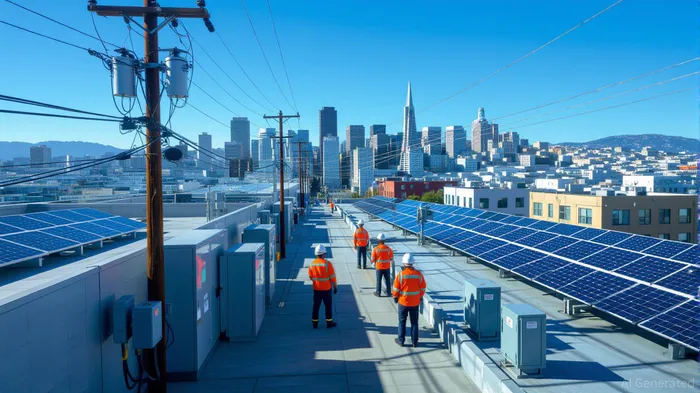
Legislative measures further reinforce this shift. Senate Bill 1142 mandates improved disconnection and reconnection protocols during extreme weather, while Assembly Bill 825 promotes regional electricity market integration to enhance grid efficiency
according to analysis. These reforms not only address immediate reliability concerns but also create a framework for long-term resilience, particularly in urban centers like San Francisco, where population density and climate risks intersect.
Capital Reallocation and Strategic Priorities
PG&E's post-outage strategy exemplifies the capital reallocation trends reshaping the sector. The utility's 2027–2030 General Rate Case (GRC)
proposes maintaining customer bill stability while funding grid upgrades, including a $145-million annual contribution to California's new $18-billion wildfire insurance fund. Such investments are critical for mitigating liabilities from infrastructure failures, as seen in the December 2025 outage. However, the CPUC's decision to remove cost-benefit ratios for power line undergrounding projects-a key wildfire resilience measure-
has introduced new risks.
Urban centers are also leveraging innovative financing. The San Francisco Public Utilities Commission (SFPUC)
has prioritized seismic-resistant infrastructure and solar-battery storage projects, aligning with broader decarbonization goals. Meanwhile, California's designation of 142 decarbonization zones
prioritizes gas line replacement and electrification in high-need areas, creating localized investment opportunities.
Investment Opportunities and Risks
The evolving regulatory and capital landscape presents a duality of promise and peril for investors. On the opportunity side, the push for grid modernization has spurred demand for advanced technologies. For example, the CPUC's pending loads framework-requiring utilities to model low, base, and high-growth scenarios-
creates a market for smart grid solutions. PG&E's $73-billion plan, which includes 300 megawatts of battery storage for data center loads,
exemplifies this trend.
However, risks persist. The CPUC's softened ROE caps may constrain utilities' ability to finance large-scale projects, particularly in high-cost urban areas. Additionally, the December 2025 outage revealed operational gaps, such as PG&E's inability to provide a clear restoration timeline,
raising questions about effectiveness of current resilience strategies. For investors, these challenges underscore the importance of due diligence on both technological and managerial capabilities.
Conclusion
The San Francisco outage and its aftermath illustrate a pivotal moment for urban utility resilience. Regulatory reforms and capital reallocation are driving a transition toward more robust infrastructure, but success will depend on balancing innovation with accountability. For investors, the key lies in identifying projects that align with both regulatory priorities and long-term risk mitigation-whether through undergrounding initiatives, energy storage, or regional market integration. As cities like San Francisco navigate the dual pressures of climate change and population growth, the utility sector's ability to adapt will define the next era of urban infrastructure investment.

Stay ahead of the market.
Get curated U.S. market news, insights and key dates delivered to your inbox.


AInvest
PRO
AInvest
PRO



Comments
No comments yet