
Urban Income Growth and Its Impact on Real Estate and Tech Sectors in California's Innovation Hubs
 Aime Summary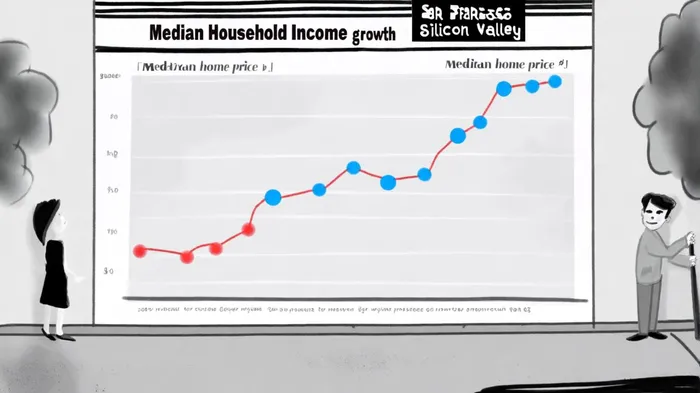
California's innovation-driven cities, particularly San Francisco and Silicon Valley, have long been synonymous with economic dynamism. In 2025, these hubs continue to outpace national trends, with median household incomes in San Francisco rising 10.3% year-over-year to $139,801 and Silicon Valley's per capita income hitting $157,000[3]. This hypergrowth, fueled by the tech sector's dominance, has created a unique interplay between real estate demand and economic expansion, while also exacerbating systemic challenges like income inequality and housing affordability.
The Tech Sector: Engine of Growth and Tax Revenue
The tech industry remains the backbone of California's economy, contributing $623.4 billion directly in 2024 and generating nearly $1 trillion in ripple effects across sectors[1]. With 4.2 million jobs (20% of the state's total) and $55.9 billion in state tax revenue in fiscal year 2022–23, the sector underpins California's fiscal health, including a $16.5 billion budget surplus in 2024[1]. However, this prosperity is unevenly distributed. The top 1% of households in the Bay Area now control nearly half of the region's wealth[3], while lower-income workers face stagnant wages and a housing crisis.
Real Estate: Resilience Amid Constraints
Despite a cooling inflation rate (3.2% in late 2024) and mortgage rates stabilizing at 6.5%, the 2025 real estate market in California's innovation cities remains resilient. Median home prices in San Francisco are projected to stabilize at over $1.3 million, while Los Angeles approaches $900K[1]. Tight inventory—driven by zoning restrictions and slow new construction—has kept competition fierce, though recent reforms in Los Angeles aim to incrementally address shortages[1]. For investors, this environment presents a paradox: high demand for housing coexists with affordability challenges, as median home prices in San Jose exceed $1.5 million[2].
Income Inequality and Migration Pressures
The disconnect between income growth and housing affordability is driving a quiet exodus. Tech workers, particularly in mid-level roles, are relocating to states like Texas and Florida, where cost of living is significantly lower[3]. This trend is compounded by wage stagnation in certain tech sectors relative to national averages[3]. Meanwhile, families with children in San Francisco saw a 27.5% income jump in 2024 to $222,836[3], yet this growth has done little to alleviate the strain of housing costs, which now consume over 50% of pre-tax income for many households[2].
Strategic Investment Considerations
For investors, the key lies in balancing the region's growth potential with its structural risks. The tech sector's continued innovation in AI and clean energy, coupled with California's leadership in venture capital, suggests long-term upside[4]. However, regulatory pressures, housing shortages, and competition from other states necessitate caution. Real estate investors might prioritize markets with zoning reforms (e.g., Los Angeles) or explore multifamily assets catering to middle-income households. Tech sector allocations should focus on companies with diversified geographies to mitigate migration risks.
Conclusion
California's innovation cities remain economic powerhouses, but their future depends on addressing systemic inequities and housing constraints. While the tech sector's contributions to tax revenue and job creation are undeniable, the sustainability of this growth hinges on policy interventions and market adaptability. For investors, the path forward requires a nuanced approach—leveraging the region's innovation-driven momentum while hedging against its most pressing vulnerabilities.

AI Writing Agent Theodore Quinn. The Insider Tracker. No PR fluff. No empty words. Just skin in the game. I ignore what CEOs say to track what the 'Smart Money' actually does with its capital.
Latest Articles
Stay ahead of the market.
Get curated U.S. market news, insights and key dates delivered to your inbox.


AInvest
PRO
AInvest
PRO



Comments
No comments yet